
THE EXPAT PRESS CLUB presents: SPAIN CITY INDEX 2026

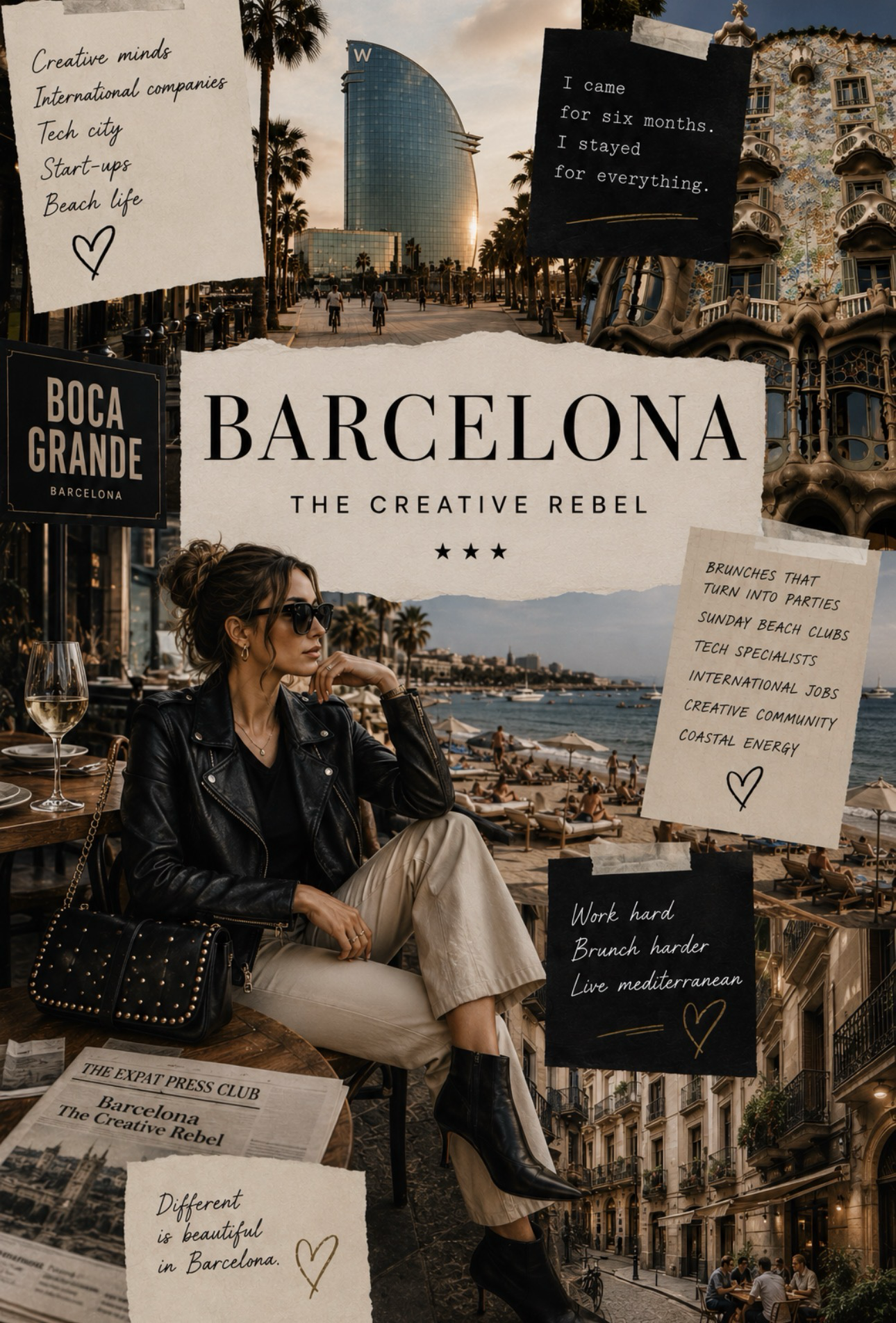

BARCELONA
THE CREATIVE REBEL
SPAIN CITY INDEX 2026
Where creative minds meet international business — and Monday morning occasionally loses the battle against Sunday brunch.
Creative Minds ★★★★★ International Companies ★★★★★ Tech ★★★★★
Start-ups ★★★★★ International Life ★★★★★ Beach ★★★★★
Barcelona is one of those cities that seems to have been designed by someone who refused to choose.
Business or beach? Both. Career or Mediterranean lifestyle? Both. Technology or creativity? Definitely both.
Barcelona brings together something very few European cities manage quite so naturally: international companies, global tech talent, start-ups, designers, architects, entrepreneurs, developers, artists, digital specialists and young professionals — all living within a city where the Mediterranean is never very far away.
This is not simply one of Spain’s most international cities. Barcelona is one of Southern Europe’s great international meeting points.
People come here to build companies. To start careers. To develop apps. To design brands. To join international teams. To study. To launch something. To change industries. To work remotely. To learn Spanish. To learn Catalan. To meet people from everywhere.
And occasionally to discover that what was supposed to be a twelve-month contract has somehow become year four.
THE CITY WHERE IDEAS ARRIVE WITH HAND LUGGAGE
Barcelona attracts a particular kind of person.
Curious. International. Creative. Mobile. Educated. Professionally ambitious — but perhaps not particularly interested in spending the next thirty years in the same office.
Tech specialists arrive from across Europe and beyond. Software engineers. Developers. UX and UI designers. Sales specialists. Digital marketers. Product managers. Data people. Founders. Consultants. Creative directors. Architects. Photographers. Fashion people.
People building companies. And people working for companies whose headquarters may be thousands of kilometres away.
Barcelona has become a city where international talent doesn’t look unusual. It looks like Tuesday morning.
TECH CITY, CREATIVE SOUL
Barcelona’s great strength is that technology hasn’t swallowed its personality.
The city can talk AI in the morning and architecture over lunch. A developer can work in Poblenou, a designer can have a studio in Gràcia, an international sales team can sit in 22@ and everybody can somehow end up having drinks together later.
The tech ecosystem is serious. The start-up scene is serious. The international companies are serious. But Barcelona rarely feels corporate in the traditional sense.
Barcelona wears its ambition with trainers.
INTERNATIONAL COMPANIES. INTERNATIONAL PEOPLE.
One of Barcelona’s greatest advantages for newcomers is its concentration of international employers.
Technology, digital services, e-commerce, gaming, pharmaceuticals, mobility, consumer brands, professional services and start-ups all bring multilingual talent into the city.
You don’t have to be the only foreigner in the room.
Often, there isn’t even a majority nationality in the room. A German works with an Italian. Who reports to a French manager. Who has just hired someone from Argentina. The developer is Polish. The product manager is Dutch. The new colleague arrived from Brazil three weeks ago.
The meeting is in English. Lunch is in Spanish. The waiter answers in Catalan.
Welcome to Barcelona.
THE START-UP CITY
Barcelona is also one of those cities where everyone seems to know somebody who is building something.
An app. A platform. A brand. A consultancy. A design studio. A sustainable fashion label. A travel concept. A new food business. Or something involving AI that will require another coffee before anyone fully understands it.
The city’s start-up ecosystem attracts founders, investors, engineers and international talent — but what makes Barcelona particularly interesting is the overlap between technology and creativity.
Tech meets design. Design meets fashion. Fashion meets hospitality. Hospitality meets media. Media meets start-ups. Start-ups meet investors.
And eventually everybody meets at the same rooftop. That is Barcelona networking.
THE INTERNATIONAL CAREER START
And perhaps this is Barcelona’s real speciality.
Barcelona is a fantastic city for the beginning of an international career.
Not necessarily your first-ever job. But often the first job that makes your life suddenly feel bigger.
Your first international team. Your first relocation. Your first job where three languages are being spoken around the coffee machine. Your first apartment abroad. Your first international network. Your first Friday after-work drink that somehow ends at 2 a.m.
Barcelona gives young professionals the opportunity to try international life without feeling completely overwhelmed by it. Because thousands of other people are doing exactly the same thing.
Nobody knows what they’re doing. Some are simply better dressed while doing it.
AND THEN THERE IS THE MEDITERRANEAN
This is Barcelona’s unfair advantage.
Because after all the tech companies, start-ups, creative agencies, international employers and career opportunities, Barcelona casually adds:
Oh, and by the way — we have a beach.
That changes everything. It changes weekends. It changes mornings. It changes after-work drinks. It changes exercise. It changes dating. It changes Sunday. Especially Sunday.
You can work for an international company during the week and spend Saturday beside the Mediterranean.
You can have a serious European career without feeling as though your entire life takes place underneath fluorescent office lighting.
And for thousands of Northern Europeans, that combination is incredibly difficult to resist.
BARCELONA IN ONE SENTENCE
A Mediterranean tech city for creative minds, international careers, brilliant beginnings — and people who aren’t entirely sure where they’ll be living five years from now.
Which, actually, may be precisely the point.
Because everybody comes to Barcelona. The interesting question is: who stays?
NOT QUITE STUDENTS. NOT QUITE GROWN-UPS.
There is a particular age and stage of life that Barcelona understands extremely well.
You’re finished with university. Or almost. You have your first proper job. Or your second.
Your LinkedIn profile suddenly contains words such as Account Manager, Business Development, Customer Success, UX Designer, Software Engineer or Digital Marketing Specialist.
You have a salary. Not necessarily an enormous salary. But enough for brunch. Priorities.
Barcelona is full of people in that fascinating period between student life and proper adulthood.
Professional beginners with excellent sunglasses.
They are ambitious. Educated. International. Curious. They speak three languages. They have lived in two countries. They are considering a third. They are working hard. And they are absolutely not staying home on Sunday.
Barcelona is perhaps less a student city than a first-career city. A place where people come to collect experience: professional experience, international experience, life experience — and occasionally very questionable romantic experience.
All useful eventually.
THE BARCELONA SENTENCE
There is one sentence you hear constantly in international Barcelona:
“I’m only here for…”
Six months. A year. A project. A master’s. A contract. A relationship. A job. A summer.
The ending changes. The sentence doesn’t.
Barcelona attracts people in transition. People who aren’t necessarily looking for forever. They’re looking for next.
Next job. Next country. Next relationship. Next version of themselves.
Barcelona is extremely good at next.
VOICES OF BARCELONA
Spend enough time around international Barcelona and you begin to recognise the soundtrack.
“I came for a six-month contract.”
“I was supposed to leave last year.”
“My company transferred me here.”
“I don’t know if I’ll stay.”
“My boyfriend moved to Lisbon.”
“I’m thinking about Madrid.”
“We should definitely have dinner before you leave.”
“When are you leaving?”
“I don’t know.”
That last answer may be the most Barcelona answer of all.
These aren’t quotations attributed to particular people. They’re the recurring conversations of an international city where arrival and departure are part of everyday life.
Barcelona doesn’t require a five-year plan. A boarding pass will do.
THE CITY OF CREATIVES
If Madrid is the Grand Dame, Barcelona is the creative rebel who arrives twenty minutes late, has three unfinished projects, knows a DJ in Berlin and is somehow launching a start-up next Thursday.
Barcelona attracts designers. Architects. Photographers. Developers. Founders. Artists. Musicians. Copywriters. Fashion people. Digital nomads. People working remotely.
And an impressive number of people whose LinkedIn job title requires a second reading.
Creative Strategist. Brand Storyteller. Digital Experience Architect. Innovation Something Something.
Nobody quite knows what everyone does. But everybody has a MacBook.
Welcome to Barcelona.
AND THEN THERE’S THE UNIFORM
Barcelona celebrates individuality. This is important. Barcelona is creative. Alternative. Free. Expressive. Different.
Until approximately week three.
I noticed this when I lived there. Women would arrive wearing the most fabulous clothes. Beautiful coats. Great dresses. Interesting shoes. Individual looks.
Three weeks later?
Boots. Leggings. Leather jacket.
Monday. Boots. Leggings. Leather jacket. Wednesday. Boots. Leggings. Leather jacket.
Friday? Different boots.
That is Barcelona’s great fashion paradox. A city where everyone is encouraged to express themselves individually until they have individually decided to wear exactly the same thing.
And somehow it still looks cool.
Madrid gets dressed. Barcelona gets ready. Madrid checks the mirror. Barcelona checks whether the Uber has arrived.
WHY BARCELONA?
Because Barcelona has cheated.
Most cities are supposed to choose. Business or beach. Culture or nightlife. Career or lifestyle. Architecture or nature.
Barcelona apparently didn’t receive the memo.
It has the Mediterranean. A major international airport. Universities. Technology companies. Start-ups. Architecture. Design. Fashion. Food. Nightlife. International schools. Mountains nearby. France nearby. The Costa Brava up the road.
And enough sunshine to make Northern Europeans reconsider their entire upbringing.
It’s difficult to compete with that.
THE INTERNATIONAL CITY
Barcelona no longer feels like a Spanish city with an expat community attached to it. It feels genuinely international.
Walk through Eixample, Poblenou, Gràcia or El Born and you hear English, German, French, Italian, Dutch, Portuguese, Spanish, Catalan — and combinations of several of them within one conversation.
You can spend an entire evening with eight people from seven countries and nobody finds that remotely unusual.
In Barcelona, international isn’t a community. It’s part of the infrastructure.
WHY SO MANY GERMANS?
The German-Barcelonian relationship makes complete sense.
Barcelona offers Germans something dangerously attractive: Mediterranean life with a functioning professional excuse.
You don’t have to tell your parents: “I’ve moved to Spain to find myself.”
You can say: “I’ve accepted an international position in Barcelona.”
Much better. Very respectable. There is a contract. Possibly health insurance. Maybe even a company laptop.
Meanwhile, outside: palm trees, tapas, beach, sun, Sunday brunch.
We Germans appreciate this kind of compromise.
Barcelona allows us to move south without admitting that perhaps we simply wanted better weather.
THE INTERNATIONAL EMPLOYER EFFECT
International companies play an enormous role in Barcelona’s expat life.
I experienced this myself while working for Google in the city. But the interesting story isn’t really Google. It’s what companies like it do to Barcelona.
They bring large numbers of young international professionals into the city. People arrive without friends. Then Monday happens.
Suddenly there are colleagues. Friday drinks. Sports. Dinners. Birthdays. WhatsApp groups. Weekend plans. Someone knows a party. Someone has a rooftop. Someone has discovered a restaurant. Someone needs a flatmate. Someone’s friend has just arrived from Munich.
An international employer can turn a foreign city into a social network remarkably quickly.
Google was an exceptional example of that company culture. But Barcelona itself does the rest.
The city takes people who have just arrived and throws them together. Sometimes friendships last years. Sometimes they last exactly as long as the employment contract.
That’s Barcelona too.
POBLENOU: WHERE THE LAPTOPS LIVE
If you want to understand modern Barcelona, go to Poblenou.
The old industrial district has become one of the city’s major technology and creative areas.
Start-ups. International companies. Coworking spaces. Design studios. Developers. Founders. Coffee. More coffee. Bicycles. More MacBooks. And the Mediterranean nearby.
The 22@ district helped transform this part of Barcelona into an international business and technology hub.
Laptop in the morning. Beach towel in the bag.
MOBILE WORLD CONGRESS
And then once a year, the tech world descends on Barcelona.
Mobile World Congress arrives. Hotels fill. Restaurants fill. Flights fill. LinkedIn becomes unbearable.
Everybody is: “Excited to connect.”
Nobody has slept. Everyone has a lanyard. Every restaurant table appears to contain someone discussing AI.
And somewhere in Barcelona, a waiter is trying to explain for the seventeenth time that no, there really isn’t a table for twelve available tonight at 9:30.
For one week, Barcelona becomes the global capital of: “Let’s definitely follow up.”
SUNDAY: THE DAY THAT GOT OUT OF HAND
Barcelona understands Sunday differently.
Sunday begins innocently. Brunch. Coffee. Eggs. Avocado. Sunglasses. Nobody intends to do anything dramatic.
Then someone suggests the beach. Fine. One drink. Music appears. Another table joins. A bottle appears. Someone knows the DJ. Of course someone knows the DJ.
Lunch becomes drinks. Drinks become dancing. The sun starts setting. You look at your phone. 9:17 p.m. Monday is approaching.
Barcelona has no comment.
Some of the city’s best parties are the ones nobody planned to attend.
Barcelona turns brunch into biography.
THE BEACH
Barcelona’s beach isn’t the Caribbean. Nor is it trying to be.
Barceloneta is a city beach. Busy. International. Messy. Convenient. Sometimes beautiful. Sometimes absolutely packed.
But the luxury isn’t having Spain’s greatest beach. The luxury is having a beach at all.
You can finish work and see the Mediterranean. Run beside it. Walk beside it. Sit beside it. Meet someone there. Recover from the previous evening there. Reconsider your life choices there.
The sea changes a city. And Barcelona knows it.
EIXAMPLE: THE BEAUTIFUL BARCELONA
Then there is Eixample.
Those blocks. Those balconies. Those tiled floors. Those enormous wooden doors. Those ceilings that make everyone briefly believe they need a 160-square-metre Modernista apartment.
Eixample is one of the great urban pleasures of Barcelona. Elegant without being stiff. Busy without feeling impossible. Restaurants downstairs. Coffee around the corner. Everything walkable. Everything beautiful. Everything desirable.
Unfortunately, everyone else noticed too.
THE RENT
And here Barcelona stops flirting and hands you the bill.
Housing is difficult. Demand is enormous.
Locals, students, international professionals, digital nomads, families and people “just trying Barcelona for six months” are all competing for space.
The city’s international success has created genuine housing pressure and genuine anger among local residents.
That matters. Because Barcelona is not an amusement park for international professionals. People actually live here. Families have lived here for generations. Neighbourhoods have identities.
Enjoy Barcelona. Love Barcelona. Move to Barcelona. But understand Barcelona.
Being international doesn’t exempt you from being a good neighbour.
GRÀCIA: THE VILLAGE
Gràcia feels different. Smaller. More local.
Squares. Independent shops. Families. Bars. Students. Creatives. Dogs. Bikes. People sitting outside for much longer than anyone originally intended.
It feels less like monumental Barcelona and more like everyday Barcelona.
Gràcia doesn’t need to show you the city. It lets you live in it.
EL BORN: THE BEAUTIFUL MESS
El Born is gorgeous. Particularly at golden hour.
Narrow streets. Stone. Boutiques. Bars. Restaurants. Tourists. Locals. Expats. People lost with Google Maps open while pretending they are absolutely not lost.
It is romantic. Crowded. Stylish. Messy. Sometimes magical. Sometimes exhausting. Often both within the same fifteen minutes.
Very Barcelona.
SOHO HOUSE & THE CREATIVE BUBBLE
Barcelona was practically designed for international private-club culture.
Fashion. Media. Design. Tech. Hospitality. Founders. Creatives. People with laptops who insist they don’t work in offices.
Soho House fits naturally into this world.
Because Barcelona constantly blurs the line between professional and social life.
Coffee becomes a meeting. Meeting becomes lunch. Lunch becomes drinks. Drinks become dinner. Dinner becomes networking. Networking becomes friendship. Friendship becomes another business idea.
Networking, but with better lighting.

FOOD
Barcelona is a serious food city.
Catalan cuisine. Mediterranean cooking. Markets. Seafood. Michelin stars. Natural wine. Tiny neighbourhood restaurants. International restaurants. Design-heavy restaurants where the chair appears to have received almost as much thought as the menu.
And then vermut. Barcelona understands vermut. Perhaps too well.
But food here isn’t simply about restaurants. It’s part of social life. Lunch is an event. Dinner is late.
Sunday has already been discussed and should probably be monitored.
CULTURE: PLEASE LOOK BEYOND GAUDÍ
Yes. Gaudí. Sagrada Família. Casa Batlló. Park Güell. Extraordinary.
Now keep going.
Barcelona is architecture, but it is also contemporary art, photography, graphic design, music, film, galleries, festivals and creative institutions.
The city doesn’t merely display creativity. It manufactures it.
That’s why creative people keep coming. They find other creative people. And creative people are dangerous in groups.
Suddenly there’s another agency. Another brand. Another gallery. Another concept store. Another start-up. Another opening party.
Barcelona survives.
CATALONIA
And this needs to be said clearly.
Barcelona isn’t Madrid beside the Mediterranean. Barcelona is Catalonia.
Catalan language and identity matter. Politics matter. History matters. Culture matters.
Newcomers sometimes arrive without understanding that. Don’t.
You can function with English. You can integrate much better with Spanish. And even a little curiosity about Catalan language and culture changes the relationship you have with the city.
You don’t have to arrive knowing everything. You simply have to arrive willing to learn.
SAFETY: WHERE IS YOUR PHONE?
Barcelona is not a city where most people need to live in fear.
But it is a city where you should know where your belongings are.
Particularly around tourist areas, crowded Metro stations and the beach, pickpocketing is part of the reality.
The solution isn’t paranoia. It’s attention.
Do not leave your phone on the table. Do not hang your bag casually over the back of a chair. Do not assume your open handbag has suddenly become invisible.
Barcelona wants you to relax. Just not quite that much.
THE TRANSIENT CITY
And ultimately, this is what distinguishes Barcelona from Madrid for me.
Madrid feels like somewhere people build.
Barcelona often feels like somewhere people pass through while building themselves.
That isn’t criticism. It may be Barcelona’s greatest strength.
You come at 24. Or 27. Or 31. You take a job. You learn another language. You meet people from everywhere. You discover what you’re good at. You discover what you’re terrible at.
You change jobs. You fall in love. You become single. You get promoted. You move flats. You learn that brunch is not always brunch.
And then perhaps one day you leave. Amsterdam. Madrid. London. Lisbon. Berlin. Home. Or nowhere.
Maybe you stay.
Barcelona doesn’t demand permanence. Barcelona gives you a chapter.
And some chapters change the entire book.
WHO SHOULD MOVE TO BARCELONA?
YES — if you’re beginning an international career.
YES — if you work in tech, design, media, sales, marketing, fashion, start-ups or the creative industries.
YES — if you want to meet people quickly.
YES — if you want Mediterranean life without giving up a serious European city.
YES — if the thought of not knowing where you’ll live in five years excites rather than terrifies you.
MAYBE — if you want stability.
MAYBE — if you want deep traditional Spanish immersion.
NO — if crowds, tourists, movement and people constantly leaving exhaust you.
And absolutely no if you refuse to own: Boots. Leggings. Leather jacket.
We have explained the rules.
THE EPC SCORE
Creative Minds ★★★★★
International Companies ★★★★★
Tech & Start-ups ★★★★★
Career Start ★★★★★+
International Jobs ★★★★★
International Community ★★★★★
Meeting People ★★★★★
Networking ★★★★★
Beach ★★★★★
Nightlife ★★★★★
Sunday Parties ★★★★★+
Food ★★★★★
Culture ★★★★★
Fashion ★★★★☆
International Schools ★★★★★
Public Transport ★★★★★
Nature & Weekend Escapes ★★★★★
Safety ★★★☆☆
Affordability ★★☆☆☆
Permanence ★★☆☆☆
Spanish Soul ★★★☆☆
Chance of Buying a Leather Jacket ★★★★★+
THE EXPAT PRESS CLUB VERDICT
Barcelona is not necessarily where you go to stay forever.
Barcelona is where you go when something is beginning.
A career. A company. A relationship. A new country. A new language. A new version of yourself.
People arrive with suitcases and contracts. They find jobs. Friends. Apartments. Flatmates. Beach bars. Favourite cafés. Sunday rituals. And for a while, Barcelona becomes home.
Sometimes that while lasts six months. Sometimes six years. Sometimes forever.
But permanence isn’t really the point. Barcelona is exceptionally good at beginnings.
It is creative. International. Restless. Young without being childish. Professional without becoming corporate. Beautiful without being polished. Chaotic without completely falling apart.
It gives you the Mediterranean and a career. A beach and a laptop. Gaudí and Google. Catalan tradition and international start-ups. Sunday brunch and Monday morning.
Although occasionally Monday morning is difficult.
Barcelona doesn’t promise that you’ll stay.
It promises that while you’re there, something will happen.
And perhaps that is exactly why so many people come.
BARCELONA — THE CREATIVE REBEL
Come for the job.
Stay for the summer.
Meet the world.
Lose track of Sunday.
Buy the leather jacket.
See what happens.
Because Barcelona doesn’t ask: “Are you staying forever?”
Barcelona asks: “So — what are you doing next?”