
FORK KISSES & FLAVOUR POETS Papín’s Camino – A Family Story Served with the Best Patatas Fritas in Madrid

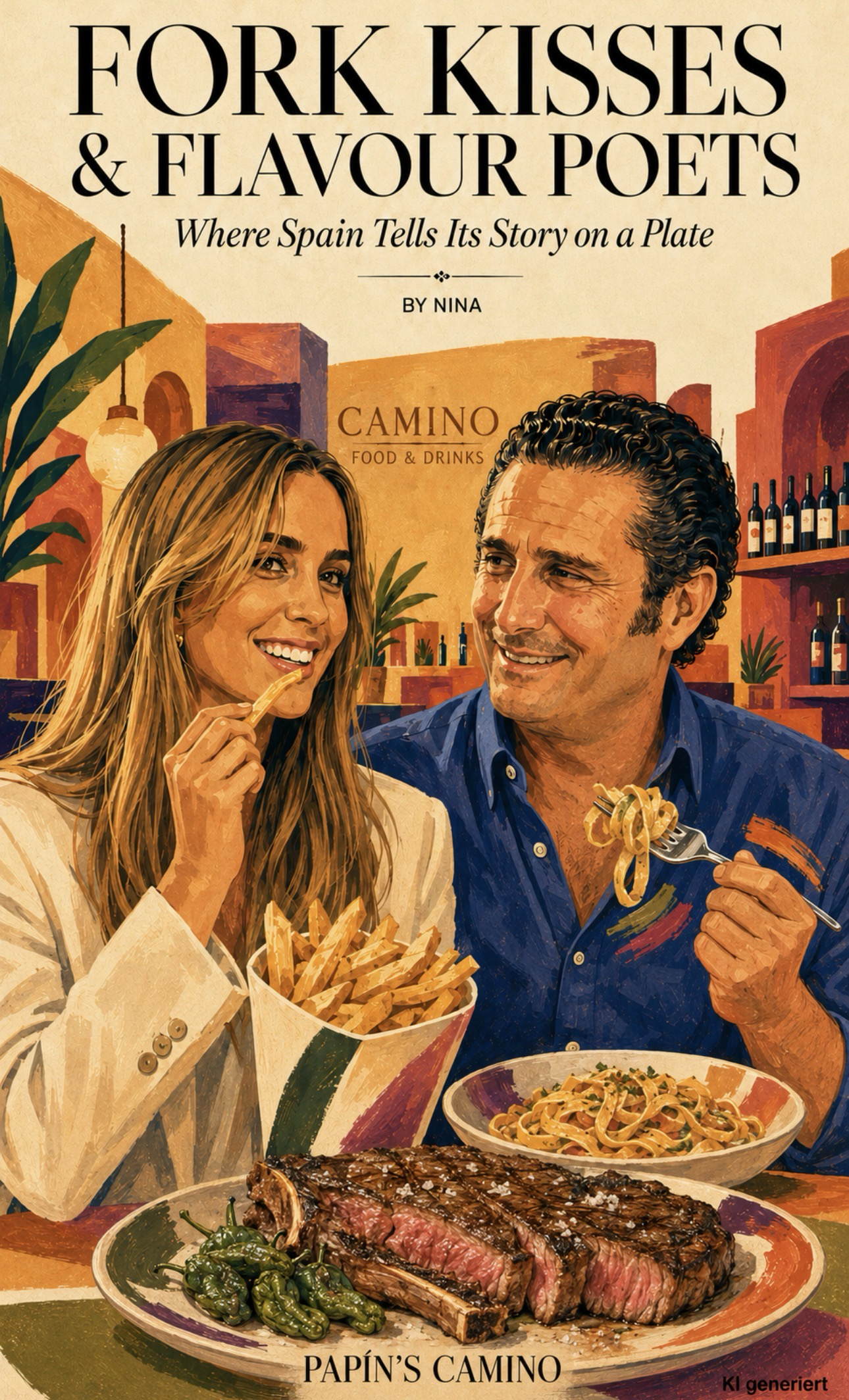

FORK KISSES & FLAVOUR POETS
Papín’s Camino – A Family Story Served with the Best Patatas Fritas in Madrid
Where Spain Tells Its Story on a Plate
There are restaurants that begin with a business plan.
And then there are restaurants that begin with life suddenly saying:
“Well, this is not how we expected things to go.”
Camino Food & Drinks belongs to the second category.
It is easy to introduce it as the Madrid restaurant owned by Víctor Pombo, father of María, Marta and Lucía Pombo. It is easy to mention the millions of followers, the television documentary, the famous family name and the possibility that someone at the next table may look suspiciously familiar from Instagram.
But that would tell only the glamorous half of the story.
Because Camino existed before the Pombo name became a digital phenomenon. Before the cameras. Before the red carpets, fashion campaigns, festivals and television appearances.
Camino opened in 2011, during one of the most difficult chapters in the family’s life.
And perhaps that is why it still feels less like a celebrity restaurant and more like a family dining room that simply grew large enough to welcome all of Madrid.
Before Papín Became Papín to Everyone
Víctor Pombo had spent much of his professional life in advertising.
He was a creative – someone accustomed to ideas, campaigns and finding the story behind a product. His wife, Teresa Ribó, affectionately known within the family as Sito, also worked in advertising.
Then life changed direction.
Víctor found himself out of work. At around the same time, Teresa was diagnosed with multiple sclerosis and was forced to step away from her professional life.
Their daughters had not yet become the public figures Spain knows today. There was no influencer empire waiting to rescue the situation, no family documentary and no enormous audience following every chapter.
There was simply a family facing uncertainty.
So Víctor took the creativity he had once poured into advertising and carried it into hospitality.
Camino was born.
The restaurant became a new professional beginning, but also something much more personal: a lifeline, a meeting place and proof that a family can turn a difficult moment into a new camino.
A new path.
Papín did not merely open a restaurant.
He gave the family a place around which life could reorganise itself.
Three Sisters, Three Personalities, One Table
Today, the Pombo sisters are among Spain’s most recognisable families, but each of them brings a very different energy to the table.
Lucía, the eldest, has often appeared as the grounded, protective sister. Marta has built her own public voice and creative projects, including her entrepreneurial work alongside María. And María, the youngest, became the family’s most visible figure – turning lifestyle content into a career that now reaches far beyond social media.
Fashion, beauty, family life, business, television, music events and gastronomy have all become part of the María Pombo universe.
Yet Camino remains one of the places where the public story returns to its private beginning.
The sisters visit. Their partners visit. The grandchildren appear. Family celebrations unfold around its tables. Lucía and her husband Álvaro have been seen dining there, while María and Marta have helped make the restaurant familiar to a new generation.
But the restaurant is not simply a backdrop for the Pombo family.
It is part of their mythology.
It represents the years before fame, the difficult decisions, the reinvention and the ability to keep moving when life does not follow the original plan.
The family may now live partly in front of cameras, but Camino tells the chapter that came before the spotlight.
And that makes it more interesting than any carefully staged celebrity opening.
María and Her Passion for Patatas Fritas
María Pombo has many talents.
She understands fashion. She understands audiences. She understands how to turn an ordinary family moment into something three million people suddenly feel they have experienced personally.
But perhaps her most relatable quality is her unconditional devotion to patatas fritas.
Not a polite interest.
Not the sort of “Oh, I might have one” performance people attempt while pretending to be disciplined.
Real love.
María has repeatedly made no secret of the fact that patatas fritas are her favourite food, and those served at Camino have become part of the restaurant’s unofficial legend.
They arrive golden, crisp and unapologetically tempting.
There is no unnecessary foam.
No waiter needs to explain their philosophical relationship with the soil.
They are simply extraordinarily good patatas fritas.
The kind that disappear while everyone is still saying they are only going to take one.
The kind that make conversation pause.
The kind that turn the phrase “for the table” into a charming work of fiction.
As a German, I take Kartoffeln seriously. We are not emotionally casual about them. They are practically part of our cultural infrastructure.
But when it comes to María Pombo and Camino, there is only one correct expression:
Patatas fritas. Always.
The Croquetas Deserve Their Own Love Letter
Then there are the croquetas.
Every Spanish restaurant claims to have good croquetas. It is practically written into the constitution of hospitality.
But a truly excellent croqueta announces itself immediately.
The outside must crack delicately. The centre must be soft, silky and almost indecently creamy. It should hold its shape just long enough to reach the mouth and then abandon all structural responsibility.
Camino’s homemade Ibérico ham croquetas have become one of the restaurant’s signatures, alongside its milanesas.
They are comforting without being ordinary, elegant without becoming precious and familiar in the very best Spanish sense.
Order one portion for the table and observe the speed at which otherwise civilised people begin counting.
“Did you already have two?”
“No.”
“You did.”
“No pasa nada.”
It always pasa something when only one croqueta remains.
And Then Comes the Meat
Camino understands meat.
Not merely as another section on the menu, but as the moment when the table becomes quiet.
The restaurant’s selection has included everything from Asturian veal milanesas and steak tartare to burgers, tender cuts of beef and a mature chuletón served sliced with patatas fritas and Pimientos de Padrón.
The chuletón is not shy.
It arrives with the confidence of a Spanish patriarch entering Sunday lunch: substantial, impressive and fully aware that everyone has been waiting.
A proper crust. A juicy centre. Flaky salt. The deep, rich flavour that only comes when good meat is treated with respect and not overwhelmed by unnecessary theatre.
This is not a tiny conceptual steak balanced on a decorative stone.
This is meat.
Sehr gut.
Add the patatas fritas and the Padrón peppers – some gentle, some arriving with the personality of a small domestic emergency – and the plate becomes the sort of shared experience around which evenings are remembered.
Good meat and perfect patatas fritas may sound simple.
They are not.
Simplicity leaves nowhere for mediocrity to hide.
A Menu That Enjoys Travelling
Although Camino’s heart is Spanish and Mediterranean, the menu does not remain obediently in one country.
It wanders.
There are artichokes and Ibérico ham, ensaladilla rusa, salmorejo and excellent meats. But there have also been tiger prawns in tempura with kimchi sauce, quesadillas, burrata, truffled pasta and the witty nigiri pasiego – grilled Cantabrian sobao paired with anchovies from Santoña.
It is a menu that behaves like Madrid itself.
Spanish at heart, international by appetite and never particularly interested in being placed inside one tidy category.
One evening may begin with croquetas, travel through burrata and tagliatelle, stop for a mature steak and end somewhere around mascarpone and chocolate.
That is not confusion.
That is ambition with an appetite.
The current published menu may not offer the Penne all’Arrabbiata we secretly hoped to find, but Papín, the suggestion remains available.
Perhaps one day:
Penne Papín.
Spicy, generous and impossible to ignore.
Rather like the family itself.
Service That Still Feels Personal
Food may bring guests into a restaurant, but service decides how the evening will be remembered.
At Camino, the service is one of the reasons people return.
It is attentive without hovering, warm without becoming rehearsed and professional without turning dinner into a ceremony.
The team understands the rhythm of a table.
When another drink is needed.
When the croquetas should arrive.
When guests want to talk and when they are ready for the next course.
There is a difference between being served and being welcomed.
Camino knows it.
Perhaps that comes from Papín’s background as a creative and his instinct for people. Perhaps it comes from the family atmosphere that has always surrounded the restaurant. Or perhaps it is simply the result of more than a decade spent learning that hospitality is not an industry of plates.
It is an industry of feelings.
Guests may initially come because they recognise the Pombo surname. They may wonder whether María will appear, whether Papín is in the restaurant or whether one of the family dogs is resting beneath a nearby table.
But curiosity alone cannot sustain a restaurant for all these years.
Fame can fill a table once.
Good service fills it again.
Finally, a Restaurant That Understands Dogs
And now we arrive at a matter extremely close to my heart.
Dogs are welcome.
Not theoretically welcome.
Not “welcome if they are tiny, silent, invisible and preferably disguised as a handbag.”

Actually welcome.
The Pombo sisters have taken their own dogs to Camino, and the restaurant is known for allowing four-legged guests.
For anyone who shares life with dogs, this changes the entire experience.
A dog-friendly restaurant does not merely permit an animal to sit under the table. It acknowledges that, for many of us, dogs are part of the family.
They are included in the walk, the afternoon, the journey and therefore the meal.
They do not need the wine list.
They are rarely interested in the risotto.
But they will maintain intense diplomatic relations with anyone holding a piece of chuletón.
As the person accompanying Cooper and Bootsmann through life, I appreciate restaurants that understand this.
A genuinely dog-friendly place sends a simple message:
Bring the whole family.
At Camino, that philosophy feels completely natural because family has always been the foundation of the restaurant.
Children, grandchildren, sisters, partners, friends – and the dog quietly monitoring the distribution of steak beneath the table.
That is not a nuisance.
That is Spanish life.
The Restaurant Behind the Famous Name
Camino has received a Solete from the Guía Repsol, recognition given to informal places with quality, personality and an atmosphere people want to revisit.
It is well deserved.
Yet the most important recognition may be the less official kind.
The regular guest who returns.
The family choosing Camino for another celebration.
The person who recommends the croquetas before even sitting down.
The dog owner relieved not to have to leave half the family at home.
The visitor who arrived because of María Pombo and leaves talking about the patatas fritas.
Camino may benefit from one of Spain’s most recognisable surnames, but it has earned its place through something more durable than fame.
Consistency.
Warmth.
Generosity.
And food that understands the emotional power of perfect patatas fritas.
Papín’s Real Recipe
Perhaps Papín’s greatest creation is not a particular dish.
It is the atmosphere around the table.
The feeling that food is inseparable from family. That difficult chapters do not have to become final chapters. That a career can be reinvented, a restaurant can become a refuge and a plate of croquetas can hold more history than anyone suspects.
María, Marta and Lucía have each created lives and careers of their own, but Camino remains the family compass.
A place that points back to the beginning.
A place shaped by Víctor and Teresa’s resilience.
A place where the grandchildren now become part of the menu’s stories and the next generation grows up surrounded by the sound of service, conversation and plates being placed on tables.
The word camino means path.
This one began in uncertainty and led to a dining room full of life.
Our Verdict
Come for the family story.
Stay for the service.
Order the croquetas without pretending you will share fairly.
Choose the chuletón, allow the Pimientos de Padrón to surprise you and guard the patatas fritas with your life.
Bring the dog.
And if Papín is there, ask him whether Penne Papín might still have a future.
Camino Food & Drinks is not merely the restaurant of María Pombo’s father.
It is the restaurant of Papín, Sito, Lucía, Marta and María.
Of resilience and reinvention.
Of family lunches that become television scenes and ordinary dinners that become memories.
It is proof that the best restaurants do not simply feed us.
They make room for us.
At the table.
In the story.
And, if we behave ourselves, close enough to the world’s best patatas fritas.
Camino Food & Drinks We Love Your Place!