


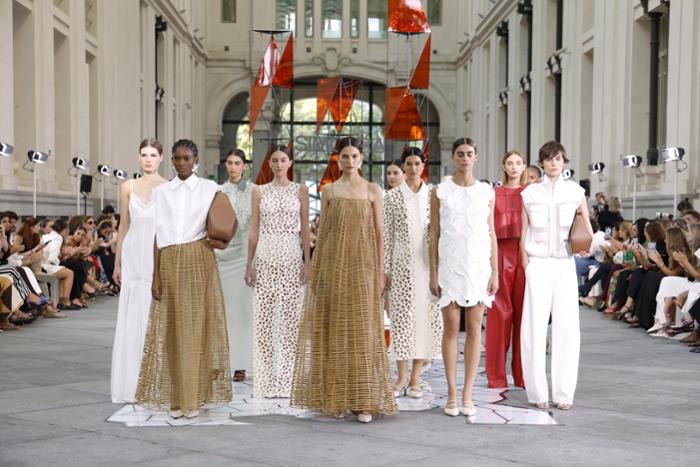


Two weeks of fashion, fabulous parties, flirty winks and the very serious business of deciding what to wear next
Madrid does not need a red carpet. The city has been walking on one for years.
But in September 2026, that carpet becomes longer, louder and considerably better dressed. It will stretch from the polished pavements of Barrio de Salamanca to the glass dome of Palacio de Cibeles, from tropical gardens in Arganzuela to royal galleries, palace courtyards and rose-filled parks.
For almost two weeks, the Spanish capital will belong to designers, models, buyers, editors, photographers, stylists, celebrities, beautiful strangers and those mysterious people who never appear to have a job yet somehow have invitations to absolutely everything.
There will be runway shows and private presentations, intimate showroom appointments and enormous public celebrations. There will be lunches that become cocktails, cocktails that become dinners, and dinners that quietly turn into dancing.
There will be very cold drinks, very warm nights and more than a few flirty winks exchanged somewhere between the front row and the hotel bar.
In other words, Madrid is not simply hosting a fashion week.
Madrid is preparing for two weeks of beautifully controlled chaos – in very good shoes.
THREE EVENTS, ONE VERY LARGE WARDROBE
Before we open the door to the dressing room, a small clarification is required.
Madrid’s September fashion calendar consists of three separate events. They are connected, but they are not the same thing.
From 7 to 10 September, OMODA Madrid es Moda brings Spanish designer fashion into the streets, boutiques, studios and cultural spaces of the city.
Around the middle of September, Vogue Fashion’s Night Out is expected to take over the luxury district for one dazzling evening of fashion, shopping, music and street-side celebration. The precise 2026 date has not yet been officially announced.
Then, from 14 to 19 September, Mercedes-Benz Fashion Week Madrid presents its official Spring/Summer 2027 runway calendar.
Think of Madrid es Moda as the intimate opening chapter. Vogue Fashion’s Night Out is the great public party. Mercedes-Benz Fashion Week Madrid is the main production – complete with official runways, front rows, international buyers, awards, private dinners and guests wearing sunglasses indoors for reasons known only to themselves.
MADRID ES MODA: WHERE FASHION STILL HAS A FACE
The story begins from 7 to 10 September with OMODA Madrid es Moda.
This citywide festival was created to bring Spanish independent fashion closer to the public. More than 30 designers, brands and creative platforms are expected to participate through runway shows, studio presentations, exhibitions, performances, showroom appointments and conversations.
Madrid es Moda is smaller, more personal and often more interesting than a conventional fashion show.
Here, fashion is not only the final dress walking down a runway. It is the pattern cutter who changed the sleeve six times. The seamstress who knows that two millimetres can ruin an entire silhouette. The jeweller who has spent three days making an earring look as though it happened effortlessly. The stylist who has slept for 45 minutes and is still somehow the best-dressed person in the room.
The theme for 2026 is “Volver a la raíz” – a return to the roots.
No, this is not about anyone’s hair colour. During fashion week, roots are dealt with privately and well in advance.
This is about returning to the true foundations of fashion: craftsmanship, patience, identity, community and the people who transform a sketch into something that can move through the world.
Madrid es Moda gives those people a voice.
It also offers something increasingly rare during a major fashion week: the possibility of actually speaking to a designer without first navigating three PR managers, two assistants and a guest wearing a hat large enough to receive satellite television.
The mood is creative rather than corporate, thoughtful rather than theatrical. Guests can discover small labels before they become large labels – and perhaps buy a piece before everyone else claims to have discovered the designer years ago.
THE ART OF SPANISH FASHION
Spanish fashion has always lived between opposites.
It can be disciplined and dramatic, severe and sensual, deeply traditional and wildly rebellious.
The black silhouettes of the Spanish court still echo through the work of modern designers. So do ecclesiastical shapes, flamenco movement, matador tailoring, lace mantillas, regional embroidery and the unapologetic glamour of women who dress not merely to leave the house, but to make an entrance.
Cristóbal Balenciaga understood architecture before fashion began using the word for every structured jacket. Paco Rabanne turned metal into movement. Sybilla made femininity intelligent and mysterious. Manolo Blahnik transformed shoes into objects of desire and walking into an occasionally dangerous art form.
Later came the colour, freedom and glorious disorder of La Movida Madrileña: Pedro Almodóvar, nightlife, provocation and a generation determined to leave restraint at home.
Today’s Spanish designers inherit all of it.
They are not simply creating clothes. They are negotiating with history – sometimes respectfully, sometimes flirtatiously and occasionally with the intention of tearing up the old rules before dinner.
VOGUE TAKES IT TO THE STREETS
Around the middle of September, Vogue Fashion’s Night Out is expected to turn Barrio de Salamanca into Madrid’s most glamorous public playground.
The final date is still to be confirmed, but the occasion traditionally takes place shortly before the official Mercedes-Benz Fashion Week.
For one evening, Calle José Ortega y Gasset and the surrounding streets of Serrano and Lagasca become an open-air fashion party. Luxury flagships and Spanish boutiques extend their opening hours. There are beauty activations, limited editions, photocalls, live music and private cocktails hidden behind velvet ropes.
Casa Loewe is traditionally one of the evening’s key addresses, while the neighbouring hotels, bars and restaurants fill with editors, influencers, clients and attractive people pretending that the encounter was entirely accidental.
Out on the street, Madrid celebrates together.
Behind the boutique doors, Madrid celebrates according to the guest list.
That contrast is exactly what makes Vogue Fashion’s Night Out so entertaining. It is both democratic and deliciously exclusive. Everyone can walk through the party, watch the performances and enjoy the atmosphere. But one well-timed invitation can transport a guest from the pavement into a private cocktail where the lighting is flattering, the ice is perfect and everybody suddenly knows somebody.
There may be Champagne. There will almost certainly be excellent alcohol-free cocktails for those who prefer their sparkle without the morning-after plot twist. And somewhere near Ortega y Gasset, two people will exchange a flirty look over the rim of a glass and briefly forget which boutique they were supposed to visit next.
This is not a runway show. It is a citywide flirtation with fashion.
People arrive “just to have a look” and leave carrying three gift bags, a lipstick in a colour they never knew they needed and the private telephone number of someone they may or may not call.
Madrid does these things to people.
THE MAIN EVENT MOVES INTO TOWN
On 14 September, Mercedes-Benz Fashion Week Madrid begins its official Spring/Summer 2027 programme.
This year, almost everything changes.
For the first time, the majority of the fashion week moves away from the traditional IFEMA-centred format. Instead of keeping designers, photographers and guests inside one large exhibition complex, 27 shows will unfold across eight locations in Madrid.
The Invernadero del Palacio de Cristal de Arganzuela, the Galería de Cristal at Palacio de Cibeles and Universidad Nebrija will serve as the three principal venues.
Additional shows will take place at Hotel Palace, the Rosaleda del Parque del Oeste, the gardens of the Palacios de Vista Alegre, the Galería de las Colecciones Reales and the Círculo de Bellas Artes.
The new structure takes inspiration from the great international fashion weeks.
In Paris, a collection might appear in a historic school, a palace or a raw industrial space. In Milan, a courtyard can become a runway. In London, fashion has long enjoyed arriving somewhere unexpected.
Now Madrid is doing the same – but with its own particular mixture of grandeur, spontaneity and taxi drivers being informed of a new location four minutes before the show begins.
Each designer will be able to establish a dialogue between collection and setting. Fashion will meet architecture. Craft will meet history. Guests will see Madrid itself rather than the inside of one pavilion.
Of course, the new format will also require careful planning, sensible shoes between appearances and a relationship of profound mutual trust with Google Maps.
But it gives Madrid something enormously valuable: character.
A dress changes when it moves beneath the dome of Cibeles. A suit acquires a different authority in a royal gallery. A romantic collection shown among thousands of roses becomes more than a presentation. It becomes a memory.
Even the journey between shows becomes part of the story.
OPENING DAY: THE GREAT SPANISH HOUSES
The official programme opens on Monday, 14 September, at the Invernadero del Palacio de Cristal de Arganzuela.
Beneath its historic structure of iron and glass, surrounded by tropical plants, Pedro del Hierro, Simorra and Adolfo Domínguez will present their new collections.
It is a beautifully judged opening: three established Spanish names inside a venue that is both architectural and alive.
Pedro del Hierro brings the confidence of a major Spanish house, combining contemporary elegance with clothes that understand real life – although preferably a real life involving beautiful restaurants and a car waiting outside.
Simorra is known for structure, material experimentation and a distinctly modern femininity.
Adolfo Domínguez returns as one of the defining names in Spanish fashion. The house has always represented a quieter type of sophistication: intelligent, natural and elegant without looking as though it has spent the entire afternoon demanding attention.
Its philosophy is almost radical in a world obsessed with shouting.
Adolfo Domínguez does not need to announce the price of the coat. The coat already knows.
It will be a first day of such polished Spanish elegance that even the tropical plants may feel slightly underdressed.
TUESDAY: THE DAY EVERYONE WILL TALK ABOUT
Tuesday, 15 September, is likely to become the great glamour day of the week.
The morning begins with a private presentation by Juan Vidal at Hotel Palace. The main programme then moves to the magnificent Galería de Cristal at Palacio de Cibeles.
Agua by Agua Bendita, presented in collaboration with the Latin American Fashion Awards, will open the official day. The Colombian label receives the International Designer Award and represents Madrid’s growing ambition to become the natural fashion bridge between Europe and Latin America.
Founded by Catalina Álvarez and Mariana Hinestroza, the brand combines intricate craftsmanship, vivid storytelling and a femininity that feels joyful rather than fragile.
It also understands an important truth: resortwear should make a woman look as if she has just arrived from a yacht, even when she has actually arrived in a taxi while answering six messages.
Celia B follows with her first appearance at MBFWMadrid. The Spanish designer is known for colour, print, movement and the kind of joyful maximalism that makes beige quietly reconsider its life choices.
Then comes Ágatha Ruiz de la Prada, who has spent decades proving that fashion does not always have to be serious, neutral or afraid of being noticed. In a world full of whispered luxury, Ágatha arrives with colour, humour and the visual equivalent of opening every window in the room.
Hannibal Laguna will receive the National Designer Award while celebrating the 40th anniversary of his house. His dresses are designed for entrances: sweeping silhouettes, dramatic femininity and the firm belief that if a staircase exists, someone should descend it beautifully.
Alex Rivière Studio brings a different language to the day – international, controlled and quietly luxurious. It is the aesthetic of immaculate tailoring, perfect trousers and apparent effortlessness.
“Apparent” is the crucial word.
Looking effortless often requires a highly organised team and at least one person saying, “No, the other earring.”
AND THEN THERE IS PALOMO
The day concludes with one of the most anticipated moments of the entire week.
Palomo celebrates its tenth anniversary with a special show in the Rosaleda del Parque del Oeste.
Alejandro Gómez Palomo belongs to the generation that changed how Spanish fashion speaks about masculinity, femininity, costume, desire and identity. His work plays with historical dress, Andalusian references, theatricality and gender – not as separate themes, but as parts of the same extravagant conversation.
Palomo’s fashion does not politely ask whether the old rules still apply.
It enters the room, takes one look at the rules and orders them a drink.
A tenth-anniversary show surrounded by thousands of roses, on a September evening in Madrid, has all the ingredients of fashion mythology: beauty, emotion, theatre and a guest list that will cause several perfectly confident adults to check their telephones every seven minutes.
It is likely to become one of the most photographed shows of the season.
And while no official afterparty has yet been announced, it would be wildly optimistic to imagine that everyone will simply admire the final look, applaud politely and go straight home.
WEDNESDAY: THE NEW SPANISH AVANT-GARDE
On Wednesday, 16 September, the fashion week moves to Universidad Nebrija.
Moisés Nieto, Ernesto Naranjo, Baro Lucas and Acromatyx will show there, before Álvaro Calafat closes the day with an OFF-calendar presentation at Hotel Palace.
This is the day for contemporary Spanish independent fashion: conceptual, experimental and often several steps ahead of the mainstream.
Moisés Nieto combines precision, craftsmanship and a modern Spanish identity that does not require clichés. Ernesto Naranjo explores volume and unconventional proportions. Acromatyx approaches fashion through an urban, technological and sharply contemporary lens.
This is where one often sees today what larger brands will politely rediscover two years later.
Álvaro Calafat’s evening presentation at Hotel Palace adds another layer to the day. During fashion week, the Palace becomes more than a hotel. It is a temporary embassy for buyers, designers, editors, international guests and people holding very urgent conversations beside enormous flower arrangements.
A coffee in the lobby can become an interview.
An interview can become a collaboration.
A collaboration can become dinner.
And dinner, in Madrid, is rarely the end of anything.
THURSDAY: COUTURE, CELEBRITIES AND A PALACE GARDEN
Thursday brings Odette Álvarez, Malne, Antonio del Canto and Isabel Sanchis to the runway.
Antonio del Canto makes the important transition from the EGO emerging-talent platform to the main schedule – exactly the kind of progression a healthy fashion week should make possible.
Isabel Sanchis represents a grander idea of femininity. Her work embraces sculptural volume, eveningwear and the kind of dresses for which one always finds an occasion.
If there is no occasion, the dress may reasonably request that one be organised.
The evening concludes with the return of Redondo Brand, showing in the gardens of the Palacios de Vista Alegre.
Redondo Brand understands the red carpet, the camera and the modern society wardrobe. Its dresses are feminine, visible and carefully designed not to disappear into the background of a photograph.
Against the palace gardens and the late-summer light, the show has the potential to become one of the week’s most elegant moments.
It is also exactly the sort of evening on which a perfectly innocent post-show drink may develop wings.
Someone suggests one cocktail. Someone else knows a table. A designer arrives. An editor waves from across the room. A charming stranger asks whether the seat is taken.
Suddenly it is 1:30 in the morning and everybody is discussing the future of Spanish fashion with tremendous sincerity.
FRIDAY: GLAMOUR HAS A SECOND WIND
By Friday, sensible people might expect the fashion crowd to be tired.
Fashion people are not sensible people.
On 18 September, Maison Mesa, Custo Barcelona, Lola Casademunt by Maite and Yolancris take over the programme.
Custo Barcelona brings colour, pattern and decades of international confidence. At Custo, the philosophy has never been “Will this be noticed?” The question is more likely to be “Will this be noticed from another postcode?”
Lola Casademunt by Maite combines commercial success with bold, visible femininity. Yolancris brings handwork, couture references and bridal drama – not dresses that simply enter a room, but dresses that expect the room to adjust accordingly.
The final show belongs to Alvarno at the Galería de las Colecciones Reales.
The setting could hardly be more symbolic. Contemporary Spanish design will appear among objects connected to royal history, ceremonial power and centuries of craftsmanship.
It is a conversation between past and present, between inherited grandeur and modern identity.
It is also a spectacular reason to wear something slightly more dramatic than originally planned.
SATURDAY BELONGS TO THE FUTURE
The final day, Saturday, 19 September, is dedicated to EGO, the platform for emerging designers.

EGO celebrates its twentieth anniversary in 2026. During those two decades, it has introduced names that later became essential to Spanish fashion, including Moisés Nieto, Juan Vidal, Ernesto Naranjo and Acromatyx.
This year’s emerging labels include Apolineo Studio, Biyeyemete, Cotes, Isabel Is My Name, Karla Aguilar and Miss Take.
EGO is where the next chapter begins.
It is the day for discovering new silhouettes, new references and designers who have not yet learned to be cautious. That freedom matters. Fashion does not move forward because everyone agrees. It moves forward because somebody decides that sleeves should be enormous, trousers should be transparent or a jacket should challenge the basic principles of sitting down.
Editors will study the collections intensely.
Buyers will calculate.
Stylists will take notes.
And several guests will nod with enormous authority before discreetly asking how the label’s name is spelled.
MADRID WANTS MORE THAN BEAUTIFUL PICTURES
Behind the glamour, Madrid has a serious ambition.
The city no longer wants to be viewed only as Spain’s fashion capital. It is positioning itself as an international centre for European and Latin American creativity, luxury, media and business.
The 2026 edition includes an expanded corporate hospitality programme, private lounges, backstage experiences, networking formats and a professional showroom at Hotel Palace.
This matters because fashion cannot survive on applause alone.
At some point, somebody has to place an order.
Designers need international buyers. Young labels need distribution. Creative talent needs investment, visibility and a realistic route from the runway to the wardrobe.
The new Madrid Fashion Week is therefore trying to do two things at once: create beautiful cultural moments and generate serious commercial opportunities.
The rose garden may produce the photograph.
The showroom may produce the future.
AFTER THE FINAL LOOK
And then, of course, there is the other fashion-week schedule – the one that is rarely published in full.
After the last model leaves the runway, the conversation moves into Madrid’s hotels, restaurants, rooftops and private clubs.
Hotel Palace will be one of the most strategic addresses of the week, particularly around the Juan Vidal and Álvaro Calafat presentations and its international buyer showroom.
In Barrio de Salamanca, BLESS Madrid, Rosewood Villa Magna, Hotel Único and Hotel Tótem are natural gathering points for designers, editors, celebrities and luxury clients.
Closer to the centre, Four Seasons Madrid, Thompson Madrid, Hotel Montera and The Madrid EDITION offer the perfect territory for dinners, rooftop encounters and those post-show drinks that begin innocently and develop a social life of their own.
The ritual is familiar.
A late lunch becomes an early cocktail. An early cocktail becomes a private dinner. Someone receives a message containing an address and the words “say my name at the door.” Three people share a taxi. Nobody knows exactly who is hosting, but everybody agrees that it would be rude not to go.
There will be cold glasses, sharp tailoring and flirtation conducted across hotel lobbies with the subtle precision of diplomatic negotiations.
There will be compliments that are really introductions.
Introductions that become invitations.
Invitations that become stories.
And at least one person will fall briefly in love with somebody whose name they cannot hear over the music.
This, too, is part of fashion week.
Not the falling in love. Although Madrid is very supportive of it.
The conversations after the shows matter because the fashion business is built on relationships. A hotel bar can be as important as a runway. A spontaneous introduction may lead to an interview, a collaboration, a campaign or a new market.
The best networking rarely announces itself as networking.
Sometimes it arrives wearing an excellent jacket and asks whether you would like another drink.
THE PLACES TO BE
Many of the official dinners, anniversary celebrations and afterparties will only be announced shortly before fashion week. Some invitations may arrive so late that the recipient is officially already in bed while privately standing in front of the wardrobe asking, “How formal is private?”
We will therefore keep watching the guest lists, hotel lobbies, new restaurant openings and discreet doors with unusually attractive people gathered outside.
Which new restaurant will become the table everyone wants?
Which rooftop will host the most beautiful sunset cocktail?
Where will Palomo celebrate after the roses?
Which hotel bar will turn into the unofficial headquarters of international editors?
Where will the buyers have breakfast, the designers have dinner and the models appear after midnight?
And which “very small private gathering” will eventually contain half of Madrid?
We will keep you updated on the confirmed parties, private dinners, new hotspots and essential places to be throughout the week.
Because during Madrid Fashion Week, knowing what happens on the runway is only half the story.
The other half begins when the lights go down.
MADRID’S NEW ROLE
Madrid has always understood the theatre of getting dressed.
This is a city of grand entrances and late dinners, of immaculate older women, fearless younger designers and men who know that a well-cut jacket can solve several problems before breakfast.
It understands ceremony, sensuality and the particular confidence required to wear sunglasses after sunset.
But September 2026 represents something larger.
By moving fashion into its palaces, gardens, hotels, universities and streets, Madrid is not simply changing the location of its shows. It is changing the way the city presents itself to the world.
Fashion will no longer take place somewhere outside Madrid.
Fashion will happen inside its architecture, its history, its nightlife and its social rituals.
For two weeks, the city will be the venue, the backdrop, the host and occasionally the most attractive guest in the room.
Madrid will wear its new international role with the same effortless confidence it brings to everything else: arriving slightly late, looking completely unbothered and already knowing where everyone is going afterwards.
The drinks will be cold.
The nights will be warm.
The glances will be flirtatious.
And Madrid will be very, very well dressed.