
THE EXPAT PRESS CLUB presents: SPAIN CITY INDEX 2026 SEVILLA

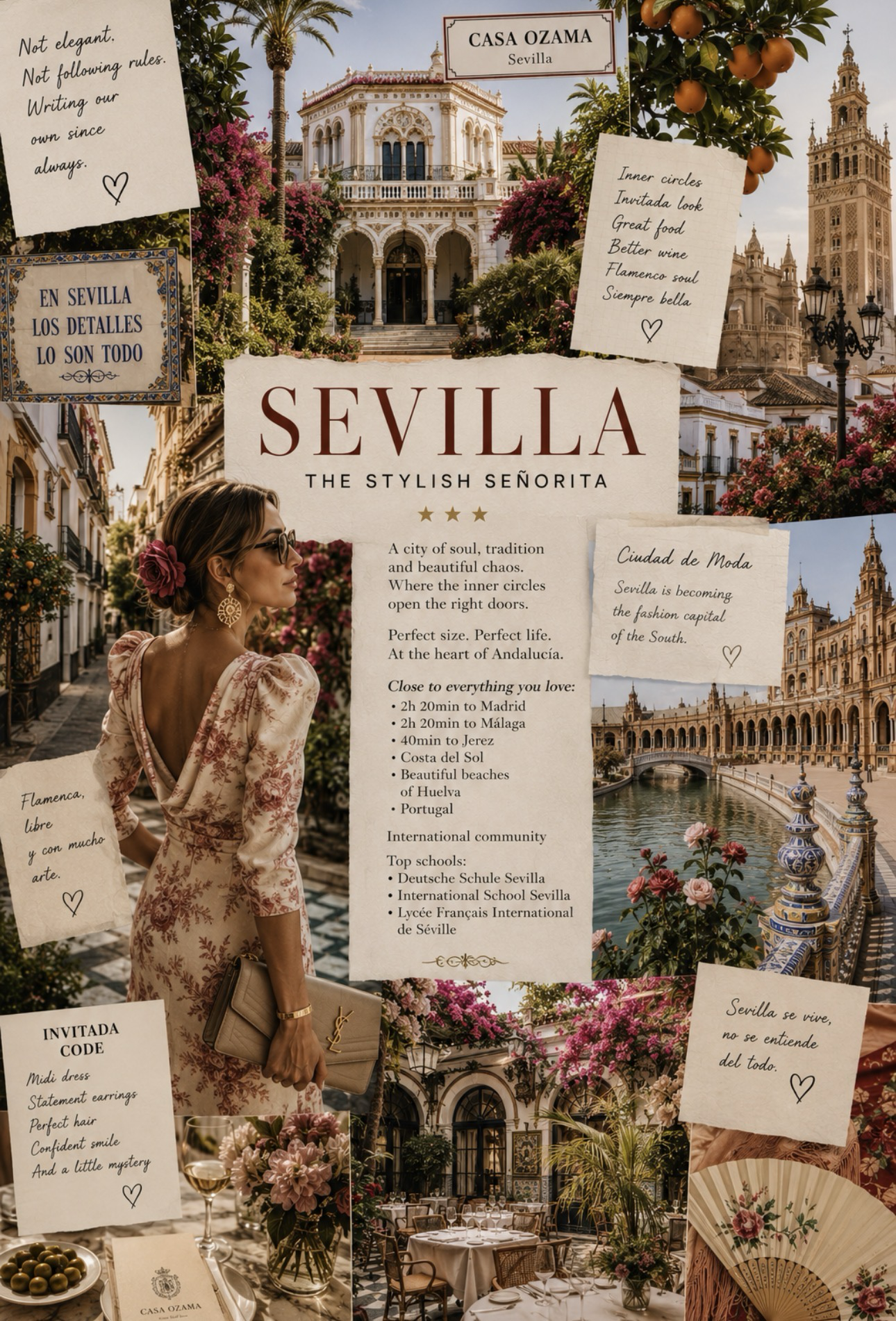

SEVILLA
THE ELEGANT SEÑORITA
SPAIN CITY INDEX 2026
She doesn’t follow trends. She doesn’t particularly follow rules either. Welcome to Sevilla.
Spanish Soul ★★★★★+ Fashion ★★★★★ Food ★★★★★
Lifestyle ★★★★★ Beauty ★★★★★ International Life ★★★★☆
If Madrid is Spain’s Grand Dame and Barcelona its Creative Rebel, then Sevilla is undoubtedly:
The Elegant Señorita.
Beautiful.
Proud.
Feminine.
Traditional.
Flirtatious.
Occasionally stubborn.
Frequently overdressed.
And completely convinced that the rest of Spain could learn a thing or two from her.
Which, irritatingly, may sometimes be true.
Sevilla doesn’t try to be international.
Sevilla doesn’t try to be cool.
Sevilla doesn’t try particularly hard to impress you at all.
Sevilla already knows who she is.
Sevilla is the elegant Señorita of Spain: orange blossom in the air, gold at her ears, silk at lunch and centuries of confidence under her heels.
She glitters, but never cheaply. Her glamour is not decoration. It is inheritance, ritual and the quiet certainty that beauty is simply part of daily life.
And perhaps that is precisely why so many foreigners eventually fall for her.
SEVILLA DOES THINGS DIFFERENTLY
Madrid has systems.
Barcelona has start-ups.
Sevilla has:
someone who knows someone.
This is important.
Because Sevilla is one of those cities where the official rules are occasionally only the beginning of the conversation.
There is the door.
And then there is the person who knows the person who can open the door.
There is the reservation.
And then there is the reservation.
There is the guest list.
And then there is the guest list nobody appears to have actually seen.
There is the business meeting.
And then there is lunch with somebody’s cousin who turns out to be the person you should have been speaking to all along.
Welcome to Sevilla.
LinkedIn can help. A Sevillano with the right cousin may help more.
THE INNER CIRCLE
And this is where Sevilla can become difficult for foreigners.
It is a warm city.
But it is not necessarily an immediately open city.
That sounds contradictory.
It isn’t.
A Sevillano may chat to you for twenty minutes.
Recommend a restaurant.
Ask where you’re from.
Tell you where to buy the best jamón.
Invite you for a drink.
And still not necessarily invite you into the actual circle.
Because Sevilla has circles.
Family circles.
School circles.
Business circles.
Feria circles.
Hermandad circles.
Friendship circles that appear to have been established somewhere around kindergarten and are apparently still accepting no new applications.
Sevilla is friendly. Access is another matter.
And if you want to do serious business here, understanding relationships matters enormously.
Trust comes before transaction.
Introductions matter.
Reputation matters.
Family names can matter.
And Spanish matters.
A lot.
ENGLISH? GOOD LUCK.
Unlike Barcelona or Madrid, Sevilla is not a city where you should assume that English will carry you through daily life.
It won’t.
Of course younger people increasingly speak English.
International businesses do.
Hotels do.
Tourism does.
But if you actually want to live in Sevilla rather than merely pass through it, Spanish changes everything.
Want to make friends?
Spanish.
Want to understand the neighbourhood?
Spanish.
Want to do business?
Definitely Spanish.
Want to understand what everyone is arguing about at the table?
Very fast Spanish.
Sevilla doesn’t really adapt itself to you.
You adapt yourself to Sevilla.
And strangely, that may be part of its charm.
BUT SOMETHING IS CHANGING
Because Sevilla today isn’t quite the Sevilla it was ten or fifteen years ago.
More international residents are arriving.
More remote professionals.
More international families.
More entrepreneurs.
More people discovering that they don’t necessarily want Madrid prices, Barcelona crowds or Marbella’s seasonal rhythm.
And Sevilla offers something increasingly rare:
a proper city at a human scale.
Big enough to have culture.
Small enough to recognise people.
Big enough for serious restaurants.
Small enough to walk home.
Big enough for international life.
Small enough to still feel unmistakably itself.
That balance is one of Sevilla’s greatest strengths.
THE PERFECT SIZE
This may be one of the most underrated things about Sevilla.
The size is fabulous.
Madrid can swallow you.
Barcelona can exhaust you.
Málaga increasingly stretches along the coast.
Sevilla?
Sevilla is manageable.
You can cross large parts of the centre on foot.
You can cycle.
You can have lunch in the centre and be somewhere completely different shortly afterwards.
You begin recognising faces.
The waiter remembers you.
The woman in the shop remembers you.
Someone waves from another table.
Your city slowly becomes your neighbourhood.
Sevilla gives you metropolitan pleasures without metropolitan exhaustion.
And that is worth far more than many city rankings acknowledge.
THE CITY OF THE INVITADA
And then there are the women.
Good Lord.
Nobody prepares you for Sevilla women.
Madrid has fashion.
Barcelona has cool.
Sevilla has:
the Invitada.
There is always something to dress for.
A wedding.
A baptism.
A communion.
A Feria.
A lunch.
A dinner.
A party.
A family event.
A religious event.
A social event.
An event whose exact purpose you still haven’t entirely understood but apparently requires earrings the size of a small chandelier.
And Sevilla women know exactly what to do.
The dress.
The shoes.
The bag.
The earrings.
The hair.
The shawl.
The lipstick.
The apparently effortless ability to walk over cobblestones in shoes that would hospitalise most Northern Europeans.
Sevilla doesn’t simply get dressed. Sevilla gets invited.
CIUDAD DE MODA
And this is where Sevilla is becoming genuinely interesting.
For years, outsiders associated Sevilla fashion almost exclusively with flamenco.
That is changing.
Flamenco fashion remains enormously important — and rightly so.
SIMOF has become an internationally recognised showcase for the sector, bringing designers, buyers, media, influencers and fashion professionals together in Sevilla. Its 2025 edition featured dozens of runway shows, more than 1,600 designs and over 100 exhibitors, while the city itself describes SIMOF as an important economic and international platform for flamenco fashion.
But something else is happening around it.
Young designers.
Invitada labels.
Small ateliers.
Accessories.
Jewellery.
Independent boutiques.
Spanish brands.
Made-in-Andalucía fashion.
Contemporary interpretations of traditional craftsmanship.
The boundary between flamenco fashion and mainstream Spanish occasionwear is becoming increasingly interesting.
And events such as We Love Flamenco show exactly why: its 2026 edition brought together around 50 designers and more than 1,300 new designs, deliberately mixing tradition with modernity.
Sevilla is becoming a Ciudad de Moda.
Not because it wants to become Madrid.
Not because it wants to become Paris.
But because Sevilla is beginning to realise that what it already has is commercially and creatively valuable.
FLAMENCO IS FASHION
And please, let’s stop treating flamenco fashion as costume.
It isn’t.
It is an industry.
Design.
Textiles.
Craftsmanship.
Pattern cutting.
Accessories.
Jewellery.
Shoes.
Flowers.
Beauty.
Photography.
Events.
Retail.
Exports.
Generations of knowledge.
And nowhere understands that ecosystem quite like Sevilla.
SIMOF’s commercial area alone exceeded 100 exhibitors in 2025, while the event continues to promote young Andalusian designers alongside established names.
Flamenco fashion constantly reinvents itself.
Colours change.
Sleeves change.
Prints change.
Silhouettes change.
But the identity remains.
Very Sevilla.
Tradition doesn’t disappear.
It gets another dress.
FERIA — SEVILLA’S OTHER RELIGION
There are cities that have festivals.
And then there is Sevilla.
Sevilla has Feria.
Calling Feria de Abril a festival is technically correct in approximately the same way as calling Versailles a house.
It rather misses the point.
Because Feria isn’t simply something Sevilla attends. Feria is something Sevilla prepares for, dresses for, saves for, talks about, plans around and occasionally appears to organise its entire year around.
And the funniest thing?
There isn’t really one Feria.
There is always another one coming.
IN ANDALUCÍA, IT IS BASICALLY ALWAYS FERIA SOMEWHERE
The great Feria de Abril in Sevilla is the queen.
The headline act.
The one everyone photographs.
The one that fills magazines.
The one that brings politicians, aristocrats, businessmen, celebrities, designers, families, horses and approximately every statement earring in Andalucía onto the same patch of ground.
But when Sevilla’s Feria finishes, Andalucía does not politely pack away the dresses and wait until next year.
Absolutely not.
Someone else is having a Feria.
A town. A village. A neighbouring municipality. A district. Another province. Another weekend. Another reason to bring the dress back out.
Across Andalucía, the warmer months unfold through a seemingly endless calendar of local ferias and fiestas.
Which means that if you live here long enough, you begin to understand:
Feria is not an event. Feria is a season.
Possibly a lifestyle.
Potentially a financial planning category.
FIRST SEMANA SANTA. THEN WE CHANGE SHOES.
Sevilla’s spring calendar is gloriously unreasonable.
First comes Semana Santa.
The city becomes solemn.
Candles. Incense. Processions. Velvet. Tradition. Silence. Music. Emotion.
Families stand together watching traditions that have existed for generations.
Then Semana Santa finishes.
There is a brief moment in which one might imagine Sevilla is going to rest.
How sweet.
Because shortly afterwards:
Feria.
The mantilla goes back into the wardrobe.
The flamenca dress comes out.
The atmosphere changes.
The horses arrive.
The casetas open.
The music starts.
And Sevilla goes from sacred procession to social marathon with astonishing efficiency.
There are cities with seasonal transitions.
Sevilla changes costume.
THE DRESS IS NOT A DRESS
This is where foreigners make their first mistake.
They look at a traje de flamenca and think: Pretty dress.
No.
No, no, no.
This is not simply a dress. This is the dress.
And there are rules. Trends. Designers. Collections. Colours. Fabrics. Prints. Sleeves. Necklines. Ruffles. Volumes. Accessories. Flowers. Earrings. Shawls. Shoes. Hair. And very strong opinions.
Every year, designers launch new collections.
Every year, silhouettes evolve.
Colours change. Sleeves move. Ruffles grow, shrink, multiply or suddenly appear somewhere nobody expected them.
One year everyone wants one thing.
The following year? Absolutely not. That was last year. Keep up.
Paris has couture season. Sevilla has Feria season.
And Sevilla takes hers just as seriously.
€200 IS WHERE THE CONVERSATION STARTS
You can find simpler flamenca dresses starting somewhere around the €200 mark.
But that is merely where the conversation begins.
From there? Up. And up. And very considerably up.
Designer dresses, made-to-measure pieces, premium fabrics, craftsmanship and bespoke details can turn a Feria wardrobe into a serious investment.
And remember: We haven’t discussed the accessories yet.
The earrings. The flower. The mantoncillo. The shoes. The bag. The hair. Possibly another dress.
Because naturally you cannot necessarily wear the same thing every day.
What are we, amateurs?
A woman who attends Feria several days may have several looks.
Families plan. People save. Dresses are altered. Older dresses are reinvented. Accessories are changed. Pieces are passed through generations. And new ones are bought.
Feria has its own economy.
And Sevilla knows exactly how to keep it moving.
THE DESIGNERS BECOME THE STARS
In the months before Feria, flamenco designers become some of the most interesting names in Andalusian fashion.
Collections are presented. Runways fill. Photographs circulate. Women discuss favourites. Instagram becomes dangerous.
Suddenly everyone has an opinion about sleeves.
And this is why Sevilla deserves to be taken seriously as a Ciudad de Moda.
Flamenco fashion is one of the rare fashion ecosystems where local cultural identity, craftsmanship, commercial fashion and annual trend cycles remain completely intertwined.
A flamenca dress must respect tradition while constantly becoming new.
That is much harder than it looks.
Too traditional? Nothing new.
Too fashion-forward? Perhaps no longer flamenca.
The great designers understand the balance.
Tradition — but make her fabulous.
AND THEN THE ENTIRE CITY CATCHES FERIA FEVER
You feel Feria coming before Feria arrives.
Shop windows change. Dressmakers become busy. Appointments disappear. Accessories appear everywhere. People start discussing casetas. Invitations circulate. WhatsApp groups become operational headquarters.
Who is going Tuesday? Who is going Wednesday? Which caseta? Lunch? Dinner? Children? Horses? What are you wearing? What is she wearing? Did you see that collection? Have you booked the hairdresser? Do you have your flower? Who has the invitation?
Feria logistics make some corporate project plans look amateur.
And then the lights come on.
And Sevilla loses its mind.
Beautifully.
THE REAL DE LA FERIA
For one extraordinary week, the Real de la Feria becomes its own city.
A temporary Sevilla inside Sevilla.
Rows and rows of casetas. Lanterns. Carriages. Horses. Flamenca dresses. Suits. Music. Rebujito. Food. Families. Friends. Children. Grandparents. Businessmen. Politicians. Socialites.
People who have been attending the same caseta for decades.
And foreigners standing somewhere in the middle thinking:
What exactly is happening?
Everything.
Everything is happening.
At once.
THE CASETA: WHERE SEVILLA EXPLAINS ITSELF
And now we arrive at the caseta.
Possibly the most Sevilla concept in existence.
At many festivals, you buy a ticket.
At Feria?
Adorable.
Many of Sevilla’s casetas are private.
They belong to families, groups of friends, associations, clubs, companies or organisations.
Membership can be deeply established.
Sometimes the easiest route in is not an app.
It is birth.
Or marriage.
Choose your parents carefully.
There are public casetas too, of course, and visitors absolutely can experience Feria.
But the private caseta culture reveals something fundamental about Sevilla:
The city is organised through relationships.
Feria simply puts those relationships under striped canvas and gives them rebujito.
BORN INTO IT. MARRIED INTO IT. INVITED INTO IT.
There are social circles in Sevilla that have existed for generations.
Families know families. Children grow up together. Schools connect families. Brotherhoods connect families. Clubs connect families. Feria connects everybody again.
The same people meet. The next generation appears. Children who once ran around the caseta eventually arrive with their own children.
This is why Feria feels so different from a normal party.
It has memory.
People don’t simply attend. They return.
To the same place. To the same people. To rituals they have known all their lives.
For outsiders, that can sometimes feel incredibly exclusive.
Because it is.
But it also explains why Feria remains so culturally powerful.
It hasn’t been invented for visitors.
It belongs to the people who live it.
THE INVITATION ECONOMY
And naturally, once private casetas exist, something else exists:
The invitation.
Suddenly a small piece of paper or a message on your phone becomes more valuable than several loyalty cards combined.
“Which caseta are you in?”
This is not small talk.
This is intelligence gathering.
Someone knows someone. Someone’s husband has access. Someone’s cousin is a member. Someone’s friend can get you in after lunch.
Someone says: “Come with us.”
Congratulations. You have just unlocked another level of Sevilla.
Feria is perhaps the only place where networking comes with ruffles.
FERIA IS ALSO A SOCIAL DIRECTORY
If you want to understand who knows whom in Sevilla, spend a few days at Feria.
Business. Politics. Old families. New money. Fashion. Media. Law. Hospitality. Property. Horses. Agriculture. Culture.
Everyone overlaps.
The same person you have spent three weeks trying to reach by email may suddenly be standing two metres away holding a glass of rebujito.
This is why applying purely Northern European logic to Sevilla can be wonderfully ineffective.
You sent seven emails? Lovely.
Have you tried Feria?
HORSES, CARRIAGES AND THE ART OF LOOKING COMPLETELY NORMAL WHILE BEING EXTRAORDINARY
Then there are the horses.
And the carriages.
This is where Feria stops looking like a party and begins looking like a film set with extremely good tailoring.
Beautiful horses. Traditional carriages. Men impeccably dressed. Women in spectacular flamenca dresses. Families arriving together.
The entire scene moving through the Real as though this were a perfectly ordinary way to spend Tuesday afternoon.
And in Sevilla? It is.
It makes spectacle look normal.
A horse-drawn carriage passes you. Nobody screams. Nobody points. Nobody asks why there is a horse.
Of course there is a horse.
It’s Feria.
Please concentrate.
REBUJITO: A SMALL GLASS WITH LARGE CONSEQUENCES
And then there is rebujito.
Sherry and lemon-lime soda.
Cold. Fresh. Light. Dangerously polite.
The sort of drink that tastes as though absolutely nothing could possibly go wrong.
This is incorrect.
Rebujito is Feria’s diplomatic representative.
Friendly. Charming. Everywhere.
And somehow responsible for several decisions that may require clarification the following morning.
Respect the rebujito. It has seen things.
FERIA DAY AND FERIA NIGHT ARE TWO DIFFERENT COUNTRIES
During the day, Feria is astonishingly elegant.
Horses. Carriages. Lunches. Families. Dresses in full daylight. Children. Friends moving between casetas.
It is social theatre at its most beautiful.
Then the sun goes down.
Lights glow. Music gets louder. The rebujito has had several hours to establish diplomatic relations.
People dance. Casetas fill. Dinner becomes midnight. Midnight becomes 3 a.m.
And at some point you realise you have been at Feria for twelve hours.
Nobody is concerned.
This is apparently normal.
WHAT ARE WE WEARING TOMORROW?
And then comes the question.
Because Feria is several days.
One dress?
Please.
Some women plan multiple looks. Different colours. Different flowers. Different earrings. Different styling.
The Feria wardrobe can become its own project.
And unlike ordinary fashion, the visual impact is communal.
Thousands of women are dressed spectacularly at the same time.
This is what photographs struggle to capture.
It isn’t one beautiful woman in a flamenca dress.
It is an entire city filled with them.
Walking. Laughing. Dancing. Eating. Standing beside horses. Crossing streets. Meeting friends. Living normally while dressed extraordinarily.
For one week, Sevilla becomes its own runway.
And the runway has horses.
Beat that, Paris.
THE WHOLE OF SPAIN LOOKS AT SEVILLA
During Feria, images of Sevilla travel everywhere.
Fashion coverage. Society pages. Television. Instagram. Designers. Celebrities. Influencers. Politicians. Photographers.
Everyone is watching the dresses.
What are the colours this year? The silhouettes? The sleeves? Who wore which designer? Which collection is everywhere? Which look will influence next season?
Feria fashion isn’t hidden folklore.
It is living Spanish fashion culture.
And for that week, Sevilla doesn’t need to ask anyone for attention.
Spain is already looking south.
THIS IS WHY FERIA FASHION MATTERS
There is something particularly powerful about a fashion tradition that women genuinely wear.
Not on a stage. Not only for tourists. Not inside a museum.
They wear it to meet friends. To eat. To dance. To socialise. To celebrate.
Mothers wear it. Daughters wear it. Grandmothers wore it. Children grow into it. Designers reinvent it. And every generation makes it slightly its own.
That is why flamenco fashion has survived.
It isn’t preserved behind glass.
It goes out.
And preferably has lunch.
FROM SEVILLA TO EVERY LITTLE FERIA
Then Sevilla’s big week finishes.
The lights go out. The Real empties. The dresses go home. Everyone sleeps.
For approximately five minutes.
Because somewhere else in Andalucía:
another Feria is starting.
Jerez. Córdoba. Local towns. Small municipalities. Neighbouring communities. Summer ferias. Village ferias. Horse fairs. Patron saint festivities.
Different places have their own traditions and personalities, but the culture of dressing, meeting, eating, dancing and celebrating continues across the region.
Which is why living in Andalucía can occasionally feel as though somebody has accidentally created a six-month social season.
You thought Feria was over?
Which Feria?
SEVILLA’S CLUB WORLD
And the Feria culture doesn’t exist in isolation.
Sevilla has a deeply established world of clubs, associations, sporting institutions, brotherhoods and social organisations.
The Real Club Náutico. Traditional social clubs. Equestrian circles. Hermandades. Private associations. Family networks. Institutions where generations overlap.
This is part of what gives Sevilla that slightly old-world, almost stately social structure.
Not aristocratic in every case. But institutional. Established. Inherited. Connected.
There are places where you don’t simply become a member because you woke up on Tuesday and filled out a form.
There are histories. Relationships. Recommendations. Waiting lists. Families.
Again: Sevilla likes an introduction.
THE GLAMOUR ISN’T IMPORTED
And this is perhaps what separates Sevilla from many international luxury destinations.
The glamour here wasn’t flown in for the weekend.
It isn’t primarily built around yachts, international brands or visitors.
It grew here.
The houses. The clubs. The horses. The craftsmanship. The jewellery. The dresses. The families. The traditions. The courtyards. The social rituals.
That is why Sevilla’s glamour feels different from Marbella’s.
Marbella says:
Look what arrived.
Sevilla says:
Darling, this has been here for generations.
Whether or not anyone actually says “darling” is beside the point.
FERIA MONEY
And yes, Feria costs money.
Sometimes a lot of it.
Clothes. Accessories. Casetas. Food. Drinks. Transport. Horses. Carriages. Hair. Social commitments. Several days of celebration.
Families budget for it. People save for it. Priorities are made.
Because from the outside, it may look like an extravagant week.
From the inside?
It’s part of the year.
People save for holidays. People save for Christmas. People save for weddings.
And in Sevilla?
People save for Feria.
Try explaining that to an Excel spreadsheet in Hamburg.
Actually, don’t.
It will only become nervous.
FERIA IS NOT A PARTY. IT IS BELONGING.
And underneath all the dresses, horses, casetas, money, fashion, music and rebujito lies something much more important.
Belonging.
This is why Feria matters.
It is where families meet. Where generations return. Where friendships are renewed. Where children learn traditions by simply growing up inside them. Where people who have moved away come back. Where the city recognises itself.
The glamour is wonderful. The fashion is extraordinary. The social theatre is fascinating.
But none of those things alone explain why people care so much.
Feria is memory wearing a beautiful dress.
And that is why Sevilla will never treat it like just another festival.
THE FERIA RULES FOR FOREIGNERS
There are a few things newcomers eventually learn.
Do not treat the traje de flamenca as fancy dress.
Do not assume every caseta is public.
Do not ask why people need another dress.
They do.
Do not underestimate the shoes.
Do not underestimate the rebujito.
Do not expect to understand the social structure immediately.
Do not schedule an important business meeting during Feria and then act surprised when nobody answers.
And if someone invites you into their private caseta?
Go.
This is not the evening to announce that you are tired.
You can sleep in August.
Nothing is happening then anyway.
It’s 43 degrees.
THE EPC FERIA VERDICT
Feria tells you almost everything you need to know about Sevilla.
It is beautiful. Complicated. Traditional. Fashionable. Expensive. Generous. Exclusive. Inclusive — once you’re inside. Family-driven. Relationship-driven. Slightly theatrical. Deeply sincere.
And completely uninterested in simplifying itself for outsiders.
You can photograph Feria. You can visit Feria. You can write about Feria.
But to really understand it, you probably have to live here long enough to hear yourself say something you never expected:
“What are you wearing to Feria this year?”
At which point it may already be too late.
Sevilla has got you.
And somewhere in your wardrobe there is suddenly a dress with ruffles that requires its own storage strategy.
Because in Sevilla, Feria isn’t simply the biggest party of the year.
Feria is fashion.
Feria is family.
Feria is society.
Feria is business.
Feria is tradition.
Feria is belonging.
And if you ask a Sevillano whether all of this is perhaps just a little excessive?
I wouldn’t.
Remember:
This isn’t a festival.
This is Feria.
And in Sevilla, that is an entirely different thing.
SEMANA SANTA: THIS IS NOT A SHOW
Then there is Semana Santa.
And here foreigners should understand something important.
This isn’t simply a tourist spectacle.
It is woven into Sevilla’s identity.
Families.
Brotherhoods.
History.
Religion.
Music.
Art.
Tradition.
Generations.
Even if you are not religious, it is difficult not to be affected by the atmosphere.
The silence.
The crowds.
The candles.
The music moving through streets that suddenly feel several centuries old.
For one week, Sevilla doesn’t perform its history.
It lives inside it.
AND THEN THERE IS THE FOOD
This is the part visitors mention to me constantly.
People come to Sevilla and say:
“Why is every second place beautiful?”
Exactly.
The restaurant scene has changed enormously.
Traditional tapas bars remain.
And they should.
But alongside them is an increasingly sophisticated new generation of restaurants, wine bars, hotel terraces, cocktail bars and beautifully designed spaces.
Sevilla has discovered interiors.
And apparently it has become slightly addicted.
One beautiful restaurant opens.
Then another.
Then another.
You walk down a street you thought you knew and suddenly:
Where did THAT come from?
This is one of the pleasures of contemporary Sevilla.
The city keeps becoming more sophisticated without completely losing its old bars.
At least so far.
THE TAPAS ADVANTAGE
And unlike Madrid, Sevilla still has something deeply embedded in everyday life:
real tapas culture.
You don’t necessarily reserve an entire evening around one restaurant.
You move.
One place.
One tapa.
Another place.
Another drink.
Someone joins.
Someone leaves.
Plans change.
Dinner develops.
And three hours later you are somewhere you never intended to go.
Sevilla is wonderfully good at spontaneous evenings.
Possibly because nobody was particularly committed to the original plan anyway.


THE EXPAT SEVILLA
The international community here is not Barcelona-sized.
And that’s exactly why it can be interesting.
You begin recognising people.
International professionals meet each other.
Language communities overlap.
Entrepreneurs meet remote workers.
Spanish partners bring international friends.
Parents meet through schools.
People arrive for a year and stay.
And increasingly, Sevilla is attracting foreigners who aren’t looking for an expat bubble.
They are looking for Spain.
That distinction matters.
If Barcelona lets you live internationally without necessarily integrating immediately, Sevilla pushes you gently — and occasionally not so gently — towards Spanish life.
You learn the language.
You learn the rhythms.
You learn that lunch is not something squeezed between two meetings.
You learn that August is not a normal month.
You learn that nobody is answering your email during Feria.
Eventually you stop asking why.
Integration by surrender.
INTERNATIONAL FAMILIES
For families, Sevilla has become considerably more interesting.
There are international and multilingual education options, including French schooling and other international programmes.
The Lycée Français International de Séville, for example, offers education from early years through secondary level and combines the French Baccalaureate pathway with Cambridge certification and trilingual education. Its community includes pupils from around 25 nationalities.
There are also bilingual and international-school options in and around the metropolitan area, making Sevilla increasingly viable for families who want Andalusian life without giving up an international educational environment.
And that changes who can realistically move here.
Sevilla is no longer only attractive for students, language learners or retirees.
Families can build a life here.
LOCATION, LOCATION, LOCATION
And then there is Sevilla’s secret weapon.
Look at the map.
Madrid is easily reachable by high-speed rail.
Málaga and the Costa del Sol are accessible for weekends.
Cádiz.
Jerez.
Sotogrande.
The Atlantic coast.
Huelva.
The beaches around El Rompido, Punta Umbría, Islantilla and beyond.
Portugal.
The Algarve.
You can live in a monumental Andalusian capital and spend your weekends somewhere completely different.
Beach?
Choose Atlantic or Mediterranean.
City?
Madrid.
Wine?
Jerez.
Horses?
Everywhere.
Portugal?
Keep driving west.
Sevilla sits in an extraordinarily useful corner of Spain.
THE HUELVA ESCAPE
And Huelva deserves particular mention.
Because when Sevilla reaches approximately the temperature of the surface of the sun, Sevillanos know what to do.
They leave.
The Atlantic beaches west of the city provide one of Andalucía’s great summer escapes.
Long beaches.
Atlantic air.
Seafood.
Beach restaurants.
A different rhythm.
And suddenly Sevilla’s lack of coastline becomes considerably less tragic.
You don’t need to live on the beach.
You just need to know where the road goes.
SUMMER: LET’S DISCUSS THE ELEPHANT IN THE ROOM
Sevilla is hot.
No.
Let me correct that.
Sevilla in summer is completely ridiculous.
There are temperatures.
And then there is Sevilla in July.
At some point, weather apps stop being informative and begin feeling personally insulting.
Walking outside at 4 p.m. becomes less an activity and more a poor decision.
Locals know.
Shutters close.
Streets empty.
Air conditioning becomes a constitutional right.
And life moves to morning and night.
But Sevilla also adapts beautifully.
Late dinners.
Terraces after dark.
Courtyards.
Pools.
Trips to the coast.
Life changes rhythm.
Sevilla doesn’t beat summer. Sevilla negotiates with it.
SPRING: THIS IS WHY WE FORGIVE HER
And then spring arrives.
Orange blossom.
Blue skies.
Jasmine.
Terraces.
Perfect evenings.
Semana Santa.
Feria.
Dresses.
Horses.
Flowers.
People outside.
The entire city smells slightly impossible.
And suddenly everyone forgets July.
This is Sevilla’s trick.
Just when you’re preparing a formal complaint about the climate, she gives you April.
Case dismissed.
THE BEAUTY PROBLEM
Sevilla is almost annoyingly beautiful.
The Alcázar.
The Cathedral.
The Giralda.
Santa Cruz.
Triana.
Plaza de España.
The river.
Palaces.
Courtyards.
Tiles.
Orange trees.
But the beauty isn’t limited to monuments.
It’s the everyday backdrop.
A doorway.
A balcony.
A courtyard.
A tiled wall.
An old bar.
A woman walking through the centre dressed for a wedding at noon.
A horse appearing somewhere a horse has absolutely no business appearing in a modern European city.
After a while you stop photographing everything.
And then someone visits.
And you see it again.
Oh yes. This is ridiculous.
BUSINESS: THE HARDER PART
And now for the part no relocation brochure will tell you.
Doing business in Sevilla can be difficult.
Particularly if you arrive with a Northern European approach and expect everything to work purely on efficiency, qualifications and a perfectly constructed email.
Sevilla is relationship-driven.
Trust-driven.
Network-driven.
Often slower.
Sometimes frustrating.
Occasionally wonderfully human.
Sometimes maddeningly traditional.
You may discover that the person with the most impressive title is not necessarily the person with the most influence.
You may discover that introductions matter more than cold outreach.
And you may discover that a thirty-minute coffee achieves what twelve emails could not.
Sevilla doesn’t necessarily ask: What do you know?
Sometimes Sevilla asks:
Who knows you?
For newcomers, this can feel closed.
Because sometimes it is.
But once relationships are established, they can also be extraordinarily loyal.
That is the trade-off.
THE NEW SEVILLA
Yet Sevilla is changing.
Slowly.
Naturally.
On its own terms.
International companies.
Tourism investment.
Hospitality.
Aerospace.
Technology.
Renewable energy.
Creative industries.
Fashion.
Gastronomy.
Remote work.
Entrepreneurship.
New hotels.
New restaurants.
New concepts.
New people.
The city is becoming more international without becoming Barcelona.
More stylish without becoming Madrid.
More cosmopolitan without abandoning Triana.
And that is exactly the point.
Sevilla shouldn’t become somewhere else.
It simply needs to become more Sevilla.
WHO SHOULD MOVE TO SEVILLA?
YES — if you want to actually live in Spain rather than inside an international bubble.
YES — if food, architecture, fashion, tradition and beauty matter to you.
YES — if you want a proper city that still feels manageable.
YES — if you have children and want an increasingly international educational environment.
YES — if being within reach of Madrid, Málaga, Cádiz, Jerez, Huelva, the Costa del Sol and Portugal sounds useful.
YES — if you enjoy knowing your neighbourhood rather than merely living in it.
MAYBE — if you don’t speak Spanish.
Learn.
MAYBE — if your career depends entirely on a huge international corporate job market.
Madrid and Barcelona remain stronger.
NO — if 40-degree weather makes you question your will to live.
July would like a word.
And perhaps:
NO — if you believe every door should open simply because you knocked.
This is Sevilla.
Someone probably knows who has the key.
THE EPC SCORE
Spanish Soul ★★★★★+
Beauty ★★★★★+
Food ★★★★★
Tapas Culture ★★★★★+
Fashion & Invitada Style ★★★★★
Flamenco Fashion ★★★★★+
Lifestyle ★★★★★
International Community ★★★★☆
International Schools ★★★★☆
Networking ★★★★☆
Ease of Doing Business as a Newcomer ★★☆☆☆
Public Transport & Walkability ★★★★☆
Weekend Escapes ★★★★★
Beach Access ★★★★☆
Affordability ★★★★☆
English-only Life ★★☆☆☆
Summer Survival ★☆☆☆☆
Chance of Needing an Outfit for Something You Didn’t Know You Were Invited To ★★★★★+
THE EXPAT PRESS CLUB VERDICT
Sevilla is not Madrid.
Thank God.
It isn’t Barcelona either.
Also fine.
Sevilla doesn’t have Madrid’s corporate power.
It doesn’t have Barcelona’s giant international tech bubble.
It doesn’t have Málaga’s beach.
It doesn’t have Marbella’s international luxury machine.
What Sevilla has is much harder to manufacture.
Identity.
Sevilla knows exactly what it is.
Sometimes too exactly.
That confidence can make the city feel closed.
Traditional.
Stubborn.
Difficult.
But it is also what protects the thing everyone eventually comes here looking for:
Soul.
Sevilla still feels Spanish.
Deeply Spanish.
Andalusian.
Proudly local.
You don’t simply consume the city.
You have to learn it.
Its rhythms.
Its people.
Its traditions.
Its circles.
Its language.
Its rules.
And the rules behind the rules.
But once Sevilla begins to open?
Something happens.
The city becomes surprisingly intimate.
You recognise people.
People recognise you.
The waiter knows what you drink.
Someone sends you a message because something is happening.
You start having favourite tables.
Favourite streets.
Favourite shops.
Favourite weeks of the year.
And then one spring evening, the orange blossom arrives again and you realise something slightly alarming:
You belong here.
Sevilla is changing.
More international.
More fashionable.
More gastronomic.
More ambitious.
More creative.
A growing Ciudad de Moda with one foot firmly planted in centuries of tradition.
And perhaps that’s the future of Sevilla.
Not becoming Madrid.
Not becoming Barcelona.
Not becoming Málaga.
Becoming a more international version of itself.
Because Sevilla has never been particularly interested in following everybody else.
SEVILLA — THE ELEGANT SEÑORITA
Come for the beauty.
Stay for the lifestyle.
Learn the language.
Find the inner circle.
Buy the Invitada dress.
Never schedule anything important during Feria.
And remember:
Sevilla doesn’t follow the rules.
Sevilla knows the person who wrote them.
THE EXPAT PRESS CLUB • SEVILLA — THE ELEGANT SEÑORITA