

THE EXPAT PRESS CLUB THE POLO POWER 20 — SPAIN

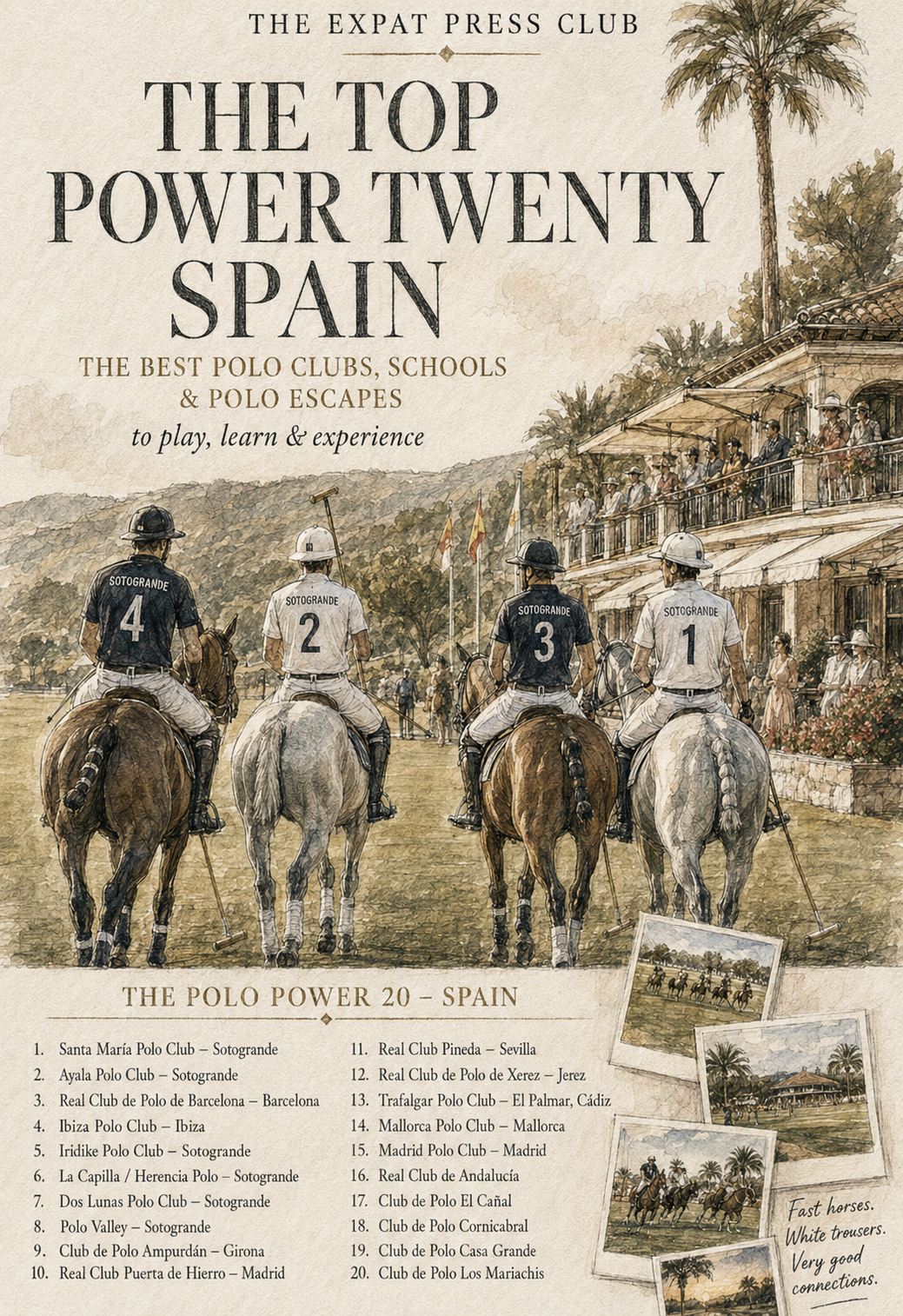

THE EXPAT PRESS CLUB
THE POLO POWER 20 — SPAIN
The Clubs, Schools & Polo Escapes You Need to Know
Fast horses. White trousers. Very good connections.
There are sports that look elegant.
And then there is polo.
Four players. Four horses per side on the field. A tiny white ball travelling at a speed that seems entirely unreasonable. Mallets swinging, ponies turning, players shouting, hooves thundering across the grass.
And somehow, from the other side of the boards, it all looks terribly civilised.
Welcome to polo.
Or, as we might call it:
Golf after somebody removed the brakes.
Spain has an extraordinary relationship with horses, but its polo world remains surprisingly invisible to many international residents.
Everybody knows Sotogrande. Some know Barcelona. A few have discovered Ibiza.
But start looking properly and another Spain appears: historic clubs, private grounds, polo schools, international tournaments, family-run establishments and places where complete beginners can climb onto a trained polo pony and discover within approximately seven minutes that hitting a ball from a moving horse is considerably harder than it looks.
Ach, wirklich?
Yes.
And that’s precisely where the fun begins.
SPAIN & THE SPORT OF KINGS
Polo in Spain isn’t a recently imported lifestyle accessory.
Its roots stretch deep into the country’s equestrian history. Jerez was an early centre of organised Spanish polo in the nineteenth century, while Madrid and Barcelona subsequently developed their own club traditions.
Today the geography of Spanish polo tells a rather wonderful story.
Madrid gives us establishment. Barcelona gives us sporting tradition inside the city. Ibiza gives us polo with bare feet waiting somewhere afterwards. Mallorca brings island life. Jerez and Sevilla connect the game to Andalucía’s extraordinary horse culture.
And then there is Sotogrande.
Sotogrande doesn’t merely have polo.
For several months every year, Sotogrande seems to become polo.
1. AYALA POLO CLUB — SOTOGRANDE
THE BIG ONE
If you want to understand contemporary polo in Spain, start here.
Ayala has become the centre of Sotogrande’s major competitive calendar, with grounds at Ayala and Los Pinos and a season stretching across the warmer months.
And this is not merely pretty ponies trotting around for spectators holding glasses.
This is serious international polo.
In 2026, the 55th International Polo Tournament runs from 27 July to 29 August, bringing together high-, medium- and low-handicap competition. The Bronze Cup ran from 27 July to 1 August, the Silver Cup from 3–15 August, and the Gold Cup runs from 17–29 August.
The atmosphere surrounding it is precisely why polo works so beautifully for EPC.
Sport on one side. Social life on the other.
At Los Pinos, the tournament environment also includes the Last Chukker concept with food, shopping, concerts and other activities.
Come for the horses.
Stay because apparently everybody you know has suddenly appeared beside the field.
EPC VERDICT: The Spanish polo experience everyone should see at least once.
BEST FOR: International polo · spectators · serious players · summer society · learning the sport.
2. REAL CLUB DE POLO DE BARCELONA
THE GRAND OLD CITY CLUB
Barcelona does something rather extraordinary.
It puts polo inside one of Europe’s great cities.
The Reial Club de Polo de Barcelona dates back to 1897, and polo isn’t some fashionable recent addition to the programme — it sits at the heart of the club’s history.
Today polo exists alongside the club’s other major sporting disciplines, creating something that feels very Barcelona: metropolitan, established, international and sporting all at once.
But here’s the part we particularly love.
You can learn.
The club’s polo school isn’t reserved exclusively for people who arrived from Argentina with a handicap and six ponies. Beginners can start learning the equestrian foundations alongside polo technique.
Which gives us possibly the greatest EPC challenge yet:
Can a complete beginner learn polo in Barcelona without humiliating herself?
We suspect the answer is no.
Which makes the article considerably better.
EPC VERDICT: Spain’s great urban polo institution.
BEST FOR: Barcelona residents · beginners · established players · club life · sporting tradition.
3. IBIZA POLO CLUB
THE BOHO ONE
Of course Ibiza plays polo.
What did you expect?
Badminton?
Ibiza Polo Club takes the sport out of its more formal surroundings and puts it into an island landscape where everything immediately feels slightly more relaxed.
Lessons are available from beginner level upward, including for children and adults, and the club offers private and small-group instruction.
And Ibiza’s climate gives it another advantage: the playing and teaching season can extend far beyond the classic summer window.
Morning lesson. Lunch. Beach. Another lesson tomorrow? Maybe. Boat? Also maybe.
Sehr schwierig.
EPC VERDICT: The place to discover polo without feeling as though you’ve accidentally entered somebody else’s private club.
BEST FOR: Beginners · couples · groups of friends · island weekends · polo holidays.
4. CLUB DE POLO AMPURDÁN — EMPORDÀ
THE SECRET ESCAPE
Drive north from Barcelona into the Empordà and another version of polo appears.
Founded in 1987 near Figueres, Club de Polo Ampurdán has welcomed Spanish and international players and offers both introductory and more advanced polo instruction.
But there is one detail we particularly adore.
The initiation into polo can become a bautismo de polo.
A polo baptism.
And afterwards?
An asado.
At which point the EPC editorial department stopped asking further questions.
Horse. Mallet. Empordà. Asado.
Book us in.
EPC VERDICT: One of Spain’s most charming polo discoveries.
BEST FOR: Beginners · weekends from Barcelona · international visitors · polo escapes · people who understand the importance of lunch.
5. REAL CLUB PUERTA DE HIERRO — MADRID
THE OLD-MONEY ONE
Madrid and polo have history.
And Puerta de Hierro belongs to the capital’s traditional sporting-club landscape.
This is a different world from Ibiza. No bohemian scarf required.
Think Madrid establishment. Trees. Tradition. Riding boots. An immaculate shirt. And somebody whose grandfather probably already knew everybody here.
EPC VERDICT: Polo with capital pedigree.
BEST FOR: Tradition · Madrid club culture · established players · classic Spanish sporting society.
6. REAL CLUB PINEDA — SEVILLA
THE ANDALUSIAN ONE
Sevilla without horses would be rather like Paris without cafés.
Technically possible. Emotionally unacceptable.
Real Club Pineda brings polo into a broader equestrian and sporting culture that feels unmistakably Sevillian.
Polo here doesn’t need to manufacture an equestrian lifestyle around itself.
It’s already there.
EPC VERDICT: Where polo meets Sevilla’s equestrian soul.
BEST FOR: Sevilla residents · equestrian culture · club life · traditional Andalucía.
7. REAL CLUB DE POLO DE XEREZ — JEREZ
WHERE THE STORY BEGAN
If we’re going to write about Spanish polo, Jerez deserves respect.
The city is fundamental to Spain’s equestrian identity and was one of the earliest centres of organised polo in the country.
Horses. Sherry country. Old estates. Andalucía. Polo.
You almost don’t need a journalist.
You need a photographer and a very long lunch reservation.
EPC VERDICT: Essential for understanding the history behind Spanish polo.
BEST FOR: Heritage · equestrian travellers · Jerez weekends · Spanish polo history.
8. IRIDIKE POLO CLUB — SOTOGRANDE
THE PLAYER’S ONE
Iridike is particularly interesting for people who don’t simply want to watch polo — they want to play.
Instruction, training and polo experiences make it relevant to international visitors as well as existing players.
You can arrive curious. Take lessons. Watch elite polo. Meet players. Understand handicaps. See how ponies are trained.
Dangerous.
You came for a weekend.
Now you’re discussing boots.
9. LA CAPILLA / HERENCIA POLO — SOTOGRANDE
THE POLO-HOLIDAY ONE
This is where sport starts becoming escape.
Lessons, chukkers and polo-oriented stays make the concept especially interesting for international visitors who want more than a one-hour introduction.
You wake up thinking about horses. You play. You learn. You talk about polo at lunch. Then you watch polo.
And by dinner somebody is explaining handicaps using bread rolls.
You’ve become one of them.
Congratulations.
10. DOS LUNAS — SOTOGRANDE AREA
THE EQUESTRIAN BEAUTY
Dos Lunas adds another dimension because the world here extends beyond polo into wider equestrian culture.
Architecture. Land. Horses. Andalucian light.
This is less “quick polo lesson before lunch” and more immersion into the equestrian lifestyle.
EPC VERDICT: One for the horse people.
11. POLO VALLEY — SOTOGRANDE
THE BEGINNER-FRIENDLY ONE
Polo Valley is particularly interesting for people who look at polo and think:
I’d love to try that, but I can’t possibly do it.
That’s precisely the audience.
Beginner experiences make polo approachable without stripping away the excitement of the sport.
Get somebody onto a suitable horse with a good instructor and suddenly the conversation changes.
The fear disappears.
The obsession begins.
12. TRAFALGAR POLO CLUB — CÁDIZ
THE WILD-COAST ONE
Now we move towards another Andalucía.
Cádiz. Atlantic light. Open country. El Palmar.
The landscape becomes rougher, freer and less manicured than Sotogrande.
And that’s precisely why Trafalgar belongs in our list.
This is polo with a slightly more barefoot soul.
EPC VERDICT: Andalucía without the polished edges.
13. MALLORCA POLO CLUB — MALLORCA
THE ISLAND ONE
Mallorca’s inclusion in the Spanish polo landscape gives us another fascinating combination:
Polo plus island life.
For our Power 20, it belongs firmly on the radar.
BEST FOR: Island equestrian life · Mallorca residents · discovering polo beyond the mainland.


PLAY · LEARN · WATCH · STAY · SOCIAL
Because a polo ground where established teams compete is not necessarily somewhere a complete beginner can telephone on Tuesday and book a lesson for Wednesday.
BUT CAN I ACTUALLY LEARN POLO?
Yes.
You do not necessarily need to arrive as an accomplished rider.
Several Spanish polo schools introduce beginners to riding and polo simultaneously.
The first objective is considerably simpler:
Stay on horse.
Locate ball.
Attempt to hit ball.
Miss ball.
Laugh.
Try again.
Welcome to polo.
WHAT ON EARTH IS A CHUKKA?
A polo match is divided into periods called chukkas.
Players carry long-handled mallets and attempt to drive the ball through the opposing goal while riding at considerable speed.
The horses are traditionally called polo ponies, even though they are full-sized horses.
Players change horses during matches because of the enormous physical demands involved.
Once you understand the basics, watching polo changes completely.
Suddenly the lines make sense.
The riding becomes astonishing.
And you begin to realise that the horse beneath the player may be the greatest athlete on the field.
THE EPC POLO DIARY 2026
If you want to see serious polo in Spain, Sotogrande is the calendar to bookmark.
The major 2026 Sotogrande dates include:
Copa Bienvenida — 19–24 May
Copa KE Sotogrande — 26–31 May
Copa Joseph McMicking — 4–14 June
Open de España — 18–28 June
Memorial Manuel Prado y Colón de Carvajal / Memorial Fundador Enrique Zóbel — 2–12 July
Bronze Cup — 27 July–1 August
Silver Cup — 3–15 August
Gold Cup — 17–29 August
Copa San Enrique de Guadiaro — 3–6 September
Copa Despedida — 10–13 September
And if you only put one polo date into the diary?
THE GOLD CUP — SOTOGRANDE
17–29 AUGUST 2026
That’s our EPC pick.
White trousers optional.
Sunglasses advisable.
Interest in polo almost guaranteed by the end.
For current tournament schedules and possible changes, readers should check the official club and federation calendars before travelling.
WHAT DO WE WEAR?
Ah.
Finally.
The serious journalism.
Polo spectatorship occupies that wonderful territory between sport and summer social life.
But please resist turning up looking as though you’ve been dressed by a costume department for Rich People Near Horses.
For Sotogrande: linen, white, navy, cream, a beautiful dress, a good shirt, loafers, sunglasses — and shoes capable of encountering grass without filing a complaint.
Barcelona can go more urban.
Ibiza gets one bohemian detail.
Madrid stays classic.
Jerez and Sevilla can carry more traditional Spanish elegance.
The key?
Effortless.
Which, as everybody knows, generally requires considerable effort.
THE THIRD CHUKKA PROBLEM
Something strange happens after you’ve watched enough polo.
First you notice the horses.
Then the players.
Then you start understanding the game.
Then somebody explains handicaps.
Then you develop opinions.
Then you’re standing beside the field saying:
“That pony is unbelievable.”
At which point it is already too late.
You have become a polo person.
Herzlichen Glückwunsch.
THE EPC VERDICT
Polo may still carry the label Sport of Kings.
But the most interesting thing about Spanish polo today is how many different worlds exist behind that phrase.
You can watch some of the world’s best players in Sotogrande.
Learn from zero in Barcelona.
Try polo during an Ibiza escape.
Combine a lesson with an Empordà weekend.
Discover its history in Jerez.
Experience Sevilla’s equestrian culture.
Or simply stand beside the boards one summer afternoon and see whether the sport does something to you.
Because polo isn’t really about white trousers.
It isn’t about champagne.
And it certainly isn’t about being seen.
When four horses thunder past you at full speed and a player somehow strikes a tiny moving ball while controlling a half-tonne animal with one hand, the social theatre disappears rather quickly.
What remains is sport.
Speed.
Skill.
Courage.
Horses.
And that completely irrational little thought:
I want to try this.
Excellent.
That’s exactly how it starts.
THE POLO POWER 20 — SPAIN
The Clubs, Schools & Polo Escapes You Need to Know
PLAY · LEARN · WATCH · STAY · SOCIAL
Fast horses. White trousers. Very good connections.
And maybe, just maybe, your first chukka.