
THE EXPAT PRESS CLUB · THE MADRID POWER CIRCLE


THE EXPAT PRESS CLUB
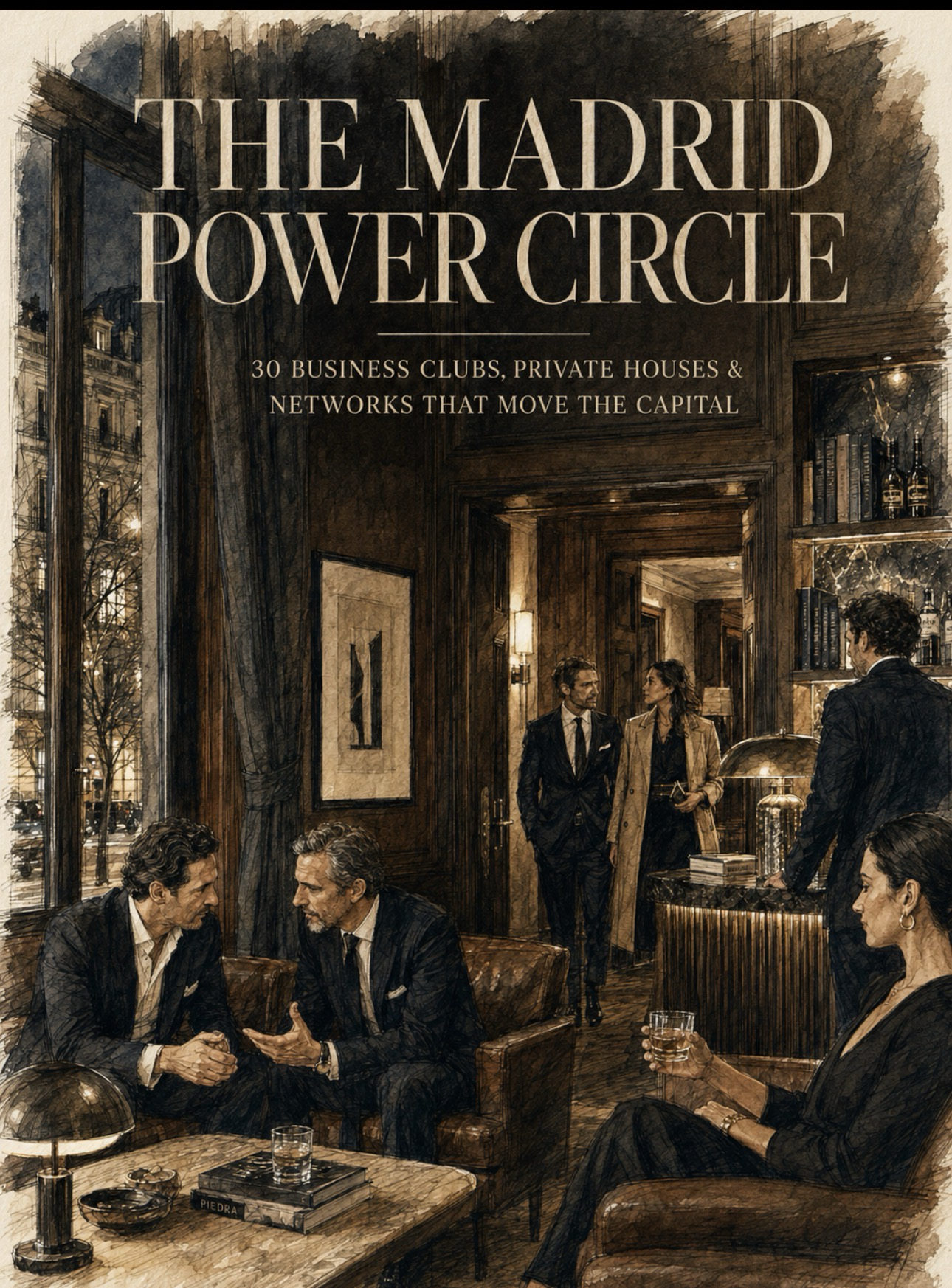
THE MADRID
POWER CIRCLE
30 BUSINESS CLUBS, PRIVATE HOUSES
& NETWORKS THAT MOVE THE CAPITAL
Madrid does not simply open doors.
First, it watches how beautifully you knock.
Madrid, Darling — Who Do You Know?
Madrid has always been very good at entrances. The city knows how to make one through a marble lobby, across a rooftop at sunset, down the staircase of a nineteenth-century palace or with nothing more dramatic than a friend leaning across lunch and saying: “You two must meet.” It is a capital with impeccable social instincts. The martini may be cold, the summer pavement may still be warm at midnight, and somewhere between the first coffee and the third introduction a newcomer suddenly realises that Madrid is no longer a place they are visiting. It has started to feel like theirs.
Of course, Madrid has never needed a members-only trend to understand the power of belonging. Long before somebody placed a velvet rope beside a beautifully restored doorway, the city was organised through circles: family, school, university, profession, golf, riding, chambers of commerce and the wonderfully Spanish institution of the long lunch. The old networks did not advertise. They reproduced themselves quietly, through trust and recommendation, while the rest of the city wondered how everybody at the table appeared to know one another’s parents.
Now Madrid is adding a dazzling new layer. Forbes has opened its first private club in the world here. Club Metrópolis has transformed one of the capital’s most photographed buildings into an entire members’ universe. Vega has made discretion — and the absence of mobile phones — part of its seduction. Soho House is preparing its arrival. Club Matador continues to prove that culture can be more attractive than celebrity, while Alma gives Madrid’s professional women a private house designed with them at the centre rather than politely added to the guest list.
But this is not a ranking of expensive upholstery. The most important room is not automatically the room with the longest waiting list, and exclusivity without chemistry is simply a very costly silence. The Expat Press Club has selected thirty circles because Madrid’s influence lives in several worlds at once: private houses, executive associations, international chambers, founder forums, alumni networks and the country clubs of La Moraleja and Puerta de Hierro. Some will welcome a newcomer quickly. Others may take a generation. All reveal something about how the capital connects.
So consider this your invitation — not necessarily to join all thirty, which would require the diary of a diplomat and the stamina of a polo pony, but to understand them. Because in Madrid, business rarely begins with a pitch. It begins with proximity, repeats itself through familiarity and becomes possible when someone trusted decides that you belong in the conversation. Vamos. The city is expecting us.
The New Private Houses
The new Madrid club does not want to be merely a room. It wants to be your office before lunch, your dining room at eight, your cultural calendar, your concierge and occasionally the reason you do not go home until much later than planned. These are the houses giving Madrid its new members-only glamour.
Some are brand new, some have already become institutions and one is still preparing its entrance. All are competing for the same precious commodity: not wealth alone, but the right mixture of people.
1. Club Financiero Génova
THE CAPITAL’S CLASSIC BUSINESS ADDRESS, MODERNISED
For decades, Club Financiero Génova has been one of the names most closely associated with Madrid business society. Its spectacular rooftop, executive lunches, institutional programme and international network of reciprocal clubs keep it relevant, while its refreshed hospitality has made it less forbidding without erasing the members-only core. Jackets are still expected in the appropriate spaces; laptops and trainers are not the point. The club remains particularly strong for finance, professional services, diplomacy and established corporate Madrid.
2. Forbes House Madrid
THE MEDIA BRAND BECOMES A PHYSICAL POWER NETWORK
Forbes chose Madrid for its first private club anywhere in the world. The 2,000-square-metre house in Chamberí is designed for leaders from business, politics, media, culture and entrepreneurship, with work areas, private rooms, a rooftop, restaurant, wine cellar and an event forum. Admission is not based on a pretty Instagram profile: new candidates are expected to demonstrate achievement and receive endorsements. With corporate members including international luxury, finance and technology brands, Forbes House is one of Madrid’s clearest attempts to turn reputation into a curated community.
3. Club Metrópolis
MADRID’S MOST THEATRICAL NEW ARRIVAL
The emblematic Metrópolis building has reopened as a 6,000-square-metre private club, boutique hotel and gastronomic universe. Created by Grupo Paraguas, the complex combines members’ salons, seven dining concepts, a rooftop beneath the Winged Victory and more than 200 promised experiences each year. It reportedly reached 1,500 members before opening and moved to a waiting list. This is not a quiet coworking club; it is Madrid staging itself as an international capital of hospitality, culture and beautiful excess — con mucho gusto, naturally.
4. Vega Members Club
NO PHONES, NO PHOTOGRAPHS, PLENTY OF CURIOSITY
At Lagasca 88, Vega combines private workspaces, meeting rooms, gastronomy, wine and evening life under a strict promise of privacy. Developed within the Mabel Hospitality world associated with Manuel Campos Guallar and Cristiano Ronaldo, with Íñigo Onieva as an executive partner, the club has been among Madrid’s most discussed openings. Membership tiers reported in the press range from younger and annual categories to a founder level. The real test will be whether Vega’s carefully selected room becomes a lasting community rather than simply the season’s most photographed no-photo club.
5. Club Matador
CULTURE FIRST, CONVERSATION ALWAYS
Born from the spirit of Matador magazine, this club on Jorge Juan has grown into one of Madrid’s most distinctive private institutions. Around culture, wine, gastronomy, jazz, cinema, books and debate, it attracts members who value ideas as much as introductions. The club reports a waiting list and requires presentation by existing members. With approximately 2,500 members reported in 2026, it has achieved something rare: scale without losing its intellectual personality. It is where a filmmaker, winemaker, architect and entrepreneur can share a table without anybody needing to call it networking.
6. Club Alma Sensai
A PRIVATE HOUSE WITH A FEMALE POINT OF VIEW
Alma was created with professional and executive women at its centre, although selected men may also be admitted. Located in a palace-style house beside Retiro, it combines business, refined leisure, gastronomy and community. Individual, corporate and non-resident memberships make it particularly relevant for internationally mobile women. Alma’s importance is not merely that it is beautiful. It offers a female-led answer to Madrid’s old club tradition and a space where leadership, friendship and opportunity can coexist without women entering as guests in somebody else’s room.
7. Soho House Madrid — Coming Soon
THE GLOBAL CREATIVE CLUB PREPARES ITS MADRID CHAPTER
Soho House has been widely reported as preparing a Madrid opening in Las Salesas for late 2026. At the time of this article, Madrid does not yet appear on the brand’s official list of operating Houses, so it must be treated as forthcoming rather than open. Its arrival nevertheless matters. Soho House would bring a globally recognised creative-membership network into a city experiencing a luxury, cultural and international renaissance. The decisive question will be whether the Madrid House develops local character or simply imports a familiar global formula.
8. Nuevo Club
THE DISCREET OLD GUARD
Nuevo Club belongs to Madrid’s traditional private-club world: discreet, established and far less interested in publicity than the new generation of hospitality-led houses. It is regularly named alongside Club Financiero Génova when Madrid’s classic elite clubs are discussed. Precisely because public information is limited, it deserves careful reporting rather than invented detail. Its inclusion recognises a basic truth of the capital: some of the most influential circles are the least eager to explain themselves online.
9. Real Casino de Madrid
NEARLY TWO CENTURIES OF SOCIETY BENEATH ONE ROOF
The Real Casino de Madrid has almost 200 years of history at Alcalá 15. Its purpose combines members’ social life with artistic, literary, cultural, sporting and recreational activity. The institution offers access to sporting facilities and a reciprocal network of more than 270 clubs worldwide. Its grand interiors may appear ceremonial, but reciprocity and continuity give the club practical value for internationally connected members. This is Madrid before the phrase private members’ club became fashionable — and it remains very much alive.
10. Real Gran Peña
GRAN VÍA TRADITION SINCE 1869
Founded in 1869 and based at Gran Vía 2 since 1917, Real Gran Peña carries royal patronage, a historic library of more than 50,000 volumes, dining rooms and reciprocal relationships with distinguished clubs abroad. Its origins were military and aristocratic; its contemporary relevance lies in history, social continuity and international club correspondence. It is not designed for quick access or loud self-promotion. One belongs to understand a tradition, not merely to collect a rooftop.
Business, Capital & Leadership
Now we leave the velvet banquette and enter the rooms where the conversation becomes more explicit. Madrid’s business organisations may offer fewer candlelit photographs, but they connect companies, capital, policy and leadership with formidable efficiency.
These are the circles for founders who have already survived the first act, executives carrying real responsibility and companies that understand that influence is built through contribution as much as visibility.
11. Club567
AN ENTREPRENEURIAL CLUB WITH ITS OWN SUPPORT PHILOSOPHY
Club567 describes itself as a club of influential people and operates from Velázquez 27. It combines business services, a prestigious company address, advisory support, selected events and its distinctive mutual-support concept. Founded in 2009, it aims to connect entrepreneurs and professionals while promoting ethics, innovation and solidarity. It sits somewhere between business centre, membership community and relationship platform — useful precisely because members can seek both practical infrastructure and introductions.
12. Círculo de Empresarios
WHERE BUSINESS ENTERS THE NATIONAL DEBATE
Founded in 1977, Círculo de Empresarios is an independent business association and think tank rather than a hospitality club. Its members contribute to economic and social debate through publications, meetings and policy proposals focused on free enterprise and entrepreneurship. This is a power circle in the literal sense: less cocktails, more ideas capable of travelling into boardrooms and government. Any serious guide to Madrid influence that ignored it would be confusing décor with power.
13. Club Empresarial ICADE
ALUMNI CAPITAL WITH BOARDROOM REACH
Created by ICADE alumni and the university community, Club Empresarial ICADE has become a respected forum for executives and entrepreneurs. Its breakfasts, debates and annual dinners attract prominent CEOs and public figures; the 2026 calendar includes leaders from Coca-Cola, Banco Sabadell, Metrovacesa and other major companies. ICADE is one of Spain’s great relationship ecosystems, and this club gives that network a structured public life. For senior corporate access, it is exceptionally strong.
14. Club Cámara Madrid
THREE HUNDRED COMPANIES AND A VERY ACTIVE DIARY
Founded in 2015, Club Cámara Madrid celebrated its tenth anniversary with more than 300 members. In 2024 it reported more than 130 activities and over 5,000 participants, including corporate breakfasts, networking, business games and specialist forums. Member companies span dozens of sectors and represent enormous combined turnover. This is one of the most practical entries on the list: a large, active platform designed to turn the Chamber’s institutional reach into relationships, knowledge and business.
15. Madrid Foro Empresarial
THE REGION’S INDEPENDENT BUSINESS VOICE
Madrid Foro Empresarial brings together more than 375 associates and reported around 100 activities in 2024. Its working groups cover the economic questions shaping the region, while its stated values include independence, leadership, transparency and influence. The organisation is particularly useful for businesses that want not only contacts but a voice in Madrid’s development. It sits at the intersection of association, advocacy and executive community.
16. EO Madrid
FOUNDERS WHO HAVE ALREADY BUILT SOMETHING
Entrepreneurs’ Organization is a global peer network for established founders, and its Madrid chapter is deeply connected to the local entrepreneurial ecosystem. EO Madrid’s invitation-only Happy Hour gathers more than 200 founders, investors, accelerators and ecosystem leaders in a deliberately relaxed format. The formal EO experience is peer-led and confidential; the wider Happy Hour acts as an access point to the city’s start-up and scale-up world. For founders, this is one of Madrid’s most commercially alive rooms.
17. YPO Madrid
PEER TRUST AT CHIEF-EXECUTIVE LEVEL
YPO is built for chief executives who meet demanding leadership and company criteria. Its value is confidentiality: members discuss decisions, pressure, family, succession and growth with peers who understand the responsibility. Madrid’s YPO circle is consequently difficult to observe from outside, but highly relevant to any map of executive influence. It should be described with restraint. The power of YPO is not a public events calendar; it is the trust inside the forum.
18. CorporateConnections Madrid
THE RIGHT PEOPLE, DELIBERATELY SELECTED
CorporateConnections serves business owners and senior leaders through curated chapters, structured relationship-building and an international network. It is more exclusive and executive-focused than mass referral groups, with an emphasis on strategic opportunities and trusted introductions. For an entrepreneur seeking cross-border business rather than a stack of random cards, the Madrid chapter can offer a highly organised route into decision-maker relationships.
International Madrid
Madrid is not international because it serves brunch in English. It is international because thousands of people arrive with careers, families, languages and networks that stretch far beyond Spain — and then build new lives here.
The city’s chambers and international communities translate arrival into access. They explain, introduce and connect; at their best, they prevent the expat bubble from becoming a beautifully furnished island.
19. InterNations Madrid
THE CITY-SIZED COMMUNITY — AND CHRISTOPH’S STORY
InterNations Madrid is one of the capital’s largest international communities. Its current public page highlights 8–10 official events each month and more than 70 activity groups, all hosted by Ambassadors and Consuls. But statistics do not explain why it matters. People arrive alone, uncertain and professionally disconnected; a recurring community gives them friends, information, introductions and eventually a sense of home. At the centre of our feature is Christoph Markert, the familiar host and connector whose real subject is not events but belonging. The Expat Press Club approaches this story from experience: its founder Nina herself spent years as an InterNations Consul in Madrid and Sevilla.
20. American Club of Madrid
ENGLISH-SPEAKING BUSINESS WITH AN AMERICAN RHYTHM
Open to English-speaking individuals and companies of any nationality, the American Club of Madrid organises monthly happy hours, business lunches and American holiday celebrations. It offers a friendly bridge between professional networking and social integration, particularly for North American companies, diplomats, executives and internationally minded Madrileños. Its openness makes it a valuable first room for newcomers who want business conversation without navigating an opaque admissions culture.
21. British Chamber of Commerce in Spain — Madrid
A SERIOUS BILATERAL BUSINESS PLATFORM
The British Chamber connects British, Spanish and international companies through committees, policy discussion, reports and events. Madrid is central to its national activity. This is not an expat social club with a Union Jack at the bar; it is a commercial institution supporting cross-border relationships and corporate visibility. Its members and speakers offer EPC access to investment, professional services, technology, education and the post-Brexit reality of doing business between Spain and the United Kingdom.
22. German Chamber of Commerce for Spain — AHK
GERMAN STRUCTURE, SPANISH OPPORTUNITY
AHK Spain offers the disciplined infrastructure expected of a bilateral chamber: market entry, vocational training, member services, events and strong corporate relationships. In Madrid it also participates in European Business Drinks, bringing together members of several European chambers in a more relaxed environment. For German companies, German executives and Spanish businesses looking north, it is one of the most useful and credible networks in the capital.
23. La Chambre — Franco-Spanish Chamber


A POWERFUL FRANCO-MADRID BRIDGE
The Franco-Spanish Chamber links companies and professionals across one of Spain’s most important European commercial relationships. Its Madrid programme spans business services, sector activity, networking and institutional exchange. French executives are deeply embedded in Madrid’s corporate life, from luxury and retail to mobility, banking and energy. La Chambre gives that presence a structured community and offers excellent interview access for an EPC international-business edition.
24. Italian Chamber of Commerce and Industry for Spain
BUSINESS WITH UNMISTAKABLE SOCIAL INTELLIGENCE
The Italian Chamber supports Italian and Spanish companies through commercial services, events and bilateral connections. Madrid’s Italian professional community moves naturally between design, food, luxury, manufacturing, finance and culture. This chamber belongs in the list because it can connect formal business development with the relational style that makes southern European commerce work so well. Business, sì — but preferably not without lunch.
25. The European Chambers Circle
ONE DRINK, SEVERAL COUNTRIES, MANY INTRODUCTIONS
Madrid’s European Business Drinks bring together members of major European chambers, including the German Chamber and collaborating institutions. Rather than listing every national chamber as though its events existed in isolation, this circle recognises the cross-chamber room: executives from different markets meeting in one elegant, low-friction format. For an expat or internationally focused company, it can be more efficient than remaining inside a single nationality bubble.
26. Professional Women’s Network Madrid
LEADERSHIP, MENTORING AND VISIBILITY
PWN Madrid belongs to an international movement advancing gender-balanced leadership. Its value lies in professional development, mentoring, events and access to women across companies and sectors. In a capital with no shortage of accomplished female executives, a network that converts experience into mutual sponsorship is commercially and socially important. It also gives EPC a stronger leadership story than the predictable “women’s networking with prosecco” cliché.
27. IE Alumni and the IE Entrepreneurial Ecosystem
A GLOBAL BUSINESS-SCHOOL NETWORK EMBEDDED IN THE CITY
IE’s international alumni community is one of Madrid’s most powerful invisible infrastructures. Graduates move through entrepreneurship, consulting, finance, technology and family business across the world; events and venture activity repeatedly bring them back into contact. It is not a single private club, but it functions like a global passport in the capital. For newly arrived international executives, IE can provide professional density at a scale few conventional clubs can match.
La Moraleja & The Country-Club Circle
North of the centre, the rules become quieter. Nobody calls the first tee a networking platform, and the stable does not issue a thought-leadership newsletter. Yet Madrid’s sporting and family clubs remain among its most durable relationship systems.
Here, trust grows through repetition: the Saturday match, the children’s lesson, the tournament lunch, the familiar face seen across several seasons. Business is not the advertised activity. That is precisely why it can happen so naturally.
28. Real Club de la Puerta de Hierro
THE CLUB OF KINGS — AND THE DEFINITION OF INHERITED ACCESS
Founded in 1895, Puerta de Hierro is one of Spain’s most exclusive country clubs, with golf, polo, tennis, padel, riding and croquet. Admission has historically been extraordinarily restrictive and tied to existing membership families. It is therefore not a practical recommendation for an expat seeking Tuesday networking. It is included because it represents Madrid’s old social architecture: family, sport, reputation and access accumulated across generations.
29. Real Club La Moraleja
FOUR GOLF COURSES AND AN ENTIRE SOCIAL GEOGRAPHY
Founded in 1973, Real Club La Moraleja has four 18-hole golf courses, extensive racket facilities, croquet, pools, fitness and several clubhouses. With thousands of shareholders and facilities across Alcobendas and Algete, it is not merely a golf club; it is one of the social anchors of Madrid’s northern executive and family world. In La Moraleja, school, property, golf and business networks overlap. A relationship begun on Campo 1 can quietly travel far beyond sport.
30. The Madrid Country-Club Triangle
CLUB DE CAMPO, RSHECC AND RACE
The final entry is deliberately a circle rather than a single address. Real Club de Campo Villa de Madrid, Real Sociedad Hípica Española Club de Campo and the RACE sports complex form a powerful network of golf, riding, hockey, tennis, padel, family life and professional relationships. RSHECC dates to 1901; Club de Campo is woven into Madrid’s sporting history; RACE maintains reciprocal golf relationships including La Moraleja. None describes itself as a business club. That is precisely the point: in Madrid, business often follows the family calendar, the stable and the first tee.
After the Last Introduction
And so we arrive at the end of thirty doors — some open, some guarded, some reached only through a friend of a friend who has known your family since school. What becomes clear is that Madrid does not have one elite, one international community or one definition of belonging. It has layers, and the most interesting people move between them.
The founder at an EO gathering may also be an IE alumnus. The German executive at a chamber drink may spend Sundays at La Moraleja. The film producer at Club Matador may dine at Metrópolis, speak at Forbes House and still prefer the old-fashioned intimacy of a table where no one is trying to sell anything. Madrid’s real power is not locked inside a single club. It travels through the connections between clubs.
For someone new to the city, this is excellent news. You do not need an inherited surname, four memberships and a handicap of nine to begin. Start with one professional organisation that gives your work depth. Choose one international community that gives your life breadth. Then find one place — a cultural club, a sports circle, a regular breakfast or a table of friends — where you actually enjoy returning. The magic is in the return. Madrid notices consistency.
And please, do not network like a person who has just read a book about networking. Ask better questions. Remember names. Introduce people who should know one another without immediately calculating the commission. Stay for the conversation after the official conversation. In Spain, the useful part of lunch often begins precisely when somebody says they really must leave.
The newest clubs will continue to arrive. Their rooftops will become more spectacular, their admission committees more mysterious and their cocktails more architectural. Some will flourish; others will discover that chandeliers cannot manufacture community. The clubs that endure will be those that make their members feel recognised, useful and genuinely at home.
Because that is the final secret of the Madrid power circle: the greatest luxury is not gaining access to a room everyone wants to enter. It is walking into a very large city and finding a room where somebody is already pleased to see you. Buenas noches, Madrid. Save us a chair.
Selected Official Links and Reporting Sources
Membership conditions and opening status can change. Soho House Madrid is presented as forthcoming and should be rechecked immediately before publication.
MAGAZINE · BUSINESS · NETWORKING