

EXPAT PRESS CLUB presents SPAIN CITY INDEX 2026 MADRID


SPAIN CITY INDEX 2026
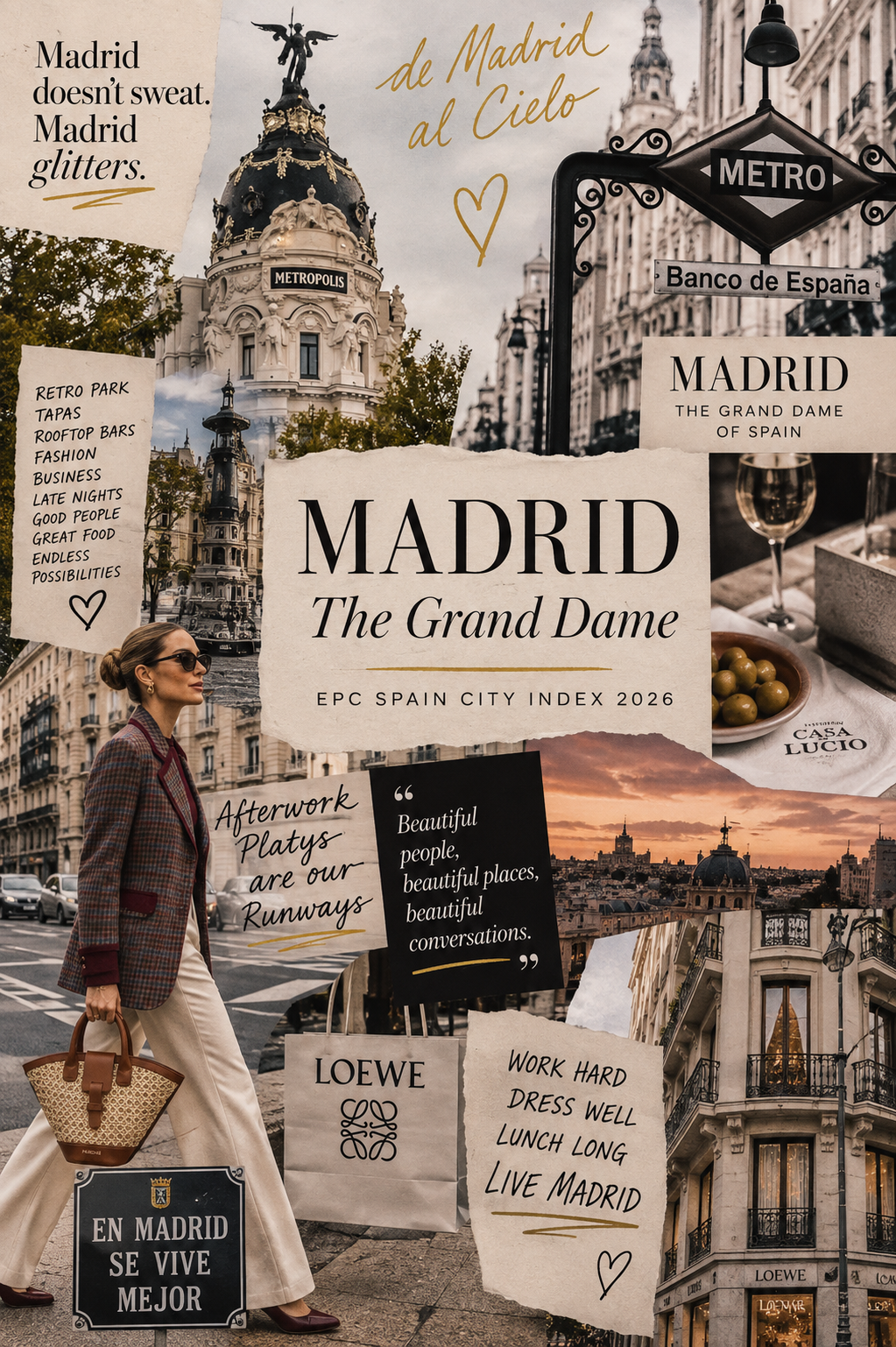
MADRID
THE GRAND DAME
SPAIN CITY INDEX 2026
“If Spain had a CEO, she would live in Madrid.”
Career ★★★★★ Food ★★★★★ Culture ★★★★★ Networking ★★★★★
International Life ★★★★★ Beach ☆☆☆☆☆
Madrid doesn’t need everyone to like her.
Madrid already knows she’s fabulous.
Spain’s capital is big, elegant, loud, sophisticated, occasionally arrogant, surprisingly relaxed — and these days, rather expensive. It’s the kind of city where investment bankers stride through Salamanca in the morning, business lunches somehow last three hours, and at 11:30 p.m. nobody has even begun to consider going home.
Madrid doesn’t sleep. Madrid occasionally takes a siesta.
And anyone who thinks Spain is mainly about beaches, sangría and flip-flops has clearly never spent more than a weekend here.
Because Madrid is a different kind of Spain. Spain in loafers.
DE MADRID AL CIELO
There’s a famous Madrileño saying: “De Madrid al cielo.” From Madrid to heaven. Because apparently, after Madrid, there’s only heaven left.
It sounds wonderfully self-important. Which is precisely why it suits Madrid so well.
Madrid has confidence. It doesn’t need to be Barcelona. It has no desire to imitate Marbella. It doesn’t require a beach, a marina or a row of beach clubs to attract people from all over the world.
Although, to be fair: a beach would be nice.
Would I miss it? I thought I would. And then Madrid introduced me to Casa de Campo, the Retiro, the Sierra around Madrid, long walks through the city and weekends that begin with absolutely no plan whatsoever.
Suddenly, the Mediterranean didn’t seem quite as urgently necessary. And should Mediterranean withdrawal symptoms become unbearable, Málaga is roughly two and a half hours away by high-speed train.
Madrid’s attitude towards the sea seems to be: Darling, you can visit it.
A PERSONAL NOTE: THE CITY I FELL FOR
There are cities you like. There are cities you admire. There are cities that are very nice for a long weekend.
And then there are cities that somehow recognise you before you have even properly introduced yourself.
For me, Madrid was one of those cities. I have rarely fallen in love with a place so quickly. And I have certainly rarely felt at home somewhere so fast.
Madrid and Sevilla are, for me, the two Spanish cities that have something almost impossible to explain rationally. Sevilla is another story — and she will get her own chapter.
But Madrid? Madrid was immediate. There was no lengthy courtship. No “let’s see how this develops.” Madrid and I basically skipped straight to the relationship.
Madrid is not simply somewhere you live. Madrid becomes part of your rhythm.
MADRID IN NUMBERS
Madrid isn’t simply the capital. It is Spain’s great metropolitan engine, and you can feel it — not necessarily because Madrid feels hectic, because surprisingly it often doesn’t, but because the possibilities seem almost endless.
From Salamanca to Chamberí, Chueca to Malasaña, Retiro to Chamartín, every neighbourhood seems to have its own personality.
The trouble starts when you try to rent one of them. Madrid is many things. A bargain is no longer one of them.
Housing has become one of the biggest challenges for newcomers, particularly in the most desirable central neighbourhoods. Fortunately, living in Salamanca is not compulsory.
Madrid’s excellent Metro, buses and Cercanías network mean you can live considerably farther out without feeling as though you have been exiled to another country. You can have the metropolis without necessarily having to live right in the middle of it.
CAREER: THIS IS WHERE SPAIN DOES BUSINESS
For international professionals, Madrid is arguably the most interesting city in Spain.
This is where major Spanish corporations, international companies, consultancies, technology businesses, banks, law firms, media groups, start-ups and European headquarters come together.
If you want to move to Spain without leaving your career at the airport, Madrid deserves serious consideration.
Major employers and corporate groups with a significant presence in the Madrid region include Spanish heavyweights such as Telefónica, Santander, BBVA, Repsol and Iberia/IAG, alongside international names including Google, Microsoft, Amazon/AWS, Meta, Salesforce and IBM, plus major professional-services firms such as Accenture, Deloitte, PwC, EY and KPMG.
For professionals working in tech, SaaS, consulting, finance, sales, marketing, legal services, aviation, pharmaceuticals and professional services, Madrid offers considerably more international opportunities than most Spanish coastal cities.
That doesn’t mean you can land your dream job without speaking a word of Spanish. But Madrid has something many smaller Spanish cities simply don’t: a significant number of companies where English is either a working language or an entirely normal part of professional life.
Madrid is where “I want to move to Spain” and “I still have a career” can actually coexist.
AND THEN THERE ARE THE START-UPS
One of the things Madrid taught me personally was to reconsider a few lazy clichés about Spanish business culture.
Because Madrid can work. And when Madrid works, it works extremely well.
There is precision here. Ambition. Young companies. Smart founders. International teams. People building things rather than merely talking about building things.
The start-up world gives Madrid another layer beyond the traditional banks, corporations and consultancies. There is a generation of founders and professionals who are Spanish, international, highly educated and completely comfortable moving between Madrid, London, Berlin, Miami, Paris and New York.
Modern Madrid isn’t trying to decide whether it wants to be traditionally Spanish or globally ambitious. It has decided to be both.
THE NETWORK
And then there is perhaps Madrid’s greatest advantage for expats: people.
You can meet almost anyone here. Entrepreneurs. Diplomats. Journalists. Bankers. Students. Lawyers. Creatives. Expats. Founders. Executives.
People who arrived last Tuesday. And people who have been saying for the past twenty years that they’ll “probably move back home one day.”
International chambers of commerce, alumni networks, business associations, expat communities, networking events, start-up gatherings, business schools and private clubs make Madrid a relatively easy city in which to start building a new circle.
A beautiful apartment is lovely. People make a city home.
BUSINESS SCHOOL CAPITAL
Madrid also has another major advantage that expat rankings sometimes underestimate: education attracts international people.
Internationally recognised institutions such as IE University and IE Business School, alongside numerous other international university and executive programmes, bring students, MBA candidates, executives, entrepreneurs and future business leaders to Madrid from all over the world.
And they don’t all leave after graduation. Madrid’s international community is constantly renewing itself. That gives the city something money can’t buy: energy.
But it also creates something else: a remarkably educated social scene.
You meet people who have lived in three countries, speak several languages, have studied abroad, started businesses, changed careers, moved continents and still somehow have enough energy left to meet you for a drink on a Thursday night.
LET’S TALK ABOUT THE PEOPLE
Madrid has an outrageous number of beautiful people.
There. I said it.
There are cities where an after-work drink looks like an after-work drink. And then there is Madrid, where occasionally you walk into an after-work event and wonder whether someone forgot to tell you it was actually casting night at Fashion Week.
The women are beautiful. The men are beautiful. Everyone appears to have found a good hairdresser. Even the person ordering a caña next to you somehow looks suspiciously well put together.
But what makes Madrid attractive isn’t simply appearance. It is the combination: beautiful, educated, intelligent, curious, international people. People who have something to say. People who have careers. People who read. People who travel.
People who know how to dress for dinner without looking as though they spent four hours trying to dress for dinner.
Madrid does effortless remarkably well.
And yes, of course there are exceptions. This is a city, not a Ralph Lauren campaign. But some Thursday evenings in Salamanca come dangerously close.
AFTER WORK — MADRID’S SECOND SHIFT
In some cities, after work means going home. Madrid finds this concept confusing.
At around 7 p.m., something happens. Laptops close. Jackets stay on. Lipstick gets reapplied. And the second shift begins.
Salamanca, Jorge Juan, Serrano, Chamberí, Castellana — terraces start filling up, glasses appear and the line between “one quick drink after the office” and “why is it suddenly midnight?” becomes dangerously thin.
The after-work parties sometimes look like runways.
Madrid understands something rather civilised: your working day ending does not mean your day has ended.
FASHION: MADRID KNOWS HOW TO DRESS
Fashion in Madrid deserves far more attention internationally than it gets.
Barcelona gets a lot of the creative-city headlines. Madrid quietly gets dressed. And very well.
Spain has produced globally recognised fashion names, but Madrid’s fashion identity is bigger than the famous labels. It is the boutiques. The ateliers. The independent designers. The tiny stores you discover by accident.
It is the impeccably dressed older woman walking her dog in Salamanca. The man wearing a navy blazer at 35 degrees and somehow not looking ridiculous. The young founder combining trainers with tailoring. The fashion editors. The PR people. The stylists. The old families. The new money. The international crowd. And the people who simply understand clothes.
Serrano and Ortega y Gasset deliver the international luxury houses, while streets such as Jorge Juan mix Spanish and international fashion with restaurants and social life.
Then there is Madrid Fashion Week and the wider ecosystem of designers, young labels, showrooms and ateliers around it. Madrid deserves its own EPC fashion chapter — and it will get one.
Madrid isn’t just somewhere you shop. Madrid teaches you to look.
FAMILY BUSINESS
Madrid is also one of Spain’s strongest options for international families.
The choice of international schools is extensive. American, British, German, French and bilingual education options mean international families have far more choice than in many smaller Spanish cities.
For international families, that means something important: moving to Madrid doesn’t necessarily mean reinventing your children’s entire education.
LET’S TALK ABOUT FOOD
Now we get serious. Food.
Anyone who thinks Madrid is just jamón, tortilla and bocadillos de calamares urgently needs a reservation.
Madrid’s gastronomic power isn’t really about Michelin stars, although there are plenty of those. It’s about contrast.
Traditional tortilla today. Japanese omakase tomorrow. Mercado for lunch. Fine dining for dinner. Cocido Madrileño on Sunday. Detox on Monday. Jamón again on Tuesday.
Madrid understands balance.
And restaurants aren’t simply places to eat here. They are part of the city’s social architecture.
Deals are discussed over lunch. Friendships happen over dinner. Dates become relationships. Relationships occasionally become disasters. And the waiter has probably seen the entire thing before.
Madrid may not have the omnipresent Andalusian tapas culture where an evening develops spontaneously by wandering from bar to bar. Instead, it gives you almost the entire culinary world.
THE CITY THAT EATS AT 11 PM
If you’re wandering around Madrid at 6 p.m. hoping for a romantic dinner, you may discover that the restaurant staff are still having coffee.
Madrid operates on Madrid time. Lunch is late. Dinner is later. Drinks are later still.
And eventually, you’ll find yourself at 1:17 a.m. on a Wednesday discussing property prices, relationships and the best tortilla in Madrid with people you didn’t know three hours earlier.
Congratulations. You live here now.
RETIRO. RETIRO. AND RETIRO AGAIN.
There are parks. And then there is the Retiro.
I could write an entire love letter to this place. Actually, I probably should.
The Retiro is not simply Madrid’s green lung. It is Madrid’s living room.
Morning runners. Elegant older couples. Children. Dogs. People reading. People kissing. People pretending not to watch other people kissing. Musicians. Rowing boats. Coffee. Long walks. No destination required.
And that last part matters. Because one of Madrid’s greatest luxuries costs absolutely nothing: walking.
Just walking through Madrid. No museum ticket. No reservation. No itinerary. Walk through Retiro. Walk down Serrano. Cross towards Chueca. Get lost in Chamberí. Find a café. Change your plan. Walk again.
Madrid rewards curiosity.
THE CITY THAT KEEPS REINVENTING ITSELF
This may be what I love most. Madrid never feels finished.
A restaurant closes. Three open. A forgotten street becomes interesting. A neighbourhood changes. A new generation of designers appears. A new founder launches something. A hotel opens. A rooftop becomes the new place everyone suddenly knows about.
And six months later, Madrid has moved on again.
Madrid doesn’t chase relevance. It generates it.
You can leave for a year, come back and recognise everything — while simultaneously discovering an entirely new city. That is a rare quality.
CASA DE CAMPO — WHO NEEDS A BEACH?
And then there is Casa de Campo.
Madrid’s enormous green escape is one of the reasons I eventually stopped complaining quite so much about the absence of the sea. Quite so much.
Because Madrid gives you space. Casa de Campo, Madrid Río, Retiro and the mountains beyond the city mean nature is never as far away as outsiders imagine.
The Sierra de Guadarrama gives you hiking, villages, mountains and even winter snow.
So yes: Madrid has no beach. Madrid will survive. And probably so will you.
Besides, if you absolutely need salt water, Málaga is only a high-speed train away.
GETTING AROUND
Another area where Madrid makes life surprisingly easy: you really don’t need a car.
Metro. Buses. Cercanías. High-speed rail. Airport.
Madrid connects Spain extraordinarily well.
Barcelona? Train. Sevilla? Train. Málaga? Train. Valencia? Train. A weekend somewhere else in Europe? Airport.
Madrid isn’t just a city. Madrid is a hub.
And once you get used to that level of connectivity, it becomes surprisingly difficult to give up.
SAFE — BUT STILL A CAPITAL
For a metropolis of its size, Madrid often feels remarkably comfortable and safe.
Of course normal big-city rules apply. Keep an eye on your belongings. Use common sense at night. Do not leave your phone on a café table and expect divine intervention.
Big-city energy without permanent big-city anxiety.
MADRID SOCIETY: WHO’S WHO?
Madrid naturally has its own universe of wealth, fame, influence and exceptionally good sunglasses.
Politics. Business. Football. Cinema. Fashion. Media. Old families. New fortunes. International arrivals.
Salamanca remains one of the great addresses for elegant city life, while La Moraleja and La Finca represent another Madrid entirely: privacy, villas, international schools, footballers, entrepreneurs, media personalities and some of Spain’s most affluent residents.
International stars, Spanish actors, designers, chefs, footballers, entrepreneurs, media personalities and society names all form part of the capital’s social ecosystem.
But celebrity Madrid deserves more than a paragraph.
COMING SOON: WHO’S WHO MADRID
The people shaping the capital — and the people everyone is talking about.
Because in Madrid, knowing where to go is useful. Knowing who’s there is even more interesting.
MADRID THROUGH THE SEASONS
Too Hot. Too Cold. Absolutely Fabulous.
And then there is the weather.
Let’s not romanticise everything.
Madrid in summer is hot.
Not cute Mediterranean hot. Not “let’s have another glass of rosé on the terrace” hot.
Madrid in July and August can be seriously, spectacularly, what-were-we-thinking hot.
But then again: who is actually in Madrid in August?
Half the city seems to have disappeared. The Madrileños have escaped to Galicia, Asturias, Cádiz, Mallorca, Marbella, the Basque Country or wherever somebody has wisely installed a swimming pool.
The streets become quieter. WhatsApp messages receive suspiciously slow replies. Your favourite restaurant may suddenly display a little sign informing you that everyone has gone on holiday.
Madrid collectively seems to say: Darling, it’s August. Why are you still here?
And if you are still there? Somehow Madrid still manages to make something of it. Because Madrid always does.
There is a rooftop. There is a pool. There is a hotel terrace. There is an exhibition. There is a ridiculously good restaurant with industrial-strength air conditioning. There is somebody who knows somebody who has discovered somewhere fabulous.
Madrid has a remarkable ability to turn inconvenience into an invitation.
MADRID DOESN’T SWEAT
This may be scientifically inaccurate. But spiritually, I stand by it.
Madrid doesn’t sweat. Madrid glitters.
There is something about the city that makes even ordinary life feel slightly more glamorous than it has any right to.
You don’t simply have an after-work drink. You somehow end up on a rooftop. You don’t simply meet a friend for dinner. Someone knows a new restaurant. You don’t simply go shopping. You accidentally discover a designer.
You don’t simply have a Tuesday. You have a Madrid Tuesday.
This isn’t Marbella-style glamour. There are fewer Lamborghinis announcing their arrival. Less obvious performance.
Madrid’s glamour is quieter. A beautifully cut jacket. A perfect white shirt. A woman in her seventies who looks more elegant walking her dog than most of us do going to dinner. An old restaurant with immaculate service. A tiny bar where everybody somehow looks interesting.
Madrid doesn’t need to shout. Madrid knows.
AND THEN WINTER ARRIVES
And this is where Madrid performs another little trick.
Because Madrid in winter is cold. Properly cold. The kind of cold that makes newcomers who moved to “sunny Spain” stare accusingly at their weather app.
Yes, this is Spain. Yes, you need a coat. Possibly gloves. Stop arguing.
Madrid sits high above sea level and winter nights can be genuinely chilly.
But here’s the problem: Madrid looks fabulous in winter.
Perhaps even more fabulous than in summer. Because then the lights come on.
MADRID AT CHRISTMAS
If you have never experienced Madrid at Christmas, put it on the list.
The streets glow. Gran Vía sparkles. Serrano dresses for the occasion. Shop windows become little theatres. Hotels transform themselves. Restaurants become warmer.
The city fills with Christmas lights, markets, beautifully decorated façades and people wrapped in coats walking beneath thousands of tiny lights.
And suddenly the cold makes sense.
Because Christmas shouldn’t really be 22 degrees. Christmas needs coats. Christmas needs scarves. Christmas needs cold hands wrapped around something warm.
And preferably Champagne afterwards. Madrid understands this.
ICE SKATING & CHAMPAGNE
There is something gloriously unnecessary about winter in Madrid.
You might go ice skating. You might wander through a Christmas market. You might meet someone for Champagne on a rooftop wrapped in a coat and wonder why sitting outside in December suddenly seems like a perfectly sensible decision.
There are terraces with heaters. Hotels with winter gardens. Beautiful restaurants where you disappear from the cold into warm lighting, heavy curtains and rooms that make you want to stay for another bottle.
There are fireplaces. Long lunches. Late dinners. Coats thrown over the back of chairs. That wonderful moment when you step inside from the cold and the entire restaurant seems to glow.
Madrid in winter knows how to seduce you.
Summer says: “Go away. Have a holiday.”
Winter says: “Come inside. Stay awhile.”
MADRID IS CHRISTMAS
Some cities decorate for Christmas. Madrid seems to become Christmas.
The lights. The cold. The elegance. The streets. The restaurants. The rooftops. The people dressed properly again. The shops. The anticipation.
That slightly ridiculous but wonderful feeling that everybody suddenly has somewhere beautiful to go.
Madrid is magic at Christmas. Madrid is sparkle. Madrid is glitter.
But never cheap glitter. Madrid is the good glitter.
The sort that somehow belongs on a black cashmere coat.
THE QUIET GLAMOUR
Perhaps this is the thing I find hardest to explain about Madrid.
It is glamorous without constantly telling you that it is glamorous. And that is an enormous difference.
Madrid is Spanish. Deeply Spanish. But it is also stylish. Classical. Cosmopolitan. Educated. Confident.
There is old money and new ambition. Tradition and start-ups. Family names and people who arrived with one suitcase and built something extraordinary.
There are grand apartments and tiny neighbourhood bars. Five-star hotels and places where the waiter has known every customer for thirty years.
It is polished without becoming sterile. And elegant without becoming boring.
A LITTLE BIT OF HAMBURG IN MADRID
Perhaps I recognise this because I come from Hamburg.
And I have to admit something: Madrid sometimes reminds me of Hamburg.
Not visually. Obviously. Nobody has secretly moved the Alster to Retiro. And Hamburg would probably file an official complaint about Madrid’s August temperatures.
But there is something else. An attitude. A certain understated elegance. That idea that quality doesn’t need a giant sign above it. That real style can be quiet.
Hamburg has always understood that. And Madrid does too.
There is something beautifully restrained about both cities underneath all their differences. Good clothes without screaming labels. Beautiful homes without needing to explain themselves. Excellent restaurants where service matters. People who can be successful without introducing themselves by their job title.
Northern elegance. Southern blood.
That is perhaps the magic combination.
UNEXCITEDLY EXCITING
Madrid has this wonderful contradiction.

It is exciting without constantly trying to prove that something exciting is happening.
Madrid is unexcitedly exciting.
There is always something happening. A restaurant opening. An exhibition. A designer. A dinner. A business idea. A new hotel. A new bar. A conversation. A person you unexpectedly meet.
But Madrid rarely jumps up and down shouting: LOOK AT ME!
Madrid simply gets on with it.
MADRID CAN DO THINGS
Madrid isn’t just talk. Madrid can do things.
Madrid has substance. Madrid works.
People create businesses here. They build companies. They design clothes. They run restaurants. They develop ideas. They study. They work hard. They organise. They execute.
They create beautiful things and, remarkably often, they create them extremely well.
That was one of the lessons Madrid taught me. It challenged some of the clichés people still carry around about working in Spain.
Because behind the lunches and terraces and late dinners, there is another Madrid.
A very serious Madrid. A precise Madrid. An ambitious Madrid. A professional Madrid. A Madrid that gets things done.
The start-up scene demonstrates it. The fashion industry demonstrates it. The restaurants demonstrate it. The hotels demonstrate it. The business schools demonstrate it. The major companies demonstrate it.
Madrid knows how to enjoy life. But don’t confuse that with not knowing how to work. Quite the opposite.
Perhaps Madrid’s greatest talent is understanding that the two don’t have to cancel each other out.
You can work hard. Dress beautifully. Build something. Have lunch. Be ambitious. Meet friends. Fall in love. Start again. Drink Champagne on a rooftop in December. And still be at your desk the next morning.
Madrid can do both.
THAT IS THE GLITTER OF MADRID
Not the lights. Not the Champagne. Not the beautiful people. Not the clothes. Not even Christmas.
The real glitter of Madrid is something else.
Possibility.
The feeling that something might happen. That you might meet someone. Discover something. Build something. Change something. That an ordinary Wednesday can suddenly become memorable.
And perhaps that is why Madrid gets under your skin.
It doesn’t demand that you constantly be entertained. It simply gives you an extraordinary number of opportunities to be alive.
BUT WHAT’S THE CATCH?
Madrid is expensive.
Summer can be brutally hot.
Winter is surprisingly cold.
The housing market can test your patience.
The city is enormous.
And no: there is still no bloody beach.
Do I care? Sometimes. Do I care enough not to live there? Absolutely not.
Madrid isn’t selling you a permanent holiday. Madrid is selling possibilities.
WHO SHOULD MOVE TO MADRID?
YES — if you want to build a career, meet international people, love culture, fashion and gastronomy, need excellent international schools or simply want a city that keeps giving you reasons to leave the house.
YES — if you enjoy beautiful things without needing everything to feel like a resort.
YES — if you want Spanish life without giving up international ambition.
MAYBE — if you’re looking for silence, cheap rent and a small-town atmosphere.
NO — if your only criterion is: “How many minutes can I walk to the beach?”
Then we need to talk. About Málaga.
THE EPC SCORE
|
Career |
★★★★★ |
|
International Jobs |
★★★★★ |
|
Networking |
★★★★★ |
|
Expat Community |
★★★★★ |
|
People Watching |
★★★★★ |
|
Fashion |
★★★★★ |
|
Gastronomy |
★★★★★ |
|
Culture |
★★★★★ |
|
International Schools |
★★★★★ |
|
Public Transport |
★★★★★ |
|
Safety |
★★★★☆ |
|
Nightlife & Afterwork |
★★★★★ |
|
Nature |
★★★★☆ |
|
Spanish Soul |
★★★★★ |
|
Affordability |
★★☆☆☆ |
|
Beach |
☆☆☆☆☆ |
|
Falling in Love With the City |
★★★★★+ |
THE EXPAT PRESS CLUB VERDICT
I have lived in and fallen for more than one Spanish city.
But Madrid is different.
For me, Madrid is simply one of the most beautiful cities in the world.
Not because it has one perfect monument. Not because it has the Mediterranean. Not because somebody decided it belongs on a list.
It is the whole thing.
The food. The fashion. The people. The conversations. The intelligence. The ambition. The restaurants. The little shops. The architecture. The Metro. The start-ups. The ridiculous after-work evenings. The ability to walk for hours without needing a destination.
The Retiro. The Retiro. And the Retiro again.
Madrid made me feel at home faster than almost any city ever has. And perhaps that is the greatest compliment I can give a place.
It didn’t make me feel like an expat. It made me feel like I belonged.
Madrid is a city where you can arrive and start again without having to think smaller.
A city where career and pleasure don’t have to be opposites. Where intelligence can be sexy. Where elegance doesn’t necessarily mean stiffness. Where tradition and start-ups somehow occupy the same postcode.
Where you can spend an afternoon alone and never feel lonely. Where you can dress up for dinner simply because dinner deserves it.
Madrid can be exhausting. Madrid can be expensive. Madrid can be loud. Madrid can be impossibly hot. Madrid has no sea.
But boring? Never.
Would I recommend moving to Madrid? I wouldn’t hesitate.
Go.
Go for three months. Go for a year. Go for work. Go because you’re bored. Go because you need a new beginning. Go because you want to meet people. Go because you want to remember what it feels like to be excited by a city.
Just go.
Madrid doesn’t promise you an easier life. It promises you a bigger one.
MADRID — THE GRAND DAME OF SPAIN
Come for a weekend.
Stay for a year.
Complain about the rent.
Fall in love anyway.
And remember:
DE MADRID AL CIELO.
Because apparently, the only upgrade left is heaven.
And having lived there, I’m not entirely convinced heaven has better restaurants.
THE EXPAT PRESS CLUB • MADRID — THE GRAND DAME •