
OH, ESPAÑA! Spanish Logic. Beautiful Chaos: Spanish School System!


OH, ESPAÑA! Spanish Logic. Beautiful Chaos.
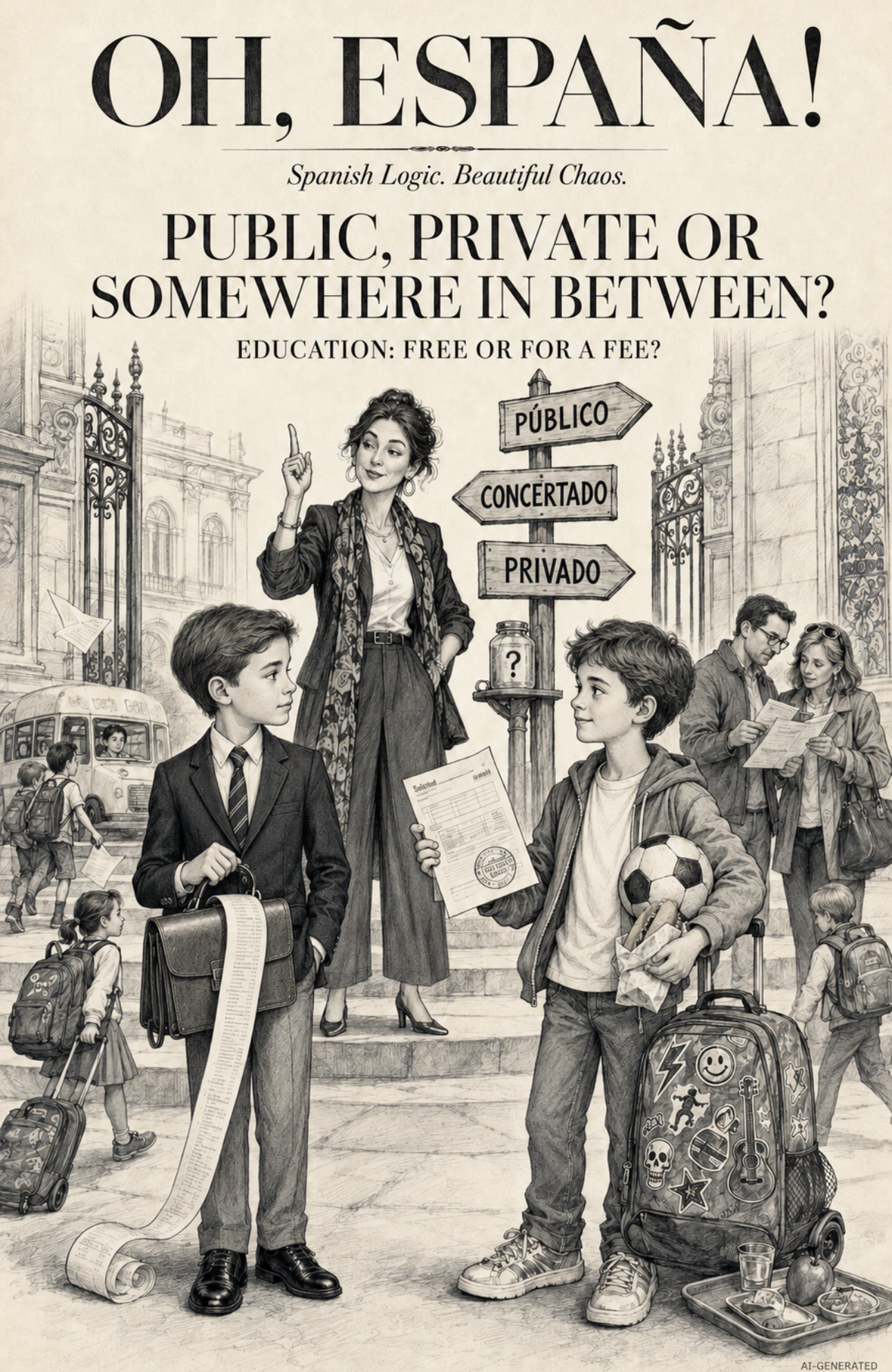
Public, Private or Somewhere in Between?
The Spanish School System, the Mystery of the Concertado — and Whether €20,000 a Year Really Makes a Child Cleverer
Families moving to Spain usually ask three questions.
First: Which is the best school?
Second: How much does it cost?
And third: Why is there a third kind of school between the free public school and the expensive private school — one that is privately owned, publicly funded, officially provides free core education and still manages to present parents with a list involving uniforms, lunch, tablets, excursions, extended hours and a “voluntary family contribution”?
Welcome to the Spanish school system.
At first sight, it appears wonderfully simple:
Público. Concertado. Privado.
Three words. Three choices. Todo claro.
Until you try to enrol an actual child.
Suddenly, there are catchment areas, points systems, sibling bonuses, language models, application periods, provisional lists, final lists and a document called the certificado de empadronamiento — which you naturally possess, but never in the exact version currently being requested.
Spanish Logic. Beautiful Chaos.
ONE COUNTRY, SEVENTEEN VERSIONS OF EDUCATION
The first thing international families need to understand is that Spain has a national education law, but it does not have one completely identical school system operating throughout the country.
The central government establishes the overall legal framework and the national minimum curriculum. Spain’s 17 autonomous communities then develop their own curricula, calendars, admission procedures, language policies and organisational details.
Under the current framework, national minimum teaching requirements account for at least 60 per cent of school hours in regions without a co-official language and 50 per cent in regions that have one. The autonomous communities and schools shape the remaining curriculum. The arrangement is explained by the Spanish Ministry of Education.
Asking “How does school work in Spain?” is therefore rather like asking:
“How do people cook in Spain?”
Well.
Not quite the same way in Galicia as in Sevilla. Not quite the same way in Barcelona as in Madrid. And certainly not the same way as at Abuela’s house.
Catalan plays a central role in education in Catalonia. Galician is taught in Galicia, Basque in the Basque Country and Valencian in the Comunitat Valenciana. There are also bilingual programmes, foreign schools and international curricula.
An expat family should therefore ask more than:
“Do they teach English?”
The more useful question is:
“In which language will the teacher explain that my child has failed mathematics?”
There is a difference.
THE SPANISH SCHOOL JOURNEY IN FIVE MINUTES
Educación Infantil: Birth to Six
Early childhood education is divided into two stages:
- First cycle: birth to three
- Second cycle: three to six
Infantil is voluntary. The second cycle, from three to six, is offered free of charge and attended by the great majority of children.
This is where pupils begin developing early language, number and social skills.
They also learn that every navy-blue jumper looks identical at collection time and that a yoghurt should never be opened after it has spent ten minutes being used as a maraca.
Educación Primaria: Six to Twelve
Primary education consists of six academic years. It is compulsory and free of charge.
Children generally enter the first year in the calendar year in which they turn six.
Core areas include Spanish language and literature, mathematics, natural and social sciences, a foreign language, art and physical education. Where applicable, pupils also study the regional co-official language.
The official national framework for Primaria is available through Educagob.
Educación Secundaria Obligatoria: Twelve to Sixteen
The four years of Educación Secundaria Obligatoria, universally known as ESO, complete compulsory education.
Subjects include Spanish language and literature, mathematics, geography, history, biology, physics, chemistry, technology, a foreign language, art and physical education. A co-official regional language may also form part of the curriculum.
Assessment is designed to be continuous and formative. Grades are expressed as Insuficiente, Suficiente, Bien, Notable or Sobresaliente.
In other words:
Insuficiente: We need to talk.
Suficiente: Technically alive.
Bien: Respectable.
Notable: Abuela tells the neighbours.
Sobresaliente: Abuela tells the entire province.
The official assessment framework is described by the Ministry of Education.
After ESO: Bachillerato or Formación Profesional
Compulsory schooling ends at sixteen.
Students can then enter the two-year Bachillerato, take vocational education through Formación Profesional, or follow another educational path.
Bachillerato prepares students for higher education and is offered in several academic specialisations, including Science and Technology, Humanities and Social Sciences, Arts and a General pathway.
Spain’s vocational system, generally known as FP, includes basic, intermediate and advanced programmes. It combines theoretical and practical learning across a wide range of professions. The Ministry provides an overview of Formación Profesional.
The Spanish system therefore does not lead along one single road towards university.
There are several exits.
Parents simply need three websites, two official appointments and possibly a cousin called Carmen to identify them all.
THE THREE GREAT SCHOOL WORLDS
1. COLEGIO PÚBLICO: THE PUBLIC SCHOOL
A public school is owned and managed by a public education authority.
Primary education and ESO are free. That does not mean an entire school year comes without costs.
Depending on the autonomous community, school and family circumstances, parents may still pay for:
- School meals
- Early-morning or afternoon care
- Materials
- Books or digital devices
- Excursions
- Extracurricular activities
- Transport in certain circumstances
Regions offer different grants, book-loan programmes and subsidies, so the actual cost varies.
A Spanish public school is not automatically a second-class option for families unable to afford something else.
Many public schools are excellent. They have committed teachers, strong leadership, effective support programmes and close links to their neighbourhoods.
Others are less impressive.
As in every country, the quality of a school depends on far more than its ownership. Leadership, teachers, resources, class composition, facilities, support services and the surrounding community all matter.
A public school can be brilliant.
A private school can be thoroughly average.
Marble in the entrance hall has never taught a child mathematics.
DO YOU HAVE TO APPLY TO A PUBLIC SCHOOL?
Yes.
Living opposite the school does not automatically guarantee admission to that particular school — even if the family can see the playground from its balcony and already knows precisely which child steals everyone else’s football.
Families submit an application during the period established by their autonomous community. They can usually list several schools in order of preference.
For Madrid’s 2026/27 admission process, families may identify their first-choice school and up to five additional publicly funded options. One application is submitted per child. The current process is set out by the Comunidad de Madrid.
In Andalucía, the ordinary application window for the 2026/27 year ran from 1 to 31 March. Families could list a preferred school plus up to four alternatives. When applications exceed available places, a points system is used. The Junta de Andalucía then publishes provisional scores, appeal periods and final allocation lists.
Admission criteria may include:
- Siblings already attending the school
- Proximity of the family home or a parent’s workplace
- Household income
- Disability
- Large-family or single-parent status
- Other regional or family circumstances
The precise scoring system differs between autonomous communities.
If several applicants finish with equal scores, a formal public lottery may be used.
This introduces a level of suspense usually reserved for the Spanish Christmas lottery.
Once a place has been offered, the family must complete the formal enrolment, known as the matrícula, within the designated period.
Application and enrolment are two separate stages.
The application says:
“We would like to come.”
The matrícula says:
“We are actually coming.”
Spanish administration appreciates a second act.
WHICH DOCUMENTS WILL YOU NEED?
The exact list depends on the region and the family’s situation. Common requirements include:
- Identity documents for the parents and child
- Birth certificate, Libro de Familia or an equivalent document
- Proof of local registration, or empadronamiento
- Previous school records
- Evidence supporting any points claimed
- Custody documents where applicable
- Additional health or administrative information requested during enrolment
Families arriving during the academic year do not have to wait until the following spring. The local education authority or school-admission office should assign an available place.
However, an available place is not necessarily a place at the famous school around the corner — the one that local parents have been discussing since the second ultrasound.
2. THE CONCERTADO: PRIVATE, PUBLIC AND UNIQUELY SPANISH
The colegio concertado is the school category that confuses international families most.
It is privately owned but publicly funded for specified educational stages. In exchange for that funding, it provides the education legally defined as free under the public agreement.
The Ministry defines concertados as private schools operating under the regulated system of conciertos educativos. The official distinction between public, concertado and private schools is explained by Educagob.
Many concertados were founded by religious orders, foundations or educational organisations. Some remain religious. Others are secular, bilingual or focused on a particular educational approach.
Some require uniforms.
Others do not.
Some have nuns.
Some have robotics laboratories.
Some manage to have both.
Admission to publicly funded places is subject to regulated procedures similar to those used by public schools. If demand exceeds supply, the official admissions criteria and points system apply.
The core publicly funded education cannot simply be priced in the same way as tuition at a fully private school.
Families may nevertheless pay for additional services such as:
- School lunch
- Extended hours
- Uniform
- Educational materials
- Digital platforms
- Additional language programmes
- Extracurricular activities
- Excursions
- Voluntary contributions
And this is where the famous conversation begins:
“The contribution is voluntary.”
“Do we have to pay it?”
“Of course not.”
“Does everyone pay it?”
A meaningful pause.
Families should request a complete written breakdown and ask which payments are compulsory, which are genuinely voluntary and which relate to services they have actively chosen.
A concertado can offer an excellent middle route: a regulated Spanish education, a distinctive school identity, sometimes longer hours and considerably lower costs than a fully private school.
But it is not automatically better than the local público.
Nor is it always as inexpensive as the phrase “publicly funded” might suggest.
Muy importante.
3. COLEGIO PRIVADO: THE PRIVATE SCHOOL
A fully private school is financed mainly through fees. It operates its own admissions process and may offer a distinctive educational, linguistic or international profile within the legal framework.
A private school is not necessarily an international school.
A Spanish private school may follow the national Spanish curriculum. An international school may offer a British, American, French, German or International Baccalaureate programme.
Some combine an international curriculum with compulsory Spanish subjects.
Private schools may establish their own application steps, including:
- Initial enquiry
- School visit
- Formal application
- Previous school reports
- Interview with the parents or child
- Age-appropriate assessment
- Language assessment
- Application or registration fee
- Formal acceptance of the place
International College Spain, for example, describes its 2026/27 process as an enquiry, school tour, formal application, supporting documents, application fee, assessment and final place offer.
With a public school, the family applies for a regulated school place.
At certain private schools, the entire family occasionally feels as though it is auditioning for a supporting role.
Different atmosphere.
HOW MUCH DOES A PRIVATE SCHOOL COST IN SPAIN?
The honest answer is:
Anywhere between manageable and breathtaking.
A traditional Spanish private school may cost approximately €6,000 to €10,000 per academic year.
International schools are often more expensive. Depending on the location, year group, curriculum and reputation, tuition frequently falls between roughly €9,000 and €22,000 per year.
Premium schools can charge €25,000 to €30,000 or more.
Current examples illustrate the range:
- The International School of Madrid charged approximately €6,225 to €14,475 per year in 2025/26, depending on the child’s age.
- The British Council School Madrid listed tuition of approximately €3,040 to €4,690 per term for most full-time year groups in 2025/26, plus other charges and a one-off new-student fee.
- St. George Madrid publishes standard 2026/27 annual fees ranging from €8,950 for Pre-Nursery to €19,440 for the IB Diploma years, with additional admission or re-enrolment charges. Its full table appears on the school’s official tuition-fee page.
- A growing number of premium schools in Madrid now exceed €20,000 per year.
These are examples, not a fixed national price list.
Madrid, Barcelona, Marbella, Sotogrande, Mallorca and other international centres may be more expensive than smaller Spanish cities.
And tuition is not always the final number.
Families may also encounter:
- Application fee
- One-off admission fee
- Annual re-enrolment fee
- Deposit
- School transport
- Lunch
- Uniform
- Books
- Laptop or tablet
- Examination fees
- Residential trips
- Sports and clubs
- Capital or infrastructure charges
The brochure may say €12,000.
The family bank account may eventually whisper €16,000.
With two children, it no longer whispers.
IS PRIVATE SCHOOL NECESSARY?
No.
A private school is not necessary for a child to receive a good education in Spain.
It may be useful.
That is a different statement.
The important question is not:
“Which school costs the most?”
It is:
“Which school suits this particular child and our real family life?”
WHEN A PUBLIC SCHOOL MAY BE THE BEST CHOICE
A public school may be ideal when:
- The family intends to remain in Spain long-term
- The child should become fully immersed in Spanish and local life
- The neighbourhood school has a good reputation and stable staff
- Integration matters more than remaining inside an international expat bubble
- The family does not require a particular foreign qualification
- The necessary language or educational support is available
- The school journey and daily timetable work well
Children do not only learn Spanish in a local school.

They learn birthdays, friendships, fiestas, family networks, local traditions and the subtle social codes of their new home.
That is genuine integration.
Not simply saying “Buenos días” to the baker.
WHEN A PRIVATE OR INTERNATIONAL SCHOOL MAY MAKE SENSE
A private or international school may be particularly useful when:
- The family expects to stay in Spain for only a few years
- The child must later return smoothly to another national system
- A particular qualification such as the IB or A Levels is required
- The child is entering Spain’s system at a difficult academic age
- A specific teaching language is essential
- Longer hours and school transport are necessary
- The school offers proven specialist support
- Its educational approach genuinely suits the child
A four-year-old may become fluent in Spanish with astonishing speed.
A fifteen-year-old arriving halfway through ESO, without Spanish and needing an international qualification two years later, faces a very different situation.
Age changes the decision.
Future plans change it too.
WHEN A CONCERTADO MAY BE THE ANSWER
A concertado can be attractive to families who want:
- A clearly defined school identity
- Uniform or a particular values-based approach
- Longer childcare hours
- A bilingual programme
- Lower costs than a fully private school
- Continued participation in the Spanish education system
Once again, however, the individual school matters more than the category.
Público, concertado and privado describe ownership and funding. They do not automatically describe teaching quality.
That is the most important sentence in this article.
Print it.
Laminate it.
Take it to the next school open day.
THE EXPAT TRAP: “INTERNATIONAL” DOES NOT ALWAYS MEAN INTERNATIONAL
A school may include “International”, “British”, “American” or “Bilingual” in its name.
Parents should still ask:
- Which curriculum is actually taught?
- Which qualifications do pupils receive?
- Is the school officially recognised?
- How much teaching genuinely takes place in English?
- Are teachers native or near-native speakers?
- How international is the pupil population?
- What is the staff turnover?
- What are the real class sizes?
- Which university routes are available?
- What happens if the child leaves Spain?
“Bilingual” may mean that a substantial part of the curriculum is delivered in English.
It may also mean that Science is taught in English on Wednesdays and the autumn festival features a sign saying Happy Pumpkin Day.
Preguntar no cuesta nada.
Not asking can become expensive.
SPECIAL EDUCATIONAL NEEDS: LOOK BEYOND THE BROCHURE
Families dealing with dyslexia, ADHD, autism, giftedness, physical disability, learning difficulties or limited Spanish should investigate support particularly carefully.
Spain’s legal framework requires education authorities to provide resources for pupils who need support beyond ordinary classroom provision.
According to the Ministry, more than 1.25 million students received some form of specific educational support during the 2024/25 school year.
That does not mean every individual school has identical specialists, staffing or experience.
Parents should ask directly:
- Which specialists work permanently at the school?
- Is there an educational counsellor?
- How is support delivered inside the classroom?
- How long does formal assessment take?
- Does the school have experience with the child’s particular needs?
- Is additional support included in the fee?
- Which therapies must be arranged privately?
- What happens when a newly arrived child speaks little or no Spanish?
A school that answers every question with “No problem” without asking a single detailed question about the child is not necessarily reassuring.
Sometimes “No problem” simply means:
“We will discuss the problem when it arrives.”
THE SCHOOL JOURNEY: THE MILLION-EURO QUESTION NOBODY ASKS
A prestigious school may be academically excellent.
If the child spends 70 minutes on a bus every morning and another 70 minutes returning home, elite education quickly becomes a transport company with homework.
Families should test the journey at the actual travel time.
Not on Sunday at eleven.
On Monday at eight.
In Madrid, a school may appear “very close” on a map while existing in another time zone during rush hour. Around Marbella and the Costa del Sol, a short distance can also become a daily emotional event.
The journey affects:
- Sleep
- Free time
- Sport
- Friendships
- Family life
- Parents’ working hours
- The atmosphere inside the car
A good nearby school may be better for a child than a famous school located beyond three roundabouts, two motorway junctions and one daily nervous breakdown.
TEN QUESTIONS TO ASK EVERY SCHOOL
- Which curriculum and qualifications does the school actually offer?
- Which languages are used for which subjects?
- What are the real class sizes?
- What is the full annual cost, including every additional fee?
- What early care, lunch and after-school services are available?
- How does the school support newly arrived children without Spanish?
- Which specialists support learning or developmental needs?
- How frequently do teachers leave?
- What does an ordinary Tuesday look like — not the open day?
- Where do pupils go after completing school?
Bonus question:
“May I speak to two parents whose children already attend?”
A good school will usually have no difficulty with that request.
A school that immediately begins talking about its new swimming pool may have a very beautiful swimming pool.
THE EPC VERDICT: THE BEST SCHOOL DOES NOT WEAR A PRICE TAG
Private schools are not automatically better.
Public schools are not automatically worse.
Concertados are not automatically the perfect compromise.
International schools are not automatically international.
The best school is the one where a particular child can learn well, build friendships, receive support and feel safe — and whose daily routine the family can realistically sustain.
Sometimes that is a public school five minutes from home.
Sometimes it is a traditional concertado.
Sometimes it is an international school offering the IB at a price that encourages the family dog to apply for a sports scholarship.
Parents should pay less attention to prestige and more attention to people.
How does the headteacher talk about children?
How do the pupils behave when nobody is presenting the school?
Are the teachers visible and approachable?
Does the administration provide clear answers?
How does the school respond when something goes wrong?
Does the building feel alive — or merely expensive?
A good school is not defined by how perfect it looks during the tour.
It is defined by what happens when life is not perfect.
Because children are not glossy brochures.
They forget books. They change. They need help. They argue. They grow. They spill tortilla inside the mathematics workbook.
A school should be prepared for all of it.
Its purpose is not to look impressive.
Its purpose is to guide a child through this wonderful, exhausting and unpredictable chaos.
OH, ESPAÑA!
Sometimes the best school is just around the corner.
You only need to discover when the application period ends.