
OH, ESPAÑA! Spanish Logic. Beautiful Chaos. BACK TO SCHOOL, SPANISH STYLE

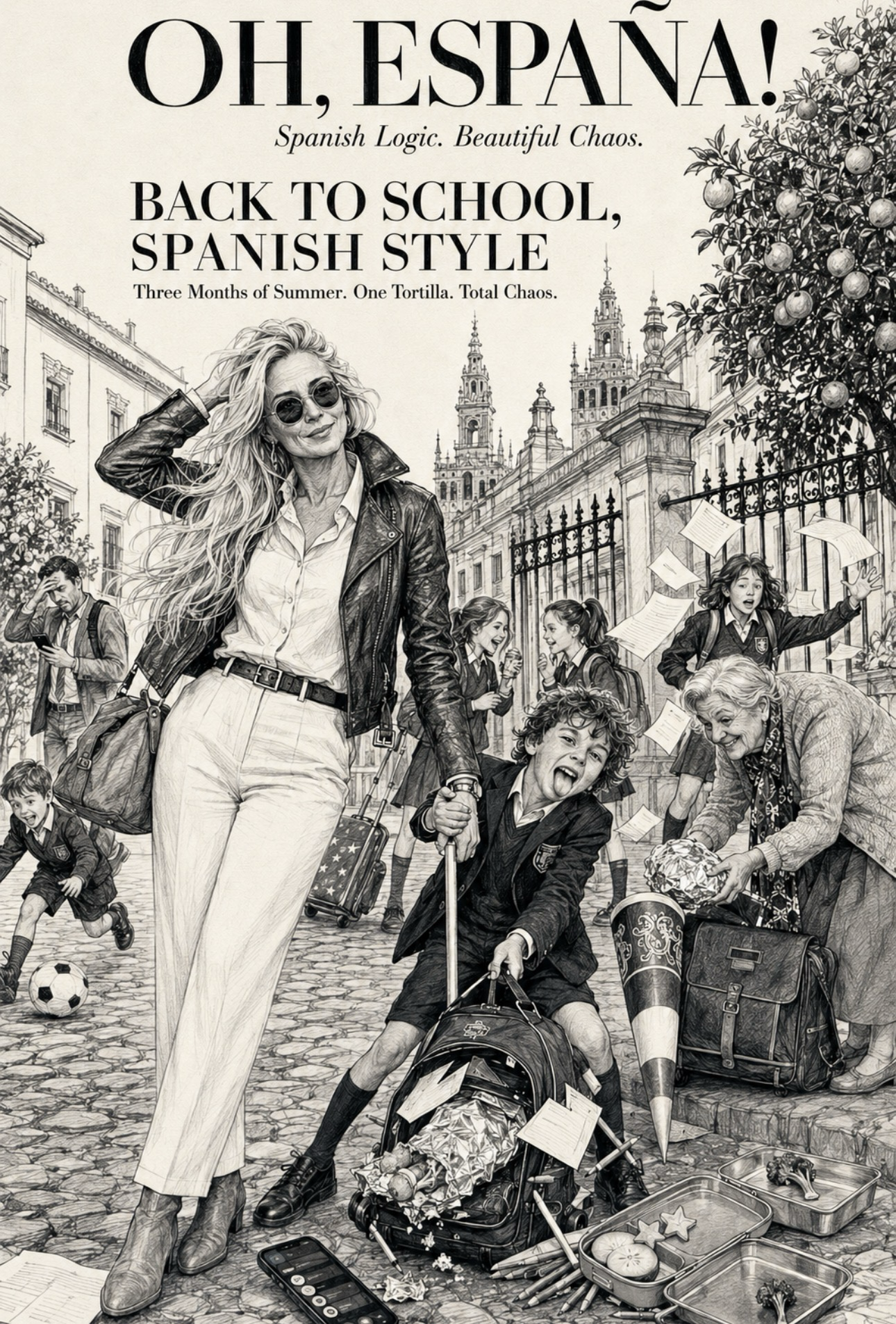

BACK TO SCHOOL, SPANISH STYLE
Three Months of Summer, 47 WhatsApp Messages and One Tortilla That Should Never Have Entered the Schoolbag
There are three unmistakable signs that summer is coming to an end in Spain.
First, the beach bar serves its final Tinto de Verano with a faint air of melancholy.
Second, parents begin standing in supermarket stationery aisles, staring helplessly at twelve almost identical exercise books while whispering:
“Cuadriculado five millimetres or four?”
And third, somewhere in Andalucía, an abuela quietly slips an enormous piece of tortilla into her grandchild’s schoolbag and delivers the most dangerous sentence of the Spanish school year:
“Por si tiene hambre.”
Just in case he gets hungry.
He will, of course, get hungry. But only after the tortilla has melted at 34 degrees, merged with the maths workbook and established a new autonomous community inside the pencil case.
Welcome to the Spanish Vuelta al Cole.
After almost three months of summer holidays, Spain’s children are finally returning to their classrooms. Parents are smiling again. Grandparents are breathing more freely. Teachers are preparing themselves emotionally. And the family WhatsApp chat has already exploded at 7.13 in the morning with one urgent question:
“Has anyone seen Mateo’s water bottle?”
Mateo owns three water bottles.
None of them is in the house.
THE GERMAN SCHOOLBAG: ENGINEERED FOR EDUCATION, WEATHER AND POSSIBLY SPACE TRAVEL
Let us begin with the schoolbag.
In Germany, buying a child’s first Schulranzen is not shopping. It is a strategic investment decision involving ergonomic consultation, professional fitting, reflective safety panels and a budget that, in some parts of Spain, might secure a perfectly respectable second-hand Seat Ibiza.
The German child enters a specialist shop and is assessed like a future astronaut.
“Please turn around, Emil.”
“How does the weight distribution feel?”
“Can you still move your arms?”
“Is your spine happy?”
The mother, father, grandmother, orthopaedic consultant and a sales assistant named Frau Krüger then discuss whether the “Space Commander Ultra Light” offers superior lumbar support to the “Dinosaur Power Ergonomic Plus”.
The final schoolbag has a chest strap, hip belt, waterproof cover, magnetic fastening system, four reflective safety zones and possibly a hidden emergency transmitter connected to the German coastguard.
It stands upright on the floor with the architectural confidence of a detached house in Lower Saxony.
In Spain, the situation is somewhat more relaxed.
Here, the mochila may sparkle, display the badge of Real Madrid, feature twelve Marvel superheroes or travel on little wheels behind the child. The wheeled versions work beautifully on polished floors and sound like an escaping toolbox when dragged across Seville’s cobbled streets.
The Spanish mochila rarely stands elegantly beside a desk. It lies sideways in the hallway.
On top of it: one football boot.
Underneath it: a parental authorisation form that should have been signed yesterday.
Inside it: three pens without lids, one bitten biscuit and a worksheet that “absolutely must” be handed in today.
When was the worksheet distributed?
“No sé.”
Who was supposed to sign it?
“Mamá.”
Why is Mamá finding out at 8.03 in the morning?
Silence.
International education. Lesson one.
THE SCHULTÜTE: A WONDERFUL GERMAN MYSTERY
The first day of school also reveals one of the most charming cultural differences between Germany and Spain.
In Germany, a child starting primary school receives a giant decorated cone called a Schultüte, filled with sweets, pencils, toys and parental optimism. It is often almost as large as the child and positioned so prominently in every family photograph that the new pupil can only be identified by a pair of small shoes appearing underneath it.
Spanish families observe this tradition with genuine fascination.
“So you give the child an enormous paper cone because from now on they have to get up early every morning?”
Yes.
“And there is chocolate inside?”
Also yes.
“Qué idea tan fantástica.”
Spain has no equivalent national Schultüte tradition. Instead, there may be new clothes, new shoes, a monumental stationery list and at least one female relative insisting that the child must look muy guapo on the first day.
The result is much the same: photographs, emotion, proud grandparents and a child who asks after seven minutes when it is allowed to go home.
WHEN DOES THE SERIOUS BUSINESS BEGIN?
Spain’s education system begins with Educación Infantil, covering children from birth to six years old. It is divided into two stages: zero to three and three to six.
Infantil is voluntary, although the second stage, from three to six, is offered free of charge and attended by a large proportion of children.
Compulsory education usually begins at six with Educación Primaria. Primary school lasts six academic years, generally taking pupils from six to twelve.
Then comes Educación Secundaria Obligatoria, better known as ESO, which normally covers ages twelve to sixteen. Education is compulsory between the ages of six and sixteen. After ESO, pupils may continue into Bachillerato, vocational training or other educational routes.
That is the straightforward part.
The less straightforward part begins when an international parent asks:
“So when exactly does school start?”
Spain does not have one single national school calendar.
Spain has 17 autonomous communities, different educational administrations, provincial arrangements, municipal holidays and schools with additional non-teaching days of their own.
It is a system designed to give foreign parents the reassuring impression that they have finally understood everything — until someone mentions a día no lectivo de libre disposición.
Suddenly, there is no school on Friday.
Why?
Because it is in the calendar.
Since when?
Since November.
Why did nobody know?
It was posted in the WhatsApp group.
Natürlich.
SPAIN DOES NOT GO BACK TO SCHOOL TOGETHER
The 2026/27 academic year begins on different dates depending on the autonomous community and educational stage.
Spanish law requires at least 175 teaching days for compulsory education. The precise calendar, however, is determined by each regional education authority.
In the Community of Madrid, Infantil, Primary and Special Education begin on 7 September 2026, while Secondary Education, Bachillerato and Vocational Training begin on 8 September.
In Andalucía, younger pupils are granted three more days in which to dismantle the family home. Infantil, Primary and Special Education start on 10 September 2026. ESO, Bachillerato, Vocational Training and several other stages begin on 15 September.
Catalonia, Valencia, the Basque Country, Galicia, the Balearic Islands, the Canary Islands and Spain’s other regions follow their own calendars. Christmas holidays, Easter breaks, regional celebrations, local fiestas and school-selected days may also vary.
The differences are not limited to dates.
Language plays a major role in several autonomous communities. Catalan is central to education in Catalonia, Galician is used in Galicia, Basque in the Basque Country and Valencian in the Comunitat Valenciana.
For an expat family, the language model of a school can therefore be one of the most important factors in choosing where a child will study.
Madrid says: “We begin on the seventh.”
Andalucía says: “Tranquila. The tenth is perfectly fine.”
The local fiesta says: “Nobody is beginning anything today.”
HOW LONG IS THE SPANISH SCHOOL DAY?
Here comes the answer most frequently encountered in Spanish administration:
It depends.
Many public primary schools follow a continuous day, known as a jornada continua, often running approximately from 9 a.m. until 2 p.m.
Other schools operate with a split timetable, including a long lunch break and classes in the afternoon. Private, concertado and international schools may have longer days, often continuing until 4 or 5 p.m.
And during September and June, some schools operate reduced hours.
Yes, exactly when working parents believe they have finally regained control of their lives.
A 2 p.m. finish does not necessarily mean that every child is standing outside the family home by 2.03. Depending on the school and region, families may have access to:
- Early-morning care, often called aula matinal
- The school dining service or comedor escolar
- Supervision after lunch
- Sports, music, languages and other actividades extraescolares
- Additional programmes organised by schools, municipalities, parent associations or private providers
With these services, a child may be at school from around 7.30 or 8 in the morning until 4, 5 or even later in the afternoon.
This sounds excellent.
Then the registration forms arrive.
Aula matinal: separate application.
Comedor: different online portal.
Football: external provider.
English club: new WhatsApp group.
Permission for Grandmother to collect the child: signed authorisation and identity document.
Permission for the father to collect the child: possibly also required, because after three months of summer nobody remembers what he looks like.
THE GERMAN PAUSENBROT: PRECISION ENGINEERING IN A LUNCHBOX
The German Pausenbrot is not merely a snack. It is an educational work of art.
Wholegrain bread. Cheese. Cucumber slices. Apple wedges. Everything placed in separate compartments inside a sophisticated lunchbox that contains more divisions than the European Commission.
Sometimes there is a little handwritten note:
“Good luck with maths! Mama loves you.”
The Spanish child, meanwhile, opens a piece of aluminium foil.
Inside: a bocadillo.
Bread. Jamón. Finished.
Depending on the family and the school, children may bring fruit, biscuits, a small juice, yoghurt or another snack for the morning break. Some schools make healthy-eating recommendations or assign particular fruit days.
But the carefully constructed German Pausenbrot, featuring cucumber stars, pepper hearts and grapes arranged according to colour, is less of a national institution in Spain.
During the morning recreo, the Spanish child eats, plays football and negotiates informal trades with impressive efficiency.
Lucía leaves home carrying one apple.
She returns with half a doughnut, two stickers, someone else’s hair clip and detailed information about the state of Mateo’s parents’ marriage.
Networking begins early.
OPERATION TORTILLA
And then there is Abuela.
Abuela does not consider an apple a meal.
She does not consider a cereal bar food.
And she certainly does not believe that one small sandwich provides enough nourishment for a child expected to survive until lunchtime.
So she prepares tortilla.
Not just any tortilla.
A proper tortilla with potatoes, eggs, perhaps onions, love and the approximate density of a paving stone.
“Only a small piece,” she says.
The small piece weighs 480 grams.
It is wrapped first in kitchen paper, then aluminium foil and finally placed inside a plastic bag. The packaging could probably survive a transatlantic flight.
It cannot survive a Spanish schoolbag.
On the way to school, the mochila is rolled, swung, dropped, kicked and briefly used as one of the goalposts in a football match.
By 11.20 a.m., the tortilla has abandoned its original shape.
By 12.05 p.m., the English workbook is involved.
By 1.30 p.m., the entire classroom smells like a tapas bar.
The teacher asks:
“¿Qué ha pasado aquí?”
The child answers truthfully:
“Mi abuela.”
The investigation ends immediately.
No proceedings are brought against Abuela.
Abuela has cultural immunity.
SCHOOL LUNCH: MEDITERRANEAN DIET MEETS SAD BROCCOLI
The Spanish comedor escolar is more than a canteen.
It provides lunch, supervision and a vital piece of the family’s daily logistics. Occasionally, it also provides a test of personal courage.
Many schools publish a monthly menu featuring pulses, vegetables, rice, pasta, fish, meat, salad and fruit — all theoretically inspired by the balanced Mediterranean diet.
On paper, it sounds delightful:
Lentejas con verduras.
Merluza al horno.
Ensalada variada.
Fruta de temporada.
In reality, the “seasonal fruit” may be an apple that appears to have been waiting for its moment since the previous government. The fish looks disappointed. The lentils have the colour of a motorway car park. And the mixed salad contains three leaves, two of which have already resigned.
Of course, not all Spanish school food is terrible.
Quality varies considerably between schools, regions, kitchens and catering providers. Some schools prepare fresh food on-site and serve genuinely excellent lunches. Others receive meals from external companies.
Allergies, intolerances and particular dietary requirements can usually be accommodated, but families must provide the necessary information and documentation in advance.
Children nevertheless tend to operate their own universal rating system:
Pasta: good.
Croquetas: excellent.
Fish: suspicious.
Broccoli: personal attack.
Lentils: acceptable only when Abuela is watching.
The German Pausenbrot sometimes returns home untouched.

The Spanish school lunch usually disappears, although nobody can say with complete confidence where it went.
PÚBLICO, CONCERTADO OR PRIVADO: THE GREAT SPANISH SCHOOL DECISION
Spain has three principal types of school.
The public school: Colegio público
Public schools are owned and managed by the education authorities. Tuition for the relevant educational stages is free, although families may still pay for materials, meals, excursions and additional services unless these are subsidised.
Admission is governed by regional rules and frequently involves a points system. Proximity to the school, siblings already enrolled, family circumstances and other criteria may all influence the application.
The Spanish school-points system is a combination of administration, mathematics and elite-level emotional sport.
Families calculate their chances with an intensity normally reserved for property purchases and Champions League tables.
The concertado school: Spain’s famous middle ground
A colegio concertado is privately managed but receives public funding for particular educational stages. It provides the teaching legally designated as free under the public-funding agreement.
Many concertados have a religious background, although not all do. Families may encounter additional payments for services, uniforms, meals, activities or voluntary contributions.
Parents should ask very clearly what is compulsory, what is voluntary and what costs extra.
The important question is therefore not:
“Is the school free?”
It is:
“What exactly does ‘free’ mean here?”
A useful lesson for life in Spain generally.
The private school: Colegio privado
Private schools are mainly funded through fees and develop their own educational identity within the legal framework. Spain also has a large number of international schools following British, American, French, German or international programmes.
Fees can range from “certainly noticeable” to “for this amount, the child could arrive every morning by private helicopter.”
Additional costs may include:
- Application fees
- Enrolment fees
- Uniforms
- School transport
- Lunch
- Books or digital devices
- Excursions
- Sports programmes
- Examination fees
- And one mysterious extra that first appears on invoice number four
In return, many private and international schools offer long school days, multiple languages, extensive sports facilities, smaller groups and internationally recognised qualifications.
But one rule remains universal:
An impressive entrance gate is not an educational philosophy.
Visit the school. Ask questions. Speak to other parents. Find out what an ordinary Tuesday looks like — not only the open day featuring flowers, violin music and perfectly ironed children.
SCHOOL UNIFORMS: FEWER FASHION CRISES, NINETEEN IDENTICAL JUMPERS
Uniforms are uncommon in German public schools but frequently worn in Spanish concertado, private and international schools.
There are obvious advantages.
No morning discussion about why a sequinned party dress may not be appropriate for PE. No negotiations over designer trainers. No desperate search for an acceptable outfit at 7.42 a.m.
Instead, at 7.42 a.m., the family searches for the navy-blue school jumper.
“It was here yesterday.”
It is not there.
“Did you look in the bathroom?”
Why would a school jumper be in the bathroom?
A pointless question.
It is, of course, in the bathroom.
At school, nineteen identical jumpers without names are later hanging over nineteen identical chairs.
By the afternoon, every child is wearing somebody else’s.
Spanish circular economy.
PARENT COMMUNICATION AND THE SACRED WHATSAPP GROUP
German schools have the Elternbrief, the official letter sent to parents.
Spanish schools also use official platforms, apps, emails and written notices. But many of the truly urgent matters circulate additionally through the parents’ WhatsApp group.
It begins innocently:
“Hola familias, soy la mamá de Valentina.”
Two hours later, the group contains 63 messages, three polls, a debate about coloured pencils and a photograph of a lost jacket.
Nobody knows who owns it.
Five mothers reply:
“No es nuestra.”
One father accidentally sends an enormous animated thumbs-up.
At 11.48 p.m., someone asks:
“Do they need sports clothes tomorrow?”
Nobody responds.
At 7.06 a.m., everyone responds simultaneously.
The German mother has already placed a colour-coded weekly schedule on the kitchen wall.
The Spanish mother knows someone who knows the teacher.
Both systems work.
Just very differently.
SO, WHICH SYSTEM IS BETTER?
To Spanish families, German schools can appear more precise, formal and organisationally strict. To German parents, Spanish schools may feel warmer, more spontaneous and occasionally rather more difficult to predict.
But national comparisons have their limits.
A school in Madrid may differ more from a small rural school in Andalucía than it does from a school in Germany. A Catalan school operates in a different linguistic environment from one in Málaga. School hours, language policies, after-school care, dining quality, holidays and digital resources vary by region, school type and individual institution.
Spain is not one educational system with one identical timetable.
It is a shared legal framework interpreted by 17 autonomous communities, thousands of individual schools and approximately 900,000 parents’ WhatsApp groups.
And perhaps that is part of its charm.
Children do not learn only mathematics, languages and science.
They also learn that a public holiday may be regional, lunchtime is negotiable and a grandmother is more powerful than any school rule.
THE EPC BACK-TO-SCHOOL SURVIVAL GUIDE
Before the school year begins, international parents should remember to:
- Check the official calendar for both the autonomous community and the individual school.
- Ask whether the school follows a continuous, shortened or split timetable.
- Register separately for early-morning care, comedor and after-school activities.
- Request a complete list of tuition and additional costs.
- Clarify the languages used in class.
- Label every single item of clothing.
- Install the official school app.
- Mute the parent WhatsApp group — but never leave it.
- Buy at least three water bottles.
- Keep Abuela away from the schoolbag.
The final point will not work.
Abuela has already prepared another tortilla.
SCHOOL IS BACK
And then the first morning finally arrives.
The children stand sleepily outside the school gates. The uniform is still clean. The new shoes are uncomfortable. The mochilas are shining. Parents take photographs, grandparents wave and somewhere a father asks which class his son is actually in.
The gates open.
The children disappear.
For one brief and precious moment, there is silence.
After almost three months of summer holidays, Spain’s parents drink the first coffee that nobody knocks over. They complete a sentence without hearing “Mamá, mira!” Some work. Some breathe. Some simply sit at the kitchen table and look gratefully at a wall.
At 2 p.m., the children return.
Half the stationery is missing. The new jumper belongs to somebody else. The snack has not been eaten. There is egg inside the schoolbag. And 87 unread messages are waiting in the WhatsApp group.
School has started again.
Juhu.