
The Golden Expat Club Over the sky 60 +

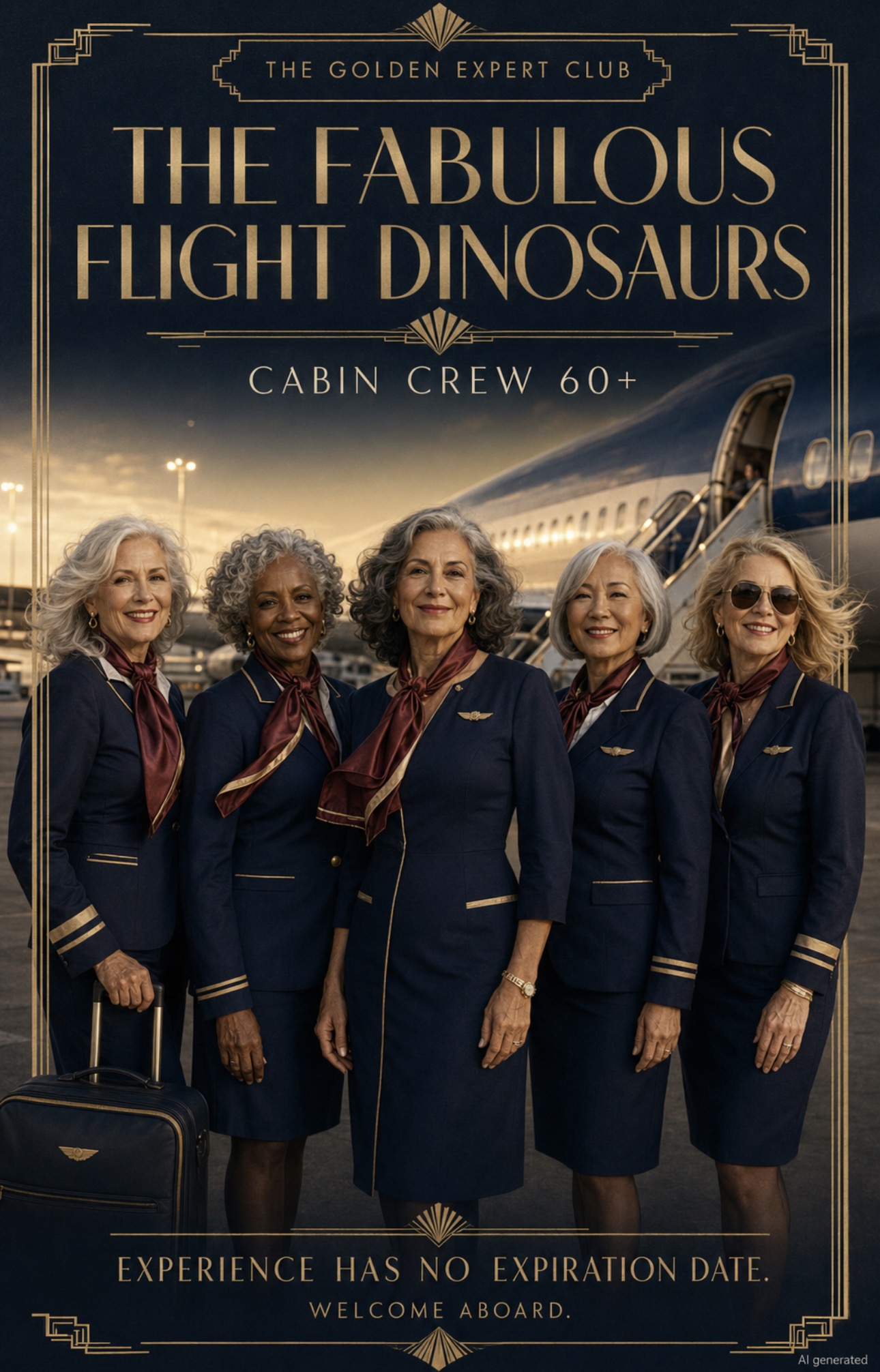

FROM “FLIGHT DINOSAURS” TO HIGH-FLYING ROLE MODELS
For decades, the image of a flight attendant was closely connected to youth.
Airlines presented young women with perfect smiles, immaculate uniforms and carefully controlled appearances. Experience was certainly valued, but visible age did not always fit the glamorous image the aviation industry wanted to sell.
Within German aviation circles, long-serving cabin crew members were sometimes jokingly – and not always kindly – referred to as “Flugsaurier”, or “flight dinosaurs.”
The expression did not officially describe a particular age group. It was informal airline slang for crew members who had been flying for many years and had therefore accumulated considerable seniority.
But perhaps those so-called “flight dinosaurs” understood something the industry is only now beginning to rediscover:
Experience does not become less valuable with age.
It becomes more valuable.
Long-serving cabin crew members have encountered nervous passengers, medical emergencies, cultural misunderstandings, difficult situations and countless unexpected moments at 35,000 feet. They know how to remain calm when others become anxious. They understand people. They can recognise when someone needs reassurance, support, clear instructions – or simply a little kindness.
A member of Lufthansa cabin crew once described the job as becoming a safety officer, firefighter, police officer, nurse, psychologist, kindergarten teacher, mediator and service professional all at once.
That responsibility requires far more than a youthful appearance.
It requires maturity, resilience, empathy, flexibility and excellent judgement.
The aviation industry is now beginning to recognise precisely those qualities in people over 50.
WHY AIRLINES WANT PEOPLE OVER 50
easyJet’s latest recruitment campaign is not merely a charming publicity idea. It reflects a genuine change in the way airlines think about age and professional experience.
Since easyJet began actively encouraging older applicants in 2022, the number of its cabin crew members aged over 50 has increased by 127 per cent. The number of crew members over 60 has almost quadrupled. Today, approximately twelve per cent of the airline’s cabin crew are over 50.
Why?
Because people over 50 bring something extraordinarily valuable on board: life experience.
They have managed families, careers, relationships, unexpected crises and major changes. They have learned how to communicate with different personalities, solve problems and remain composed when plans suddenly fall apart.
Many have spent decades working with customers, patients, colleagues, teams or international clients. They understand responsibility. They know how to listen. They often possess the patience and confidence that can only develop through experience.
More than half of the over-50 easyJet crew members surveyed by the airline said they also felt they acted as mentors to younger colleagues.
This is not a competition between generations.
It is an example of how powerful a multigenerational team can be.
Younger crew members may bring energy, new perspectives and digital confidence. Older colleagues contribute experience, calmness and a deep understanding of people. Together, they create a stronger team.
THE FREEDOM TO BECOME FLEXIBLE AGAIN
Flexibility is essential in aviation.
Cabin crew work does not follow a conventional Monday-to-Friday schedule. There are early departures, late arrivals, weekends away, changing destinations and days when the alarm clock rings at a time when most people have not yet gone to bed.
The work can be physically demanding. It requires stamina, reliable health, adaptability and the willingness to learn extensive safety procedures.
At first glance, employers may assume that younger candidates are automatically more flexible.
But life after 50 can create an entirely different kind of freedom.
The children may have left home. The school calendar no longer controls the family schedule. There may be fewer daily responsibilities and more independence than there has been for decades.
After years of organising life around children, partners, careers and other people’s needs, many women reach a point at which they can finally redesign their time.
They are not becoming less flexible.
They are reclaiming their flexibility.
They may be ready to work unusual hours, meet new people and see parts of the world they never had the opportunity to discover before. They may no longer want a conventional office routine. They may be searching for movement, purpose, community and a role that makes every day feel different.
For some women, becoming cabin crew after 50 or 60 is not simply a new job.
It is a declaration of independence.
It says:
The children have built their lives. Now I am ready to build my next one.
A CAREER CHANGE ABOVE THE CLOUDS
Consider Francesca Hicks, who joined easyJet cabin crew in her sixties after working in healthcare.
She already possessed the skills the role required: communication, organisation, empathy and the ability to deal calmly with people. Aviation gave her a completely new setting in which to use them.
Within approximately eighteen months, she had worked on more than 250 flights.
Then there is Andrew Hampson, who joined easyJet after running a corporate events company. At 61, he described his new career as making him feel 20 years younger.
These stories matter because they challenge one of society’s most persistent assumptions: that career reinvention belongs to the young.
It does not.
A 50- or 60-year-old applicant is not beginning with nothing. They arrive with decades of transferable skills. They may need to learn aircraft procedures, safety regulations and service routines, but they already understand responsibility, teamwork and human nature.
Their previous career has not been wasted.
It is travelling with them.
FLEXIBILITY MUST WORK BOTH WAYS
Airlines have long offered different employment and part-time arrangements to accommodate operational requirements and different phases of working life.
Some highly experienced crew members reduce their schedules significantly as they grow older, although publicly available Lufthansa information does not confirm one universal arrangement under which older flight attendants work only one flight per month. Current Lufthansa recruitment information lists several working-time models, and the precise roster always depends on the contract, airline and operational schedule.
But the underlying idea remains important.
If companies truly want to benefit from experienced employees, flexibility must work both ways.
People over 50 may be willing to work, learn and contribute for many more years – but not necessarily under exactly the same conditions they accepted at 25.


A flexible roster, seasonal work, part-time models and carefully designed return-to-work programmes can make an enormous difference. They allow airlines to retain experience and attract people who want a meaningful new challenge without giving up every part of the life they have already built.
The future of work after 50 should not be about forcing older people back into old structures.
It should be about creating intelligent new structures around what they can offer.
GOLDEN JOBS: NEW WORK AFTER 50 AND 60
This story marks the beginning of a new series within the Golden Expert Club.
In Golden Jobs, we will introduce professions, projects and opportunities that can offer people over 50 and 60 a meaningful new beginning.
We will look beyond the tired idea that older workers should simply accept whatever is left.
Instead, we will discover industries that actively value experience, reliability, maturity, empathy, language skills and the confidence to deal with people.
Some roles may involve travel. Others may be connected to hospitality, education, mentoring, tourism, customer service, property, culture, health, events or international communities.
Some may become full new careers. Others may provide additional income, social connection, purpose or simply the joy of trying something completely different.
We will ask practical questions:
Which companies are genuinely recruiting mature candidates?
What skills are required?
What training is provided?
How physically demanding is the work?
Can it be done part-time or seasonally?
And most importantly: what does the opportunity give back to the person doing it?
Because work after 50 or 60 should not only be about earning money.
It can also be about belonging, learning, contributing and feeling needed in a completely new way.
The message from the skies could hardly be clearer:
Your professional life does not come with an expiration date.
Your experience is not excess baggage.
And the next destination may be one you never expected to reach.
Perhaps your new beginning is not waiting around the corner.
Perhaps it is waiting above the clouds.
Welcome aboard.