


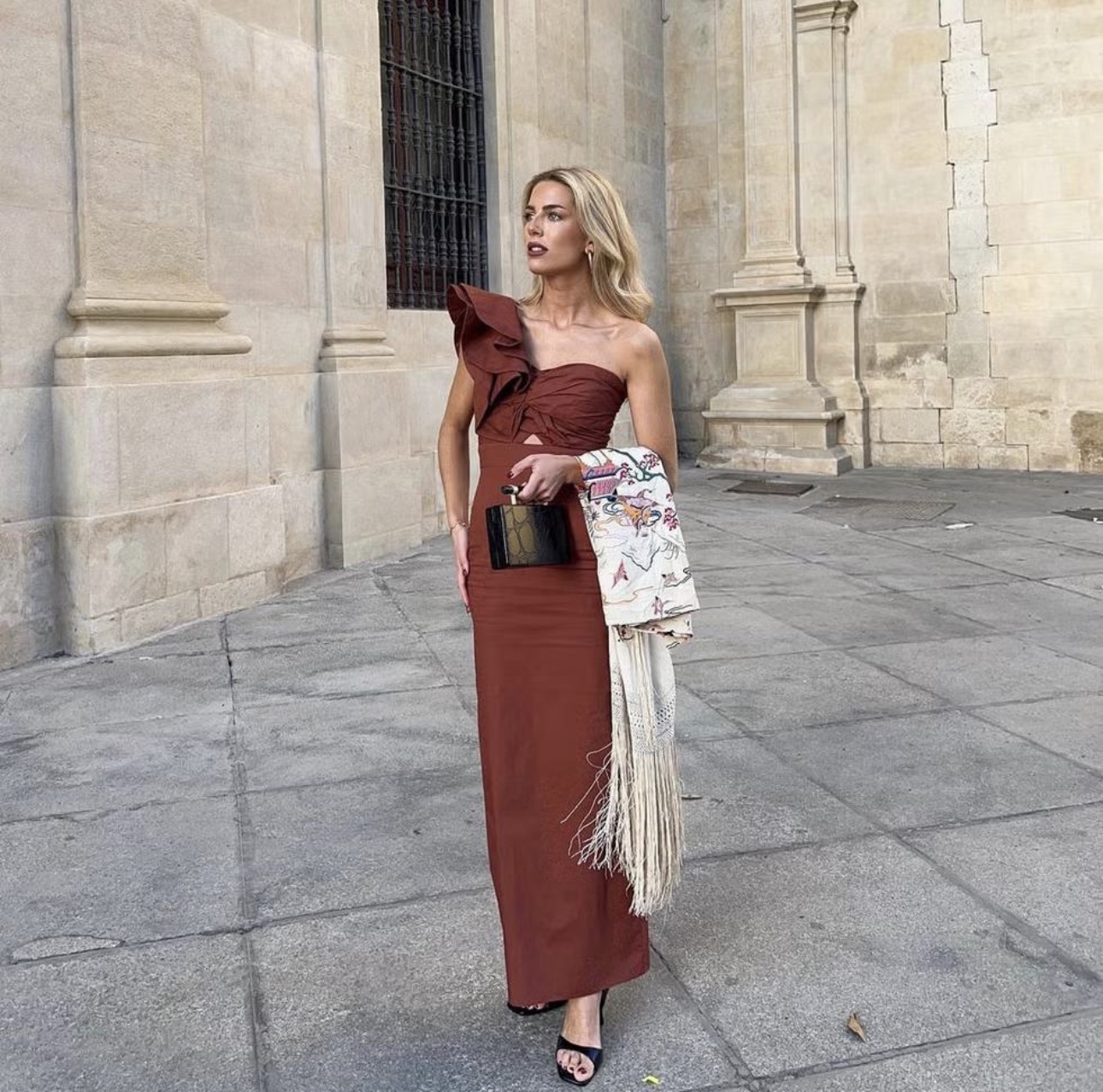

There are women who wear fashion.
And then there are women who define it.
María Conde undoubtedly belongs to that rare circle of personalities who have managed to leave their unmistakable signature on an entire style movement – and elevate it to a whole new level.
When it comes to the perfect Spanish invitada look – the art of dressing impeccably as a wedding or event guest – there is simply no getting around her.
She is not merely part of this world.
She is its ultimate authority.
As a fashion expert, stylist, trend editor and the influential voice behind one of Spain’s leading accounts for elegant occasionwear, María Conde has done far more than simply follow the evolution of invitada style. She has analysed it, interpreted it and brought it confidently into the present.
With more than 765,000 followers on her Instagram account, @invitadatrendy, she has long since become far more than a source of inspiration.
She is a guide.
She is the benchmark.
And for countless women, she is the first port of call when elegance, style and making the perfect entrance are required.
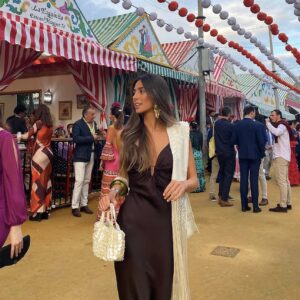
We meet her in Seville – a city where the Feria is not merely an event but a state of mind. Surrounded by light, music and that unmistakable blend of tradition and glamour, one thing quickly becomes clear:
This is a woman who does not simply understand fashion.
She understands the soul of the Feria.
The Art of Dressing Like a Sevillana
“The Feria is so special because it brings together elegance, culture and tradition in a way that is almost impossible to describe,” María Conde explains.
For her, this world is not only aesthetically fascinating – it is deeply personal. Born and raised in Seville and immersed in its traditions from childhood, she carries this understanding almost instinctively.
“You simply feel it,” she says.
And that feeling makes all the difference.
As she points out, Sevillian women have their own very distinctive way of dressing – during the Feria and well beyond it.
“We grow up learning how to dress for special occasions – weddings, celebrations and, of course, the Feria. That culture shapes us.”
Timeless Style Meets a Sharp Eye for Trends
María does not expect any dramatic fashion revolution between 2025 and 2026.
“When you look at fashion over longer periods, you can clearly see the changes. But from one year to the next, much remains the same – and that continuity is part of elegance.”
The classics remain, although each season gives them a subtle new twist:
Polka dots, expressive prints, and red and black as failsafe style anchors.
Then there are beautifully crafted fabrics, embroidered mantones de Manila, fringes and ruffles – elements that unite movement, femininity and tradition. In other words: clothes that do not merely enter a room; they make an entrance.
The Perfect Invitada Look
When María Conde speaks about the perfect invitada look, one thing becomes immediately clear:
This is not fancy dress.
“The biggest mistake is to look as though you are wearing a costume,” she says frankly.
An outfit should suit the occasion – but it must also suit the woman wearing it.
Too much sparkle, too many accessories, overly dramatic lengths or combinations that simply refuse to get along can quickly destroy an otherwise elegant look.
For María, style means one thing above all:
Balance.
Day Versus Night – The Art of Subtle Elegance
For María, the difference between daytime and evening dressing lies in the details.
At night, a look may become darker, more sophisticated and slightly more dramatic – perhaps through black, richer fabrics or more refined accessories.
During the day, the mood should remain lighter and more effortless.
Elegance, after all, should never appear to have spent three hours trying.
Accessories – The Quiet Stars of the Look
For María, the details are essential:
A fan – practical, elegant and wonderfully Spanish.
Statement earrings.
A natural red carnation worn in the hair.
A perfectly draped mantón de Manila.
Coral jewellery as a refined finishing touch.
For footwear, she recommends elegant sandals or destalonados – slingback shoes. Those who prefer a little more comfort can choose stylish espadrilles.
Because even the most beautiful outfit loses some of its magic when its wearer is silently negotiating with her shoes.
Hair and Make-up – Less Is More
Here too, María remains faithful to her signature philosophy.
Classic hairstyles dominate: an elegant bun, a ponytail or beautifully styled loose hair.
“Personally, I love simple, classic looks at the Feria,” she says.
When it comes to make-up, harmony is everything.
The individual elements should never compete for attention; the entire look must work as one.

Her Advice for a First Feria
Her most important piece of advice is simple:
“Follow the protocol – but do not disguise yourself.”
An elegant midi dress, an ankle-length look or a beautifully tailored trouser suit can be every bit as perfect as a more elaborate outfit.
Above all, she advises:
“Look polished and stylish – but make sure you are comfortable. The Feria lasts for many hours.”
Sound advice. After all, true elegance should survive more than the first photograph.
When Individuality Meets Tradition
For María Conde, the secret – as so often in fashion – lies in finding the right balance.
“Be yourself, but respect the tradition.”
Those who interpret the rules with sensitivity may certainly introduce something new, provided that both style and respect remain intact.
Tradition, after all, is not a cage.
It is a language – and the most stylish women know exactly how to speak it with their own accent.
The Most Stylish Women at the Feria
When asked who she considers the most stylish women at the Feria, María deliberately avoids naming one definitive queen.
“There are so many women with incredible style, and every year different women stand out.”
Nevertheless, a few names appear time and again:
Inés Domecq, Nieves Álvarez and Laura Sánchez.
What do they have in common?
“Their looks are harmonious, elegant and always full of personality.”
Final Thoughts
Our conversation with María Conde reveals that the Feria is far more than a social occasion.
It is identity.
It is culture.
And for some women, it is an art form.
Or, as María Conde puts it so beautifully:
You do not simply wear the Feria.
You live it.