

Fork Kisses & Flavour Poets Dani Carnero – Where Memories Meet the Fire

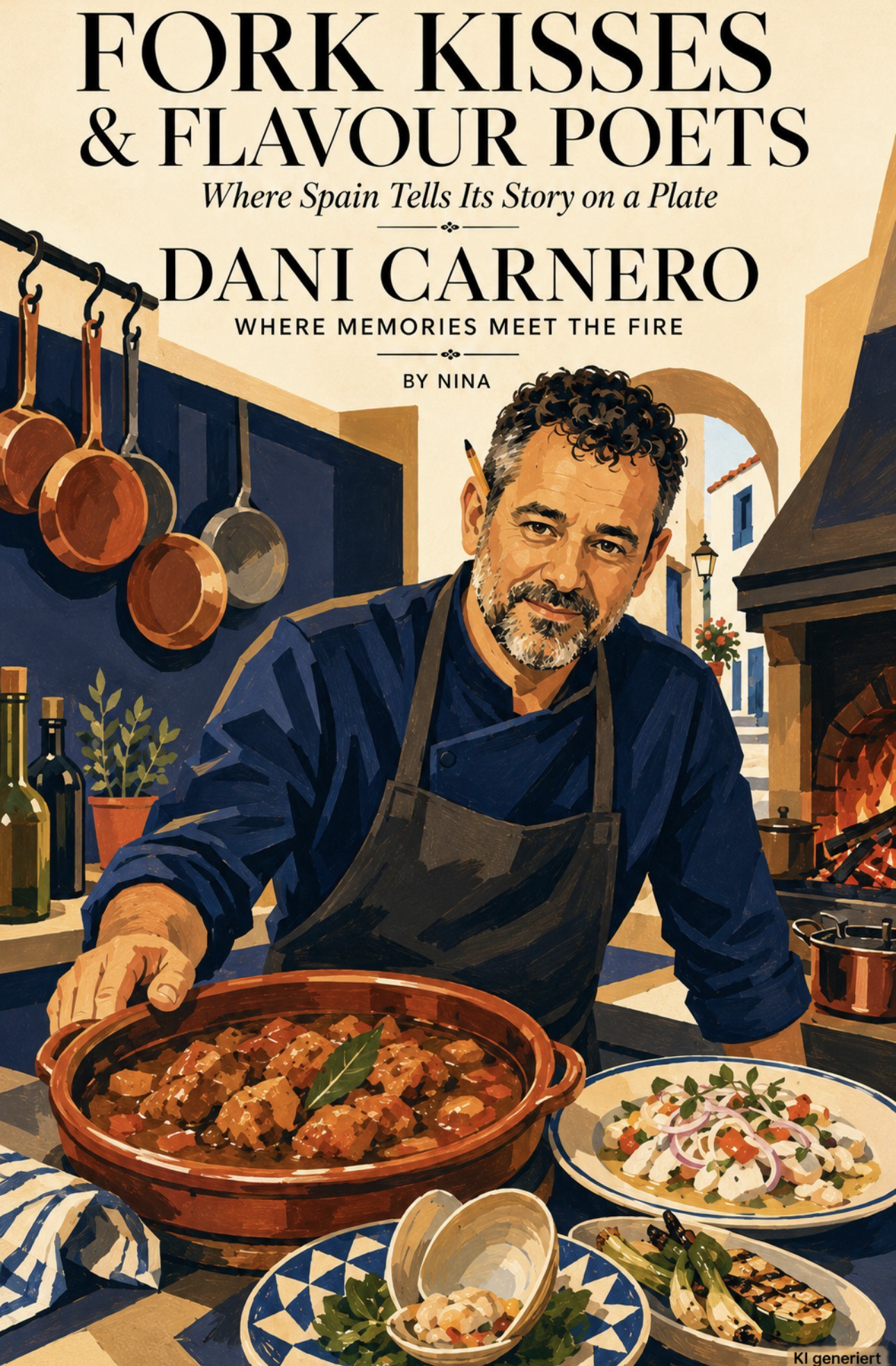

Fork Kisses & Flavour Poets
Dani Carnero – Where Memories Meet the Fire
There are chefs who cook with recipes.
There are chefs who cook with technique.
And then there are those rare cooks who appear to place an entire childhood inside a pot, add heat, patience and memory – and serve it back to us as something we thought we had forgotten.
Dani Carnero belongs to that final group.
He is not interested in food that merely looks impressive beneath perfect restaurant lighting.
He cooks the scent of a family kitchen.
The sound of a spoon touching the bottom of a casserole.
The Sunday lunch that began long before the guests arrived.
The sauce that was never measured, only understood.
The recipes that mothers and grandmothers carried in their hands rather than in notebooks.
At Kaleja, his Michelin-starred restaurant in Málaga’s historic Jewish quarter, fire is not a fashionable accessory.
It is language.
It is memory.
It is the oldest storyteller in the room.
And Dani Carnero listens.
A Cook, Not a Celebrity Chef
Dani Carnero has worked in some of Spain’s most important kitchens.
He trained under Martín Berasategui.
He spent time with Manolo de la Osa.
He worked for a year at El Bulli with Ferran Adrià, at a time when the restaurant was changing the vocabulary of modern gastronomy.
That résumé would be enough for many chefs to build an entire personality around prestige.
Dani appears to have taken the opposite route.
After experiencing the highest levels of Spanish culinary innovation, he returned to Málaga and looked back toward the food that had existed long before foams, laboratories and culinary theatre.
He returned to the market.
To local ingredients.
To guisos.
To casseroles.
To the patient intelligence of traditional cooking.
He has said that he prefers to be called a cocinero rather than a chef.
A cook.
The distinction matters.
“Chef” can sound like status.
Cocinero sounds like work.
Like heat.
Like repetition.
Like standing in front of a stove every day and understanding that no award can replace the responsibility of making a guest happy.
This is perhaps the first thing that makes Dani Carnero so fascinating.
He possesses all the technique required to complicate food.
Instead, he uses that knowledge to make it feel honest.
Málaga Before Everything Else
Dani Carnero was born in Málaga and began working in professional kitchens in the late 1980s.
His early career included time at Mar de Alborán, one of the city’s most respected restaurants of that period. From there, his path led him through some of Spain’s great gastronomic houses.
But Málaga remained the point of return.
Not merely as a geographical location.
As a flavour.
As an attitude.
As a way of placing food on a table without unnecessary ceremony.
The city is present in his cooking through its markets, its seafood, its stews and its contradictions.
Málaga can be polished yachts and paper cones of fried fish.
It can be marble hotel lobbies and a grandmother shouting from a kitchen.
It can be new international glamour and an old recipe that refuses to disappear.
Dani’s cuisine lives in that tension.
It knows where it comes from, but it is not trapped there.
A Childhood Written in Steam
Every family has dishes that become part of its private language.
They are rarely the most expensive dishes.
They are not always the most beautiful.
But one spoonful can transport us more powerfully than any photograph.
For Dani Carnero, food and family memory are inseparable.
One of the dishes associated with La Cosmo is his version of hake salpicón, inspired by the way his mother prepared it.
That detail says more about his cooking than a long technical description ever could.
A mother’s recipe is not reproduced by simply following ingredients.


The exact quantities may never have existed.
A little more of this.
Enough of that.
Taste it.
Wait.
Now it is ready.
To reinterpret such a dish is delicate work.
Change too much, and the memory disappears.
Change too little, and the restaurant adds nothing.
The skill lies in protecting the emotional truth while giving the dish a new voice.
That is where Dani Carnero is at his strongest.
He does not place memory under glass.
He allows it to continue living.
Kaleja – The Alley Where the Fire Waits
The name Kaleja comes from the Ladino word for alley.
It could hardly be more appropriate.
The restaurant sits in Málaga’s old Jewish quarter, where narrow streets carry centuries of footsteps and the city seems to fold history into every corner.
Kaleja feels less like an isolated restaurant concept and more like something discovered.
A door.
A passage.
A room shaped by darkness, warmth and the glow of the candela.
Here, Dani’s cooking moves at a different pace.
Stocks deepen.
Sauces reduce.
Vegetables absorb smoke.
Meat softens.
Time becomes an ingredient.
The fire does not merely grill.
It transforms.
It gives bitterness, sweetness, depth and that almost primitive scent that makes the body understand food before